
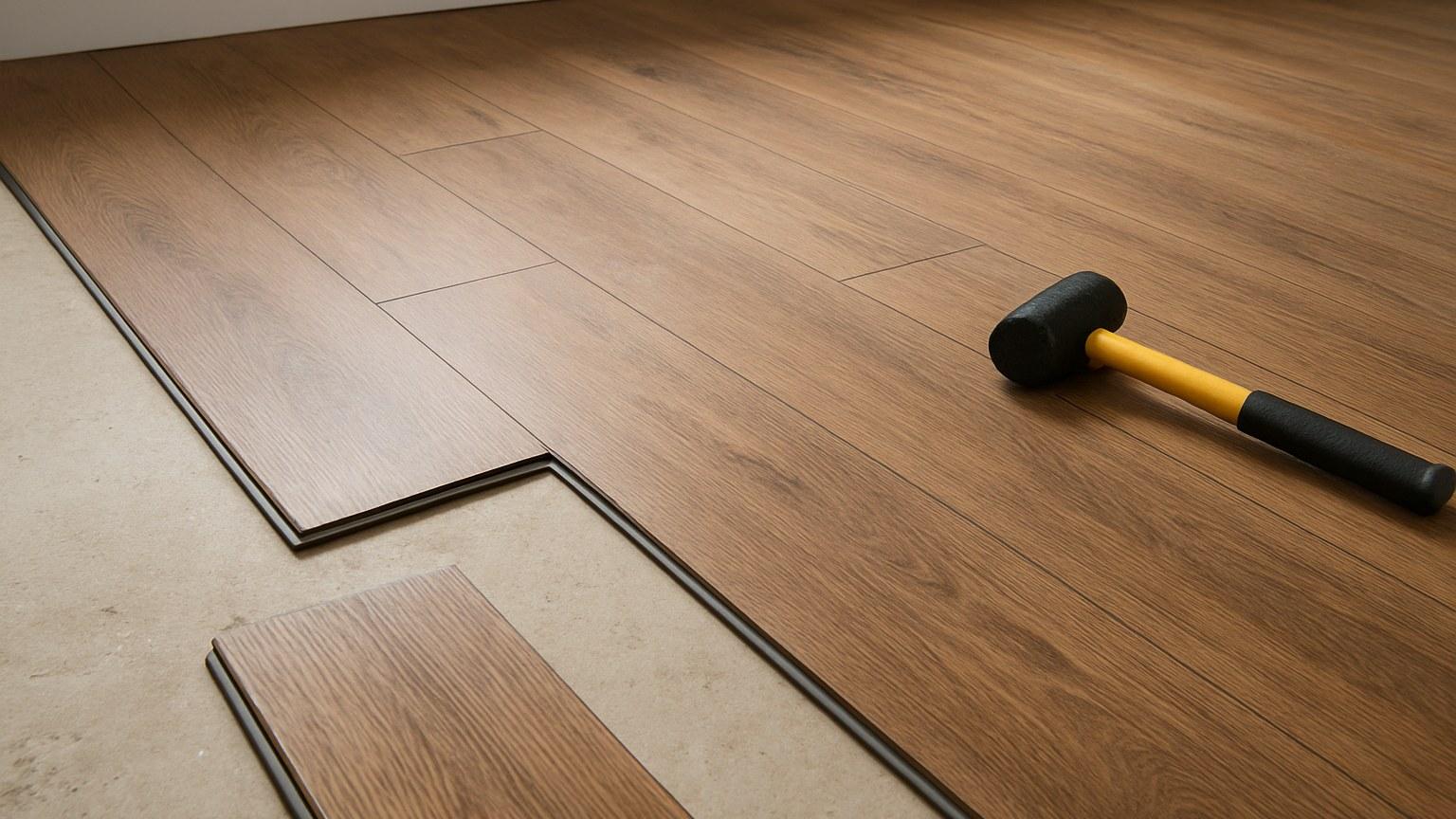
For most rooms, floating click-lock wins, and glue down vinyl plank flooring earns its place only over radiant heat, on damp concrete slabs, across big open spans, and under heavy rolling traffic. The hard part is that the waterproof-core label gets sold as the whole story, and it isn't. Pick wrong and you end up with a floor that peaks, gaps, or traps water.
Key takeaways
- Click-lock (floating) vinyl plank suits most rooms and is DIY-friendly; glue-down earns its keep over radiant heat, on high-moisture concrete slabs, in big open spans, and under heavy rolling or commercial traffic.
- Glue-down vinyl plank runs about $2.50-$7 per sq ft for materials and $4.50-$12 per sq ft installed, per estimators.us 2026 figures; labor alone runs roughly $2-$5 per sq ft.
- A waterproof core does not make glue-down automatically better for wet rooms; water still sits under floating floors at the perimeter, while glue-down's full-spread bond leaves less room for it to travel.
- Glue-down is harder to repair and demands a flatter, cleaner, drier subfloor than floating, so run flatness and moisture (RH) checks before any adhesive touches the floor.
- Stairs, big open-plan moisture transitions, and glue-down jobs in general are worth hiring out; click-lock in a bedroom is realistic DIY.
Glue-Down vs Click-Lock Vinyl Plank: The Full Comparison
Click-lock (floating) planks snap together and sit loose over the subfloor, so they suit most bedrooms and living rooms and are friendly to a first-time DIYer. Glue-down planks get bonded flat to the subfloor with adhesive, which makes them the right call for big open floors, radiant heat, high-moisture concrete slabs, and heavy rolling or commercial loads. The National Wood Flooring Association (NWFA) recognizes glue-down as one of several standard installation methods, alongside nail-down and floating. For the full step-by-step on either approach, work through the vinyl flooring installation guide.
The table below scores both across cost, prep, DIY difficulty, repairability, and water tolerance, so you can hold your own room up against it.
| Factor | Glue-Down | Floating (Click-Lock) |
|---|---|---|
| Upfront cost | Similar plank cost, more labor and consumables (adhesive, trowel, roller) | Lower labor, but underlayment can add cost |
| Subfloor flatness | Must be dead flat, clean, and dry | More forgiving, still needs flatness |
| DIY difficulty | Harder; adhesive timing and mess | Beginner-friendly click-lock |
| Repairability | Hard; planks are bonded down | Easy; lift and swap a plank |
| Water tolerance | Full-spread limits water travel under the floor | Waterproof core, but water can sit under the perimeter gap |
| Best for | Big spans, radiant heat, slabs, heavy traffic | Most bedrooms, living rooms, light-traffic rooms |
How glue-down and floating vinyl plank compare on cost, prep, DIY difficulty, repair, and water tolerance.
The water tradeoff is the one shoppers misread most. Both types can carry a waterproof core, meaning the plank body itself won't swell when it gets wet. But "waterproof" on the box describes the plank, not the seams and not the room.
Water that penetrates the perimeter gap in a floating floor travels under the planks and remains on the subfloor, as nothing anchors the floor down. Glue-down's full-spread bond leaves far less room for water to travel sideways under the floor. Neither one seals the seams for you, so edges still matter.
One more split: floating floors often need or already include an attached pad, while glue-down goes straight onto a prepped subfloor with no pad at all. Many rigid-core planks come with that pad baked in, and adding a second layer under them can void the warranty. If you're weighing that, read the vinyl flooring underlayment guide before you buy anything extra.
When Glue-Down Earns Its Keep
Glue-down is worth the extra labor in four situations: long open spans, radiant heat, damp concrete slabs, and heavy traffic. In every other room, a floating floor does the same job for less money and less hassle.
Commercial and High-Traffic Floors
Rolling loads are what break floating floors. Office chairs, equipment carts, and dollies push a loose floor around, and over time the planks shift and the seams open. A full-spread bond doesn't move under that load. Loose lay flooring faces the same risk since it relies on weight alone to stay put, as explained in the loose lay vinyl flooring guide.
This is also where a thicker wear layer pays off. The wear layer is the transparent top skin, measured in mils, which the maker discloses in documentation. Commercial-grade vinyl pairs a thicker wear layer with glue-down so the surface and the bond both hold up to cart wheels and foot traffic. Quote the specific product's mil rating, not a category average, when you compare them.
Radiant Heat and Big Open Rooms
Over radiant heat, a full-spread bond handles the warm-up and cool-down cycling better than many floating systems, which can gap or peak as they expand and contract. Radiant heat is a place to follow the product's own instructions to the letter, including any temperature limit, because not every vinyl is cleared for it.
Big open rooms work the same way. The longer the unbroken run, the more a floating floor wants to move, and the more likely you are to see a gap or a high spot develop. Gluing it down takes that movement off the table.
Glue-Down Vinyl Plank by Room
Here's the room-by-room call, so you can read your own case off the list instead of applying one blanket rule. NALFA (North American Laminate Flooring Association) notes that room suitability, moisture exposure, traffic, and subfloor type, should guide the installation method for resilient and laminate flooring, which lines up with the breakdown below.
Glue-Down Vinyl Plank in the Bathroom
Glue-down is worth it in a bathroom because the full-spread bond limits how far a leak can travel under the floor. The seams and the perimeter are still the weak point, not the plank face, so seal the edges and don't trust the "waterproof" label to cover the whole room.
Glue-Down Vinyl Plank on a Concrete Slab
On a slab, run a relative humidity (RH) moisture test and a pH test before anything else. RH tells you how much moisture is sitting inside the concrete; pH tells you whether the surface is too alkaline for the adhesive. Glue-down with the right adhesive is the common call on slabs because it tolerates slab conditions a floating floor won't.
I pulled up a floating floor in a basement near Dayton once where the owner had skipped the moisture test. The slab read high on my meter, and the whole floor had cupped and smelled musty underneath. We glued down the replacement after the slab checked out. That replacement has held up fine ever since, which tracks with how the longevity factors for vinyl flooring play out once a basement slab is actually dry.
Glue-Down Vinyl Plank on Plywood
Plywood has to be flat, sound, and screwed down tight, with any old adhesive residue scraped off first. A loose or crowning subfloor telegraphs right through glue-down vinyl, and residue keeps the new adhesive from grabbing.
Glue-Down Vinyl Plank on Stairs
Stairs need glue-down, full stop. Floating planks aren't safe on stairs because there's nothing holding them to the tread, and a plank that shifts underfoot on a step is a fall waiting to happen. Each tread's leading edge still needs a proper cap, which is where an LVP (luxury vinyl plank) stair nose comes in.
Kitchens sit between all of these. They're often an open span that flows into the next room, so the choice there is really a whole-room decision. If that's your project, work through how to choose the right kitchen flooring before you lock in glue-down or floating. Where that kitchen floor meets another room at the same height.
A room-by-room verdict on where glue-down vinyl plank is worth the extra labor.
What Glue-Down Vinyl Plank Costs (Materials vs Labor)
Materials run about $2.50-$7 per square foot and the installed total lands around $4.50-$12 per square foot, per estimators.us 2026 figures. Labor alone is roughly $2-$5 per square foot, according to carpetexchange.com and cavalieriflooring.com.
| Item | Cost per sq ft (2026) |
|---|---|
| Materials (vinyl plank) | $2.50-$7 |
| Labor (installation) | $2-$5 |
| Installed total | $4.50-$12 |
Run that across a real room and the math is simple. A 1,000 square foot floor at the installed range of $4.50-$12 per square foot comes to about $4,500 at the low end and $12,000 at the high end, materials and labor together.
Then there are the tools and consumables, most of which you buy or rent on top of the plank. A moisture meter runs $20-$250 per homedepot.com, a notched trowel is about $19.95 per greenbuildingsupply.com, a floor roller rents for $15-$60 per day per countbricks.com, and leveling compound is roughly $21-$91 per bag per lfishman.com.
Two things push you toward the top of the installed range. Basements cost more because of the slab prep and moisture work, and stairs cost more because every tread is a cut and a wrap. An open rectangular room is the cheapest square footage on the job.
How to Glue Down Vinyl Plank Flooring
Start with the subfloor, every time, because the adhesive bond and the manufacturer's warranty both hinge on it. The plank you picked matters far less than what's under it.
Check flatness first with a long straightedge, then run moisture and pH tests on a slab. The standard installers work to here is ASTM F710, ASTM stands for the American Society for Testing and Materials, the group that publishes this testing standard, and it's the industry rule for prepping concrete to receive resilient flooring like vinyl. It covers how to check the slab for moisture (RH) and alkalinity (pH) before any adhesive touches it.
Grind down high spots and fill low spots with a portland-based self-leveler, and scrape off any old adhesive residue so the new glue can grab. Skip this and you'll feel every bump and hollow through the finished floor.
Acclimate the planks only if and how the box sheet tells you to. Some products ask for it, some say it's unnecessary, so the maker's sheet governs, not a rule of thumb passed around online.
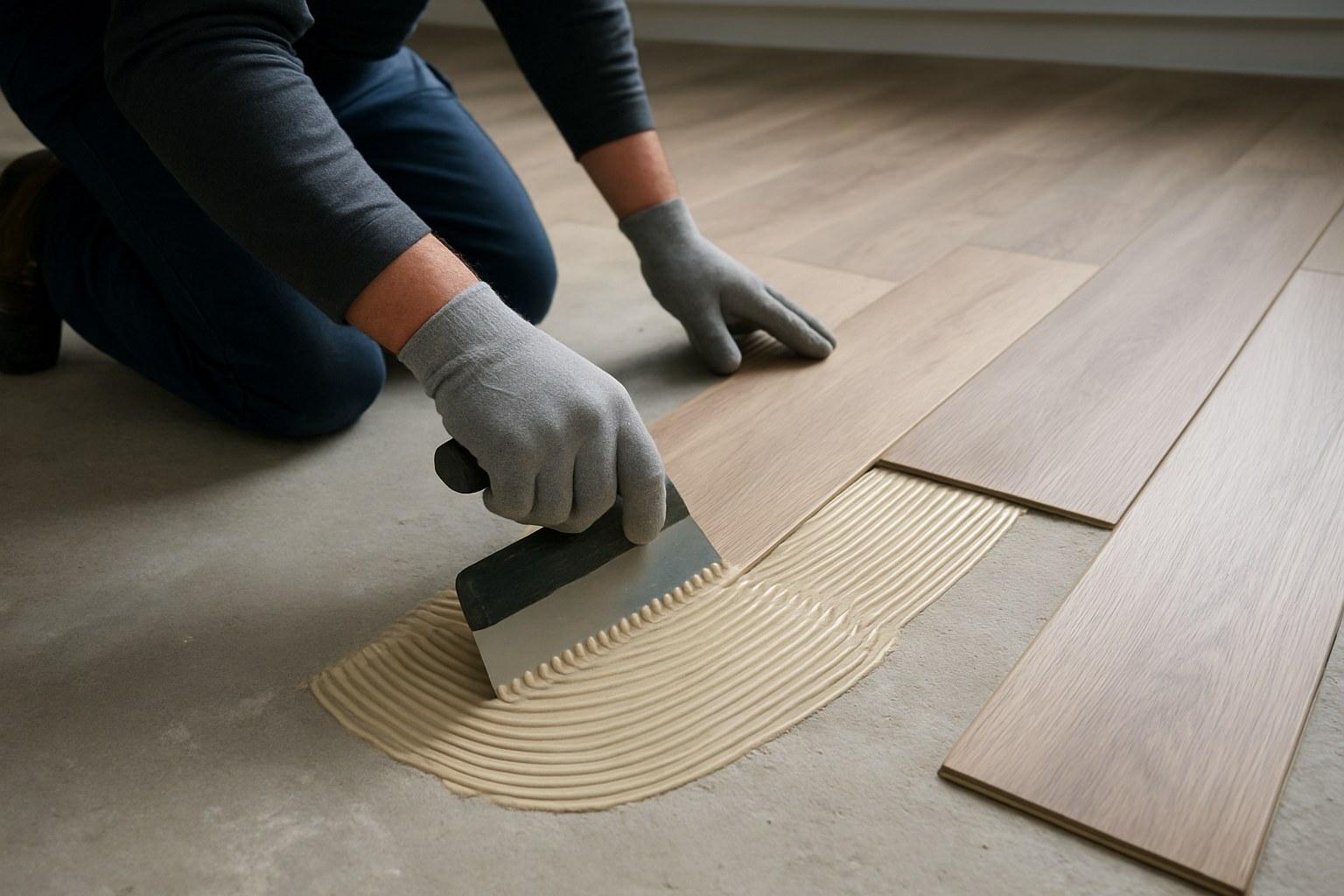
Then spread the adhesive in a full-spread pattern using the exact trowel notch the glue calls for. Watch the open time and tack time on the bucket. Open time is how long you have to lay planks after spreading; tack time is how long the glue must sit before it grabs. After the planks are down, roll the whole floor with a weighted roller to seat them into the adhesive.
How to start the first row of vinyl plank flooring
Snap a chalk line and square it off the room with a carpenter's square so your first row runs straight and the whole field stays aligned. Leave the perimeter expansion gap the maker specifies, since that figure is set by the product, not a universal number. Cut the edge rows clean so they tuck under the trim.
For the full plank-by-plank sequence, work through the luxury vinyl plank installation guide, and for clean edge cuts without a saw, see the vinyl plank cutter guide.
The Downsides and Common Problems of Glue-Down
Glue-down's drawbacks are real, and they all trace back to the bond. It's harder and messier to install, it demands a flatter and drier subfloor than a floating floor, and it ties up the room while the adhesive cures.
Repairs are the big one. When a floating plank gets damaged, you unclick the floor back to it and swap one board. A glued plank is stuck down, so fixing one means cutting it out, scraping the old adhesive, and bonding in a replacement that may not match the color of planks that have aged.
Cure time bites people too. You usually can't roll furniture or heavy loads back on until the adhesive has set, and loading it early can shift planks and open seams.
Add it up and glue-down is far less DIY-friendly than click-lock. A click-lock floor in a bedroom is a realistic weekend for a careful homeowner. Glue-down over a slab, a big open span, or a set of stairs is where paying a pro usually saves you money, because the cost of a bad bond is tearing the whole floor back out. That same click-lock weekend job gets a full walkthrough in the vinyl plank flooring installation guide, covering everything from subfloor prep to the last row.