
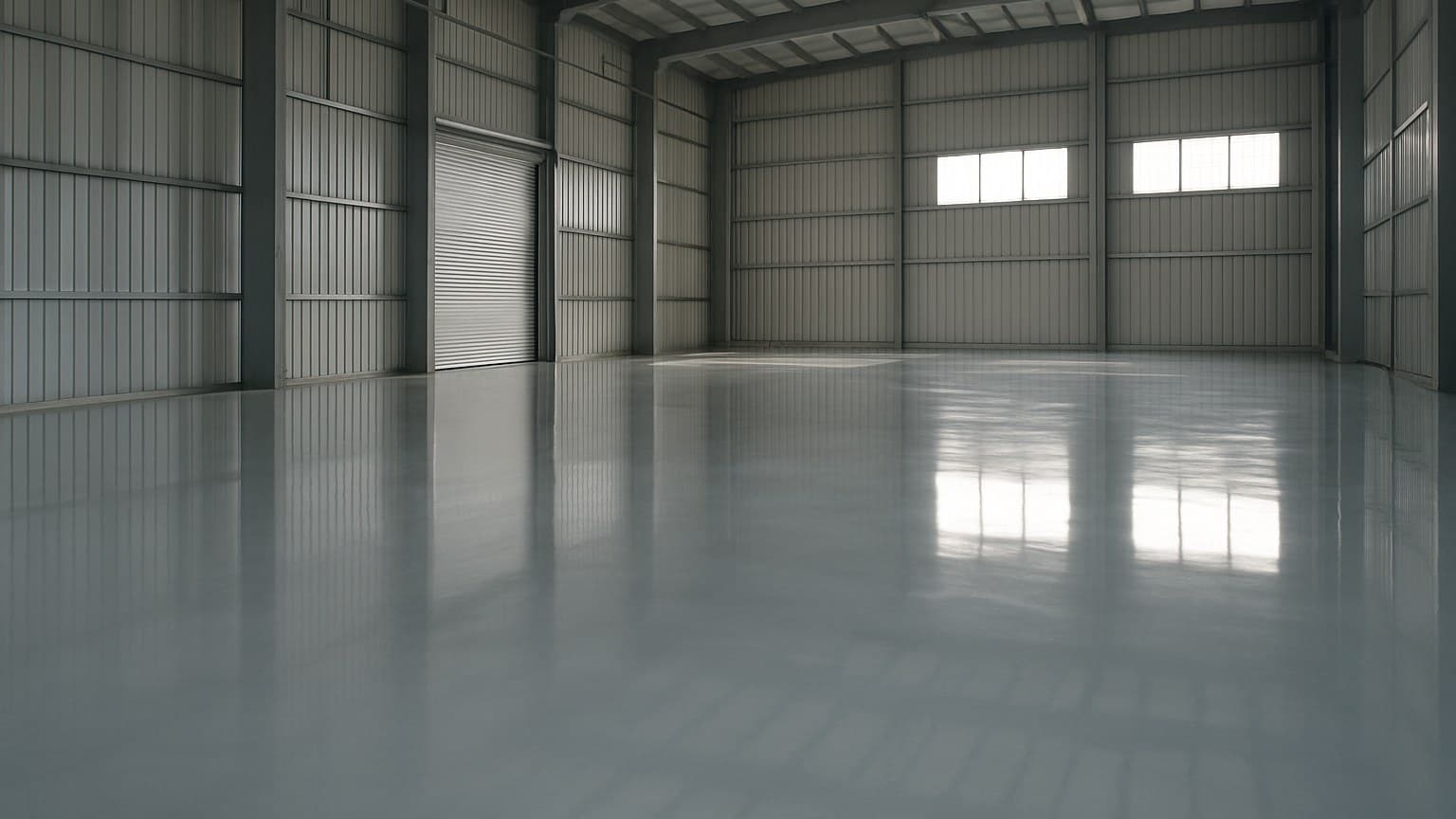
The phrase "commercial epoxy flooring" hides a trap. It sounds like one product, but the wrong system on the wrong slab peels inside a year. Here is how to match all seven systems to the floor you actually have.
Key takeaways
- There is no single "commercial epoxy." Seven systems each fit a specific floor: standard coating for light warehouses, self-leveling for worn slabs, quartz/flake broadcast for wet kitchens and clinics, ESD for electronics, novolac for chemicals, and polyaspartic topcoat for fast cure.
- Installed commercial epoxy runs roughly $3-15 per square foot depending on system, and labor is usually the bigger half of that number, not the materials.
- Wet-area slip safety comes from the topcoat texture, not the color. For food and clinic floors you want a broadcast grit hitting DCOF 0.42 or higher, the ANSI A326.3 wet-floor line.
- The Questmark-vs-Everlast argument is a false choice: heavy-mil coatings and mortars fit rough or damaged slabs, while thin seamless overnight polyaspartic fits sound concrete where downtime is the real enemy.
- Most commercial systems (self-leveling, ESD, novolac) are pro-only. A plain standard coating is the only one a maintenance crew should attempt in-house.
Match the System to the Floor Before You Pick a Color
The one decision that saves a commercial floor is boring: read the slab first, then pick the system. Check moisture, cracks, traffic, and the hygiene rules for the room. The color comes last, if it matters at all.
You will see a Questmark-versus-Everlast style argument online, heavy coatings against thin overnight systems, as if one wins. It's a false choice. Thick coatings and mortars are built for rough or damaged concrete. Thin seamless overnight systems are built for sound slabs where every hour of closed floor costs money. They fit different floors, not the same one.
Prep is where these jobs live or die. A rough grind to open the concrete and a real moisture check come before any product goes down, because on a commercial job the condition of the slab underneath the coating is what actually determines whether the floor holds up. I once let a homeowner in Tulsa talk me out of a moisture test before we coated her garage floor, just to save an afternoon. The floor failed before the season was out, and I relaid it on my own dime. I don't skip the test anymore, and neither should your installer.
One quick round of terms before the table. Mil means one-thousandth of an inch, the unit used to measure how thick a coating is. ESD stands for electro-static discharge, the small shock you feel touching a doorknob after walking across some floors. Novolac is a tougher epoxy resin built to shrug off harsh chemicals. DCOF means dynamic coefficient of friction, a lab number for how much grip a wet floor gives underfoot. Higher is safer.
| System | Best floor | Mil thickness | Cure downtime | Slip (wet DCOF) |
|---|---|---|---|---|
| Standard coating | Light warehouse, dry storage | ~5-15 mil | 24-72 hr | Low unless grit added |
| Self-leveling | Worn slabs, restaurant kitchens | ~40-125 mil | 24-72 hr | Smooth, needs added grit |
| Quartz/flake broadcast | Clinics, wet kitchens, food prep | ~60-250 mil | 24-72 hr | Meets 0.42 wet with grit |
| ESD/static-dissipative | Electronics, server rooms | ~30-60 mil | 48-72 hr | Low, texture optional |
| Novolac (chemical-resistant) | Labs, marinas, battery rooms | ~30-250 mil | 48-96 hr | Grit versions available |
| Water- vs solvent-based | Formula choice within a system | Thin (water) to thick (solvent) | Varies | Set by topcoat |
| Polyaspartic topcoat | Forklift lanes, tight-downtime rooms | ~4-20 mil topcoat | A few hours | Grit-friendly, UV stable |
Source: the manufacturer data sheets I spec from and my own commercial installs
Figures reflect commonly cited industry ranges for build thickness, cure times, and wet DCOF benchmarks across commercial epoxy systems; actual specs vary by manufacturer and job conditions.
The seven commercial epoxy systems, mapped to the floor each one fits, with build thickness, downtime, and wet slip grip.
1. Standard Epoxy Coating: Light Warehouses and Dry Storage
Best floor: dry, low-abuse spaces. Think storage rooms, light warehouse aisles, and back-of-house areas that mostly see foot traffic and pallet jacks. This is often the starting point when researching industrial epoxy flooring options and costs, since it's the lightest-duty system on the list.
You roll it on in a couple of thin coats, usually landing around 5-15 mil total. A mil is one-thousandth of an inch, so this is a thin film, not a thick pour. It seals and brightens the concrete and shrugs off scuffs, but it's not built for chemical baths or heavy wheeled loads.
Cure and downtime run about 24-72 hours to foot and light traffic. The bare film is slick when wet, so if the room ever sees spills, you broadcast in an anti-slip grit while the coat is still wet.
Cost sits on the low end, roughly $2-3 per square foot in materials and $1-4 in labor. This is the only commercial system a maintenance crew should try in-house. For a home garage or a small space, what epoxy costs for a home runs on its own scale and is worth checking separately.
2. Self-Leveling Epoxy: Restaurant Kitchens and Beat-Up Slabs
Best floor: worn, pitted, or uneven concrete that needs to come back flat and seamless. A busy restaurant kitchen or a food-prep room is the classic case.
It pours out thick, usually 40-125 mil, which is about one-sixteenth to one-eighth of an inch. As it flows, it flattens itself and buries minor cracks and low spots. That seamless result matters because there are no grout lines or seams for grease and bacteria to hide in.
The finished surface comes out smooth. On a wet kitchen floor that's a slip risk, so you add a broadcast grit to the topcoat to bring the grip up. For how the rest of the room should be built around that floor, see the kitchen flooring guide.
Cure and downtime run 24-72 hours. Installed cost is roughly $5-11 per square foot, and if you want a deeper breakdown of what drives that number, the self-leveling epoxy flooring cost guide walks through it. This is pro work, not a weekend job.
3. Quartz and Flake Broadcast: Clinics, Wet Kitchens, Food Prep
Best floor: wet or hygiene-critical rooms. You broadcast, meaning you throw media into the wet epoxy, for grip and a tough, cleanable surface. Quartz sand is the heavy-duty industrial version. Vinyl flake, sometimes called chips, is the decorative commercial version.
That texture is what carries these floors to DCOF 0.42 or higher when wet. That number is the wet-floor line in standard A326.3 from the American National Standards Institute, the accepted mark for a safe wet floor. It's why hospitals and commercial kitchens lean on broadcast systems.
For food areas under USDA or FDA rules, pair it with an integral cove base. That means the epoxy curves up the wall a few inches so there's no seam where the floor meets the wall for grime to collect. Total build often runs 60-250 mil once you stack the coats.
Installed cost is roughly $5-12 per square foot depending on how many broadcast coats you spec, and the epoxy floor coating cost per square foot breakdown covers how each extra coat moves that number. Always pro-installed.
Here is how the layers stack up on a broadcast floor, top to bottom:
The five layers of a quartz/flake broadcast system, outermost first. Drawing is not to scale.
4. ESD / Static-Dissipative Epoxy: Electronics and Server Rooms
Best floor: rooms where a static spark is a real hazard. Electronics assembly, server rooms, clean rooms, and munitions handling all qualify. ESD stands for electro-static discharge, which is the tiny shock you feel touching a doorknob. On the wrong floor, that spark can fry a circuit board or worse.
A conductive grid, usually thin copper strips, runs under the coating and ties into the building ground. Static drains away through that grid instead of building up on the floor and on people.
Here's the catch: it only works when it's grounded and tested correctly. This is strictly a specialty install with electrical verification at the end. A coating that looks like ESD but was never grounded is just an expensive standard floor. Don't let anyone sell you the look without the test.
Build is usually 30-60 mil. Installed cost runs roughly $6-13 per square foot, and it climbs with more grounding points. For a broader sense of epoxy floor price across systems, this ESD build sits toward the higher end of specialty work.
5. Chemical-Resistant Novolac Epoxy: Labs, Marinas, Battery Rooms
Best floor: anywhere harsh chemicals hit the deck. Battery rooms, labs, food processing with strong sanitizers, and marina service bays all fit. Novolac is a tougher epoxy resin that shrugs off acids and solvents that would eat a standard coating down to bare concrete.
Spec it when you expect spills of acid, fuel, or strong cleaners on a regular basis, not just the odd drip. A standard floor in a battery room will soften and lift at the spill spots, and then the concrete starts taking the damage.
Build ranges widely, from about 30 mil for a thin protective coat up to 250 mil for a full mortar system in a room that takes real abuse. Cure and downtime stretch longer here, often 48-96 hours, because the chemistry needs time to fully harden before it faces its first spill. Grit versions are available where the room is also wet.
Installed cost is roughly $7-15 per square foot depending on thickness and detailing. This is pro-only work with real ventilation.
6. Water-Based vs Solvent-Based: The Formula Choice Inside a System
This is not a seventh floor type, it's a formula choice you make inside the other systems. Water-based and solvent-based (or 100 percent solids) epoxies can both build the same kind of floor, but they behave differently going down.
Water-based epoxy is thinner, lower in odor, and more forgiving to apply. It builds a lighter film, so it fits offices, retail back rooms, and jobs where fumes are a problem, like an occupied building. It gives up some chemical and abrasion resistance for that easier install.
Solvent-based and solids-heavy epoxy build thicker in fewer coats and hold up harder to traffic and chemicals. The trade is strong fumes and a shorter working time, so the crew needs real ventilation and has to move fast. For a warehouse or a shop, that toughness earns its keep.
Match the formula to the room's fumes tolerance and abuse level, then let the topcoat set the slip grip either way.
7. Polyaspartic Topcoat: Forklift Lanes and Tight-Downtime Rooms
Best floor: rooms that cannot stay closed. Forklift lanes, retail floors, and any space where a two- or three-day shutdown is not an option. Polyaspartic is a fast-curing cousin of polyurethane, most often used as the topcoat over an epoxy base.
The headline is speed. It can cure to traffic in a few hours instead of a couple of days, so a crew can grind, coat, and reopen a bay over a single weekend or even overnight. It's also UV stable, meaning it won't yellow in sunlight the way some straight epoxy does near a roll-up door or window.
It goes down thin as a topcoat, around 4-20 mil, and it takes broadcast grit well for slip grip. The one downside is the fast cure gives the crew a short window to work, so this is a job for a pro who moves quickly.
As a topcoat over an epoxy base, an installed polyaspartic system runs roughly $4-9 per square foot. If the space in question is a garage bay, epoxy garage floor cost breaks that down at the smaller scale.
What Commercial Epoxy Costs, System by System
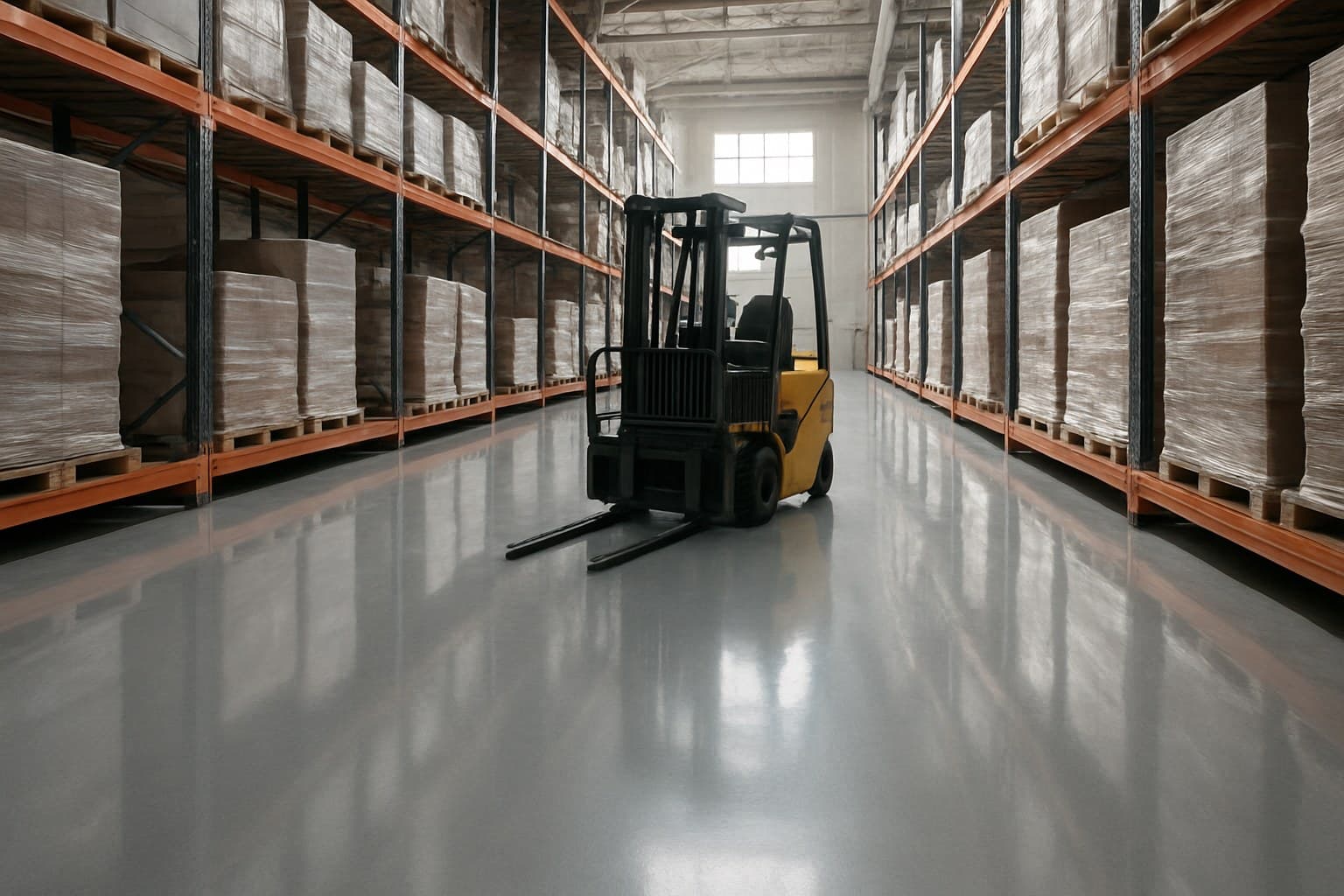
Installed commercial epoxy runs roughly $3-15 per square foot, and the system you pick decides where you land in that band. On almost every job I quote, labor is the bigger half of the number, not the materials. Grinding a rough or oil-soaked slab, adding a cove base, cutting in around trench drains, and stacking extra broadcast coats all push labor up.
A sound, open slab is the cheap version. A damaged slab, a wet room that needs a cove base, or a chemical room that needs a mortar build all cost more per foot for the same square footage, the same way a cut-up floor beats a plain open one on price.
| System | Installed cost per sq ft |
|---|---|
| Standard coating | $3-7 |
| Self-leveling | $5-11 |
| Quartz/flake broadcast | $5-12 |
| ESD/static-dissipative | $6-13 |
| Novolac | $7-15 |
| Polyaspartic topcoat | $4-9 |
Relative installed-cost comparison across six commercial epoxy systems, from lowest to highest. See the exact per-system ranges in the table above.
For a broader look at how flooring life-cycle costs stack up over a building's lifespan across many flooring types, see the National Wood Flooring Association's life-cycle cost research, linked in Sources below.
If you want the full arithmetic on labor, prep, and add-ons, epoxy floor installation cost is the useful next read, because it breaks the installed number down line by line so you can check a quote against it.