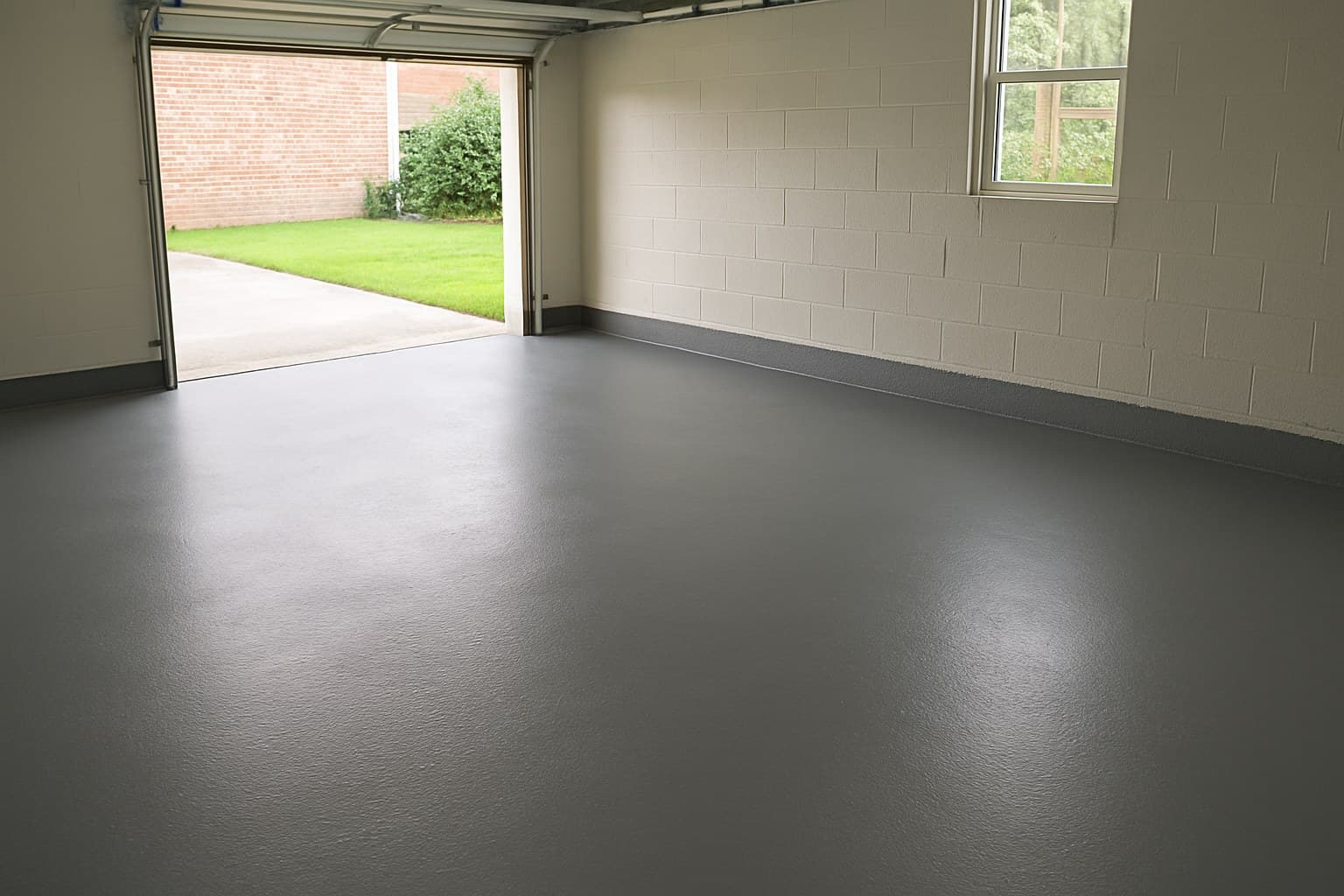
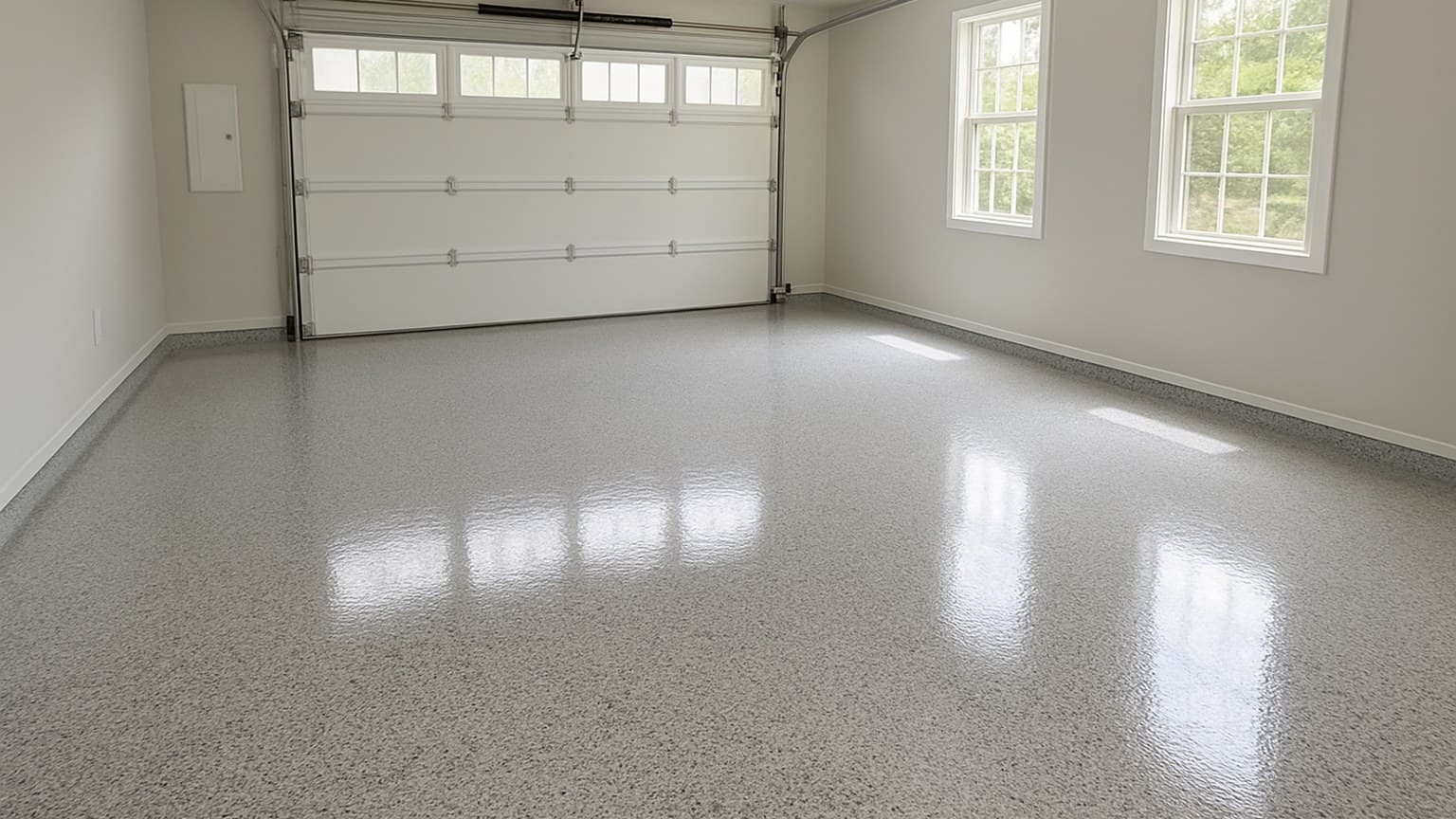
Epoxy garage floor cost swings more than almost any quote I write, because slab prep drives the price more than the coating does. One bid lands at $1,200 and the next at $4,000 for the same square footage. Price your own floor first and you'll spot a fair bid from an inflated one at a glance.
Key takeaways
- Installed epoxy runs about $3-12 per sq ft; a typical 2-car garage job lands around $1,000-3,000.
- Coating tier sets the price: solid color is cheapest per sq ft, flake sits in the middle, metallic costs the most.
- Your slab's condition adds real money: resurfacing runs about $1-3 per sq ft, a topcoat $0.50-2, on top of the coating.
- A DIY kit can cost far less upfront than hiring out, but thin kits are the ones that peel on hot-tire spots.
- Get the quote itemized (grinding, crack repair, number of coats, topcoat, cure time) and compare three bids, not just the bottom line.
Step 1: Measure Your Slab and Get Real Square Footage
Square footage is the one number every per-square-foot price gets multiplied against. Guess it wrong and the whole estimate is wrong before you start. If you want to see exactly which factors push that per-square-foot number up or down, our guide on epoxy floor coating cost per square foot breaks each one down.
Grab a tape and measure length times width, in feet. Don't lean on the "two-car" label. A typical two-car garage runs about 400 to 500 sq ft, a one-car about 200 to 250, and a three-car roughly 600 to 720. But a deep or extra-wide two-car bay often crosses 500 sq ft, and that extra depth nudges every total up.
Then subtract the parts you won't coat. A water heater platform, a built-in workbench, or a run of floor cabinets all take up slab you're not paying to epoxy. Measure those and take them out, so you're pricing only the floor that actually gets a coating.
Confirm with your own tape before you trust a size chart. I've had homeowners quote me the "standard" size off a floor plan and be off by 80 square feet once we measured for real.
Step 2: Pick Your Coating Tier (Solid, Flake, or Metallic)
Your coating tier sets the base price. There are three to choose from: solid color is cheapest per sq ft, flake sits in the middle, and metallic costs the most. Those three tiers are the residential picture; if you're pricing a warehouse floor or retail space instead, commercial epoxy flooring systems follow a different set of rules entirely.
Solid color epoxy gives you one flat color with no pattern. It's the least expensive because it's the least material and the least labor.
Flake is the chip system. Colored specks get tossed onto the wet coat by hand, then sealed under a topcoat. Those chips hide small slab flaws and add grip, which is why flake is a common garage pick I install.
Metallic mixes a pigment that swirls into a marble-like look. It costs the most per sq ft, and most of that extra money is skilled labor, not material. The swirl is worked by hand while the epoxy is still wet, so you're paying for the installer's time and touch. If that look is what you're after, our metallic epoxy floor cost breakdown digs into what drives that price.
Here's how the three tiers split into materials versus labor, so you can see where the money actually goes.
| Tier | Materials per sq ft | Labor per sq ft | Installed per sq ft |
|---|---|---|---|
| Solid color | $2-4 | $1-3 | $3-7 |
| Flake (chip) | $3-5 | $2-4 | $5-9 |
| Metallic | $4-7 | $3-5 | $7-12 |
Source: the materials-and-labor split I write into garage coating quotes
Per-square-foot ranges for the three garage coating tiers, split into materials and labor.
Step 3: Add the Prep Your Slab Actually Needs
Prep is what decides whether the epoxy sticks, so check the slab before you price a single coat. Two things matter most: moisture and flatness.
Run a moisture test first. Tape a two-foot square of plastic sheet flat to the concrete overnight, and if the underside is damp or the slab is dark in the morning, you've got moisture pushing up through the slab that will lift a coating. A moisture meter, a handheld tool that reads how wet the concrete is, gives you a faster number if you have one. Then check flatness with a straightedge laid across the floor, and mark any low spots and dips that need filling. For a slab with more than a few shallow dips, it's worth pricing out a self-leveling epoxy flooring cost separately before you commit to a tier.
Once you know the slab's condition, you can add the prep line items it needs. These stack on top of the coating price, not inside it.
| Line item | What it fixes | Cost per sq ft |
|---|---|---|
| Crack & pit repair | Fills cracks and low spots before coating | Part of resurfacing, $1-3 |
| Diamond grinding | Grinds the top skin off the concrete with a diamond machine so epoxy bonds | Usually rolled into labor |
| Oil-stain degrease/resurface | Removes contamination that blocks the epoxy from sticking | $1-3 |
| Topcoat / seal | Adds wear and chemical resistance on top of the color | $0.50-2 |
| Decorative finish | Flake or metallic effect layers | $1-5 |
Common prep line items for a garage slab and what each adds per square foot on top of the coating.
An oil-soaked, cracked slab costs real money to get ready, while a clean newer pour needs little more than a grind. That prep gap explains why two quotes on the same garage come back so far apart. For the full picture on why the concrete makes or breaks the job, read why the slab decides if epoxy lasts.
Step 4: Do the Math for a 2-Car and 3-Car Garage
Here's the arithmetic in plain form:
Total = (square footage x tier price per sq ft) + prep line items
Every part of that is a number you now have. Square footage came from Step 1, the tier price from Step 2, and the prep add-ons from Step 3.
Walk one all the way through. Say you've got a 400 sq ft two-car garage and you want flake at $6 per sq ft installed. That's 400 x 6 = $2,400 for the coating. If the slab needs crack repair and a light resurface, add roughly $400 to $800 on top. Call it $2,800 to $3,200 all in. If you want to run a few more examples like this one for your own garage, how much epoxy flooring costs guide walks through several more scenarios.
This table gives you the coating-only totals before prep, so you can find your own case fast, then add your prep line items to it.
| Garage | Solid | Flake | Metallic |
|---|---|---|---|
| 400 sq ft (2-car) | $1,200-2,800 | $2,000-3,600 | $2,800-4,800 |
| 600 sq ft (3-car) | $1,800-4,200 | $3,000-5,400 | $4,200-7,200 |
Coating-only totals by tier for a 400 and 600 sq ft garage, before any slab prep is added.
The widely quoted $1,000 to $3,000 typical band fits a flake job on a clean two-car slab. Metallic, a three-car bay, or a slab that needs heavy prep all land above it. For a deeper walk-through of the numbers, see how we calculate epoxy flooring cost step by step.
DIY Epoxy Kit vs Hiring a Pro
A store kit for a two-car garage runs $50 to $600 in materials, while hiring a pro for the same floor runs $1,200 to $4,800 installed. The gap is labor, and the risk is what that labor buys you.
| Approach | What you pay | Prep included | Best for |
|---|---|---|---|
| DIY kit | $50-600 in kits (materials only) | You grind or etch and repair yourself | Clean, newer slab, solid one-coat look |
| Hire a pro | $1,200-4,800 installed | Grinding, crack repair, topcoat, warranty | Oil-stained or cracked slab, metallic, wanting a warranty |
Source: pricing store kits against my own install bids on the same-size garage
A store epoxy kit compared with a professional install on the same 400 sq ft garage.
DIY saves you the labor line, plain and simple. What it risks is a thinner build, skipped grinding, and hot-tire pickup, which is when warm tires soften a thin coating and peel it up when you pull out of the garage. Those thin one-and-done kits are the ones I get called back to strip and redo.
Be honest with yourself about the slab. A clean, newer floor with a solid one-coat kit is a realistic weekend job for a careful homeowner. But grinding a rough slab, working a metallic swirl, or dealing with oil stains and cracks is where hiring out usually pays for itself. To compare a kit's price against a real bid, see how pro labor is priced in our epoxy floor installation cost guide.
One more thing I've learned the hard way in Dayton garages: I don't rush the recoat window even when the customer wants to park that night. Pull tires onto a coating that hasn't cured and you get peel marks you can't undo. A kit won't warn you about that the way a good installer will.
Epoxy vs Painting vs Replacing the Floor
If you're weighing epoxy against the alternatives, here's the price ladder: floor paint runs about $0.50 to $2 per sq ft, epoxy $3 to $12, and fully replacing the slab $4 to $15.
Each buys something different. Paint is a thin cosmetic layer that sits on top and wears fast, especially where tires roll. Epoxy is a coating that bonds into a prepped slab, so it lasts and cleans easily. Replacement is a whole new pour, and you only reach for it when the concrete itself is broken past repair.
Paint makes sense for a quick refresh on a tight budget, epoxy for a floor you want to keep for years, and replacement when the slab is failing under you.
Keep in mind epoxy is a garage and utility-space answer, not a whole-home one. You wouldn't put it in a living area or kitchen, where you'd want a warmer, softer material instead. If you're floored through the rest of the house, our guide on how to choose the right kitchen flooring covers what actually holds up in a room you live in.