
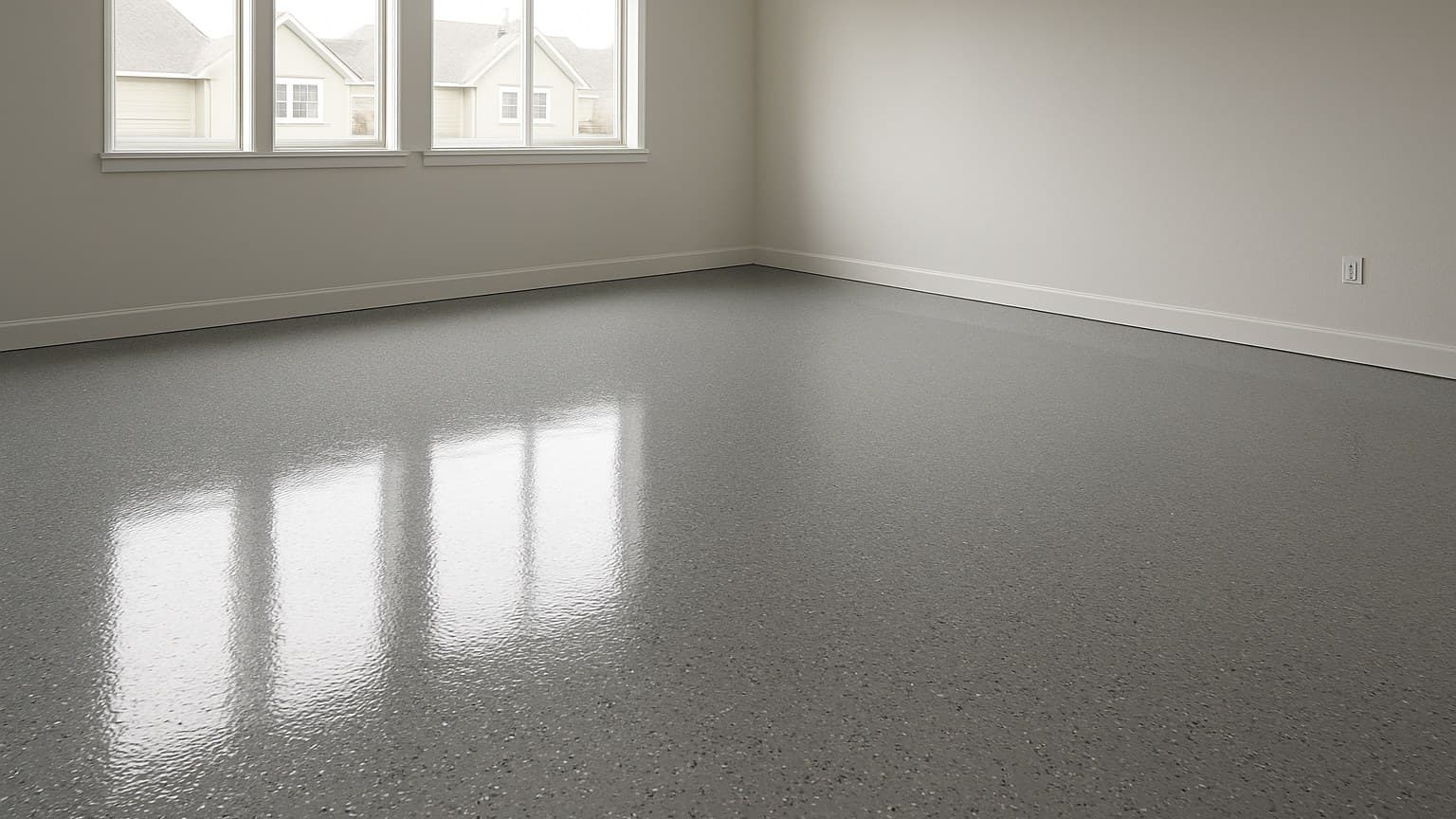
Here's where people get burned: they treat epoxy over a vinyl floor as one yes-or-no question, when the real answer swings entirely on whether that vinyl is glued solid or free to move underneath. Guess wrong and the coat cracks or peels within months. That one difference is the whole game.
Key takeaways
- Floating or click vinyl plank: never coat it. The floor moves and a rigid epoxy coat cracks at every seam.
- Old glued-down sheet vinyl or VCT (20-plus years, solvent mastic) can sometimes take a coat if it's firmly stuck and fully stripped of wax.
- Modern peel-and-stick LVT and flexible sheet vinyl almost always fail under epoxy because the thin glue releases and plasticizers break the bond.
- Run a 2x2 ft test patch with a tape-pull adhesion check before you commit to the whole floor.
- Before grinding any vinyl or VCT from before the 1980s, have it tested for asbestos first.
Start Here: The Go or No-Go by Vinyl Type
Whether you can coat over vinyl comes down to one thing: what's under your feet, and whether it's glued down tight or floating loose. A floor that's bonded solid and doesn't flex can sometimes hold a rigid epoxy coat. A floor built to move cannot, no matter how good your prep is.
Most "epoxy vinyl flooring" shortcuts you see online fail on floating and peel-and-stick floors. They work, when they work at all, on old solid glued-down floors. Here's the quick call for each type. The same movement logic carries over if you're instead asking about epoxy over laminate flooring, which has its own separate verdict worth checking before you start.
| Vinyl type | Glued or floating | Can you epoxy it? | The one reason |
|---|---|---|---|
| Glued-down sheet vinyl (old, solvent mastic) | Glued | Maybe | A firmly bonded, non-flexing base can hold a rigid coat |
| VCT, vinyl composition tile, 20+ years old | Glued | Maybe | Hard and stuck solid, but strip the wax and test for asbestos first |
| Floating / click vinyl plank | Floating | No | The floor is built to move; the coat shears at every seam |
| Peel-and-stick LVT, luxury vinyl tile (modern) | Lightly glued | No | Thin glue releases and lifts the coat with the tile |
| Flexible sheet vinyl (modern) | Glued | No | Too much flex underfoot cracks a rigid coat |
| Linoleum (true, glued, solid) | Glued | Maybe | Can take a coat only after a full wax strip and scuffing |
Go or no-go verdict for each common vinyl floor type, based on whether the base moves under a cured coat.
VCT just means vinyl composition tile, the hard 12-inch tiles you see in old schools and basements. Mastic is the old glue underneath, often a black tar-like adhesive on jobs from decades back. Those same hard-tile spaces turn up constantly in commercial buildings, where facility managers typically specify commercial epoxy flooring systems instead of coating over the old VCT.
1. Glued-Down Sheet Vinyl and VCT: Sometimes, If the Mastic Is Old and Solid
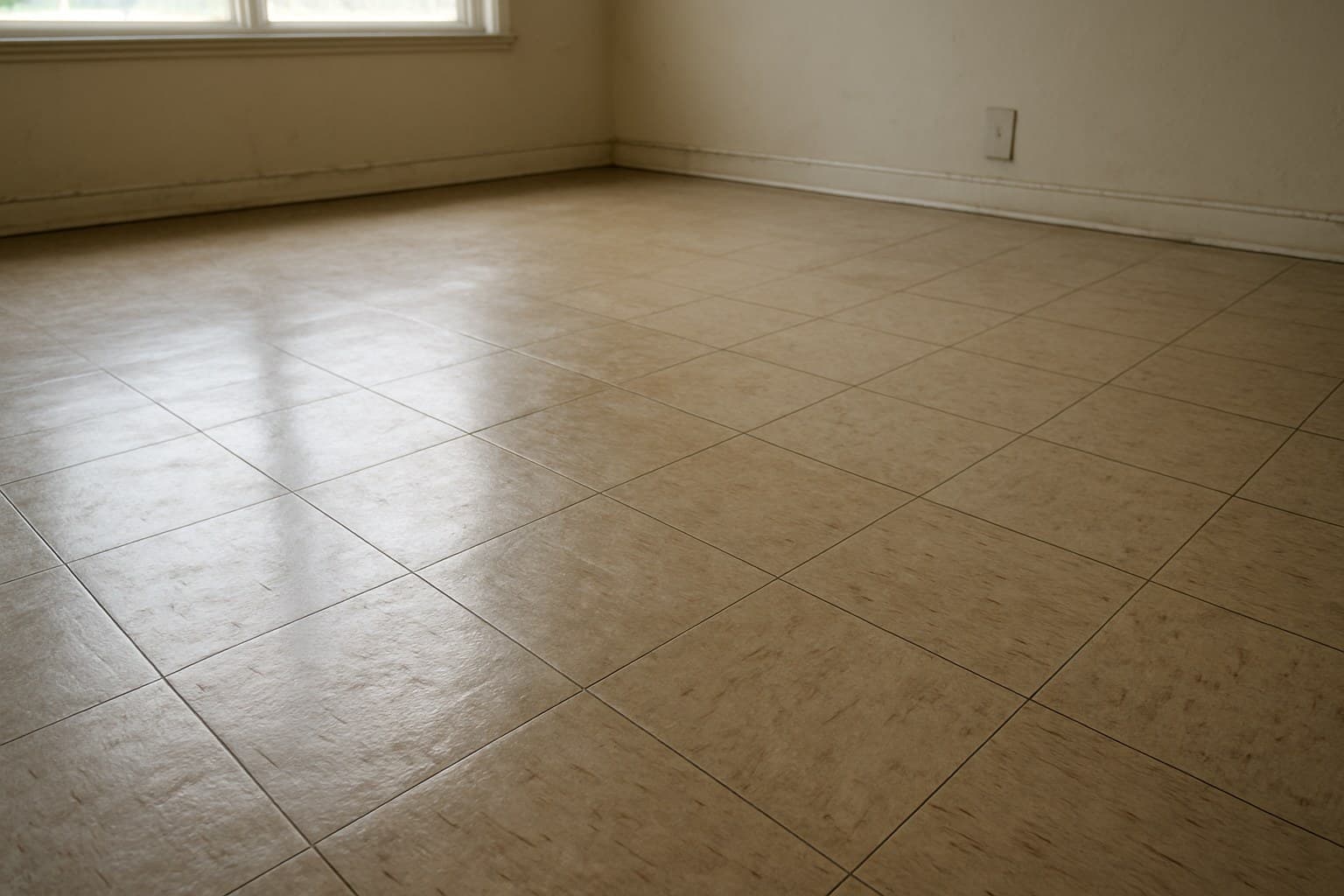
This is the one group where the answer can be yes. VCT and sheet vinyl laid 20-plus years ago on solvent-based mastic, the old black glue, often stay locked down tight. That solid, still base is the whole reason a coat can hold here at all.
Hard VCT is a better bet than soft sheet vinyl. The tile barely flexes, so a rigid coat on top isn't being asked to bend. Bendy sheet vinyl is riskier even when it's glued, because it still gives a little underfoot.
Prep is not optional. The Tile Council of North America's guidance on tiling over vinyl makes the same point for any new surface material: strip off every trace of wax and floor polish, then abrade the surface, meaning scuff it up with a sander or a buffer so the epoxy has teeth to grab. Coat over even a thin film of wax and it will peel, guaranteed.
One hard safety line: before you grind anything laid before the 1980s, have it tested for asbestos. Old VCT and the mastic under it can contain it, and dry-grinding that without testing throws fibers into the air you do not want to breathe. A lab test is cheap next to that risk.
2. Floating or Click Vinyl Plank: Don't Coat It, Period
Don't coat a floating or click floor. These floors are designed to move, expanding and shifting with temperature, and a cured epoxy coat is rigid and can't move with them. Polyurea coatings flex more than epoxy but still aren't rated for floating floors, so if that's the route you're weighing, polyurea garage floor coating cost guide covers what that option typically runs.
What happens is predictable. The coat cracks and shears along every plank seam, usually within a few months, no matter how spotless your prep was. I've watched a clean-looking garage coat split into a grid of lines right over the joints. It's an expensive lesson to learn in a space like a garage, which is why it's worth checking garage floor coating cost guide before committing to a full coat there.
This is a movement mismatch, not a bonding problem. No primer, no fancy product, no extra coat fixes it, because the issue is physical, not chemical.
If you want a hard coated surface in that room, the plank has to come up first. Before you start pulling, figure out exactly which product you have, because build and thickness vary a lot; our vinyl flooring buyer's guide walks through how to tell what's actually on your floor.
3. Modern Peel-and-Stick LVT (Luxury Vinyl Tile) and Flexible Sheet Vinyl: Almost Never Worth the Gamble
Skip it on both. Peel-and-stick glue is thin and weak, and under warmth and weight it releases, so the whole coat lifts away with the tile.
There's a second problem working against you. Plasticizers, the oils that keep vinyl soft and bendy, slowly bleed up to the surface over time. They break the epoxy bond from underneath, so even a patch that grabbed on day one can let go months later.
Flexible modern sheet vinyl has the same flex problem that kills coatings on floating floors. It bends underfoot, the coat can't, and the bond shears.
The honest call: pull it up and start clean on the subfloor. Chasing a bond that won't hold just means paying for the epoxy twice. Some homeowners use that clean subfloor as a chance to switch finishes entirely, and microcement flooring cost guide covers one popular alternative to epoxy.
4. Linoleum: A Maybe, With a Full Wax Strip and Scuffing
Linoleum is a genuine maybe, and the advice splits. PerformanceDIY says well-bonded linoleum can be coated directly; Sherwin-Williams and Armorpoxy lean toward removing it after direct attempts came back off. That disagreement tells you this one is decided by the floor in front of you, not by whose page you read.
Judge it by condition, not brand opinion. It qualifies only if it's fully glued with no loose or hollow spots, every trace of wax and finish is stripped, and the surface is scuffed up for grip.
Keep in mind true linoleum isn't vinyl. It's made with natural oils that can still reject a coat even when the floor is sound. That's exactly why a test patch, not a sales page, makes the final call here.
The One Physics Reason Behind Every Call
Every verdict above comes from a single fact: a cured epoxy coat is rigid, so it only lasts over a base that does not move. Get that one idea and you can predict the answer for any floor without a chart.
A floor glued solid is a still base, and the coat holds. A floating, flexing, or weak-glue floor moves, and the coat shears at the seams. Same coat, opposite result, and the only variable is movement.
Surface films do the same damage a different way. According to the Tile Council of North America's FAQ on tiling over other types of flooring, finishes like wax and polish act as a "bond breaker", a thin layer that keeps anything new from sticking to what's underneath, and must be fully removed first. Bled-up plasticizers act like a bond breaker too, which is why soft modern vinyl keeps failing. The same rule explains why the concrete slab under an epoxy floor decides how long it lasts: a sound, still base is everything.
The right way is the first panel: a still base keeps the cured coat whole. The other two show the coat failing the moment the base moves or the glue lets go.
How to Test Your Floor Before You Commit
Before you buy epoxy for the whole room, prove it on a small patch. This is the step most how-tos skip, and it's the one that saves you from coating an entire floor that peels in a month.
Run it like this, in order:
- Pick a 2x2 ft spot in a traffic area and strip off every bit of wax, polish, and finish.
- Abrade the patch, meaning scuff it rough, then vacuum and wipe it clean and let it dry fully.
- Mix and apply the epoxy exactly as the product's own data sheet says, same ratio and spread rate.
- Wait the full cure time listed on that sheet, not overnight by guess.
- Score a cross-hatch X into the cured patch, meaning cut a shallow grid with a blade, press strong tape over it, and pull it off fast.
- Press down and rock the patch with your hand, watching the nearest seam for cracks or lift.
- Check the patch for bubbles, soft spots, or edges you can peel; any one of these is a fail.
A test-patch and tape-pull adhesion check you can run on any vinyl floor before committing to a full coat.
If the tape rips up flakes of epoxy, you have no bond, and that answer won't change across the rest of the floor. Two more things before any full coat: glued floors over concrete can trap moisture under the slab, so check for it, and confirm the subfloor is flat, since a wavy base telegraphs through and stresses the coat. Moisture and flatness decide more floating-floor and coating outcomes than the product you picked.
When Ripping It Out Beats Coating Over It (and the Cost)
Pull the vinyl when it's floating, peel-and-stick, won't fully strip of wax, or flunks the test patch. Those floors won't hold a coat no matter how much you spend fighting them, so the money goes into removal and a sound base instead. Prying up floating click plank or peel-and-stick tile is a fair DIY job for most homeowners with basic tools. Stripping old mastic-glued sheet vinyl or VCT, and coating a basement or stairs, is worth hiring a pro for, the asbestos testing, moisture checks, and tight cuts raise the stakes.
On cost, keep materials and labor separate. A basic DIY epoxy kit runs roughly $1.50 to $3 per square foot in materials; a pro install adds labor on top, often in the $3 to $7 per square foot range depending on prep and coats. Vinyl removal is its own labor line beyond that, commonly $1 to $3 per square foot, and it climbs when the glue is stubborn. Basements and stairs run higher than an open room every time, because of the cutting, the tight work, and the moisture checks a slab below grade needs.
Once the vinyl is gone, give the epoxy a base it can actually bond to. That usually means a clean concrete slab, a plywood underlayment, or a self-leveling topping if the floor is uneven; our guide to self-leveling epoxy flooring cost covers when that topping is worth it. One habit from my own jobs: schedule the haul-off for the torn-out vinyl before you lift a single board, or it sits in your garage for a week.
For the full breakdown by room size, coats, and finish, run your own numbers with How Do You Calculate Epoxy Flooring Cost? before you buy, since it's the fastest way to see what your exact floor will actually run.