
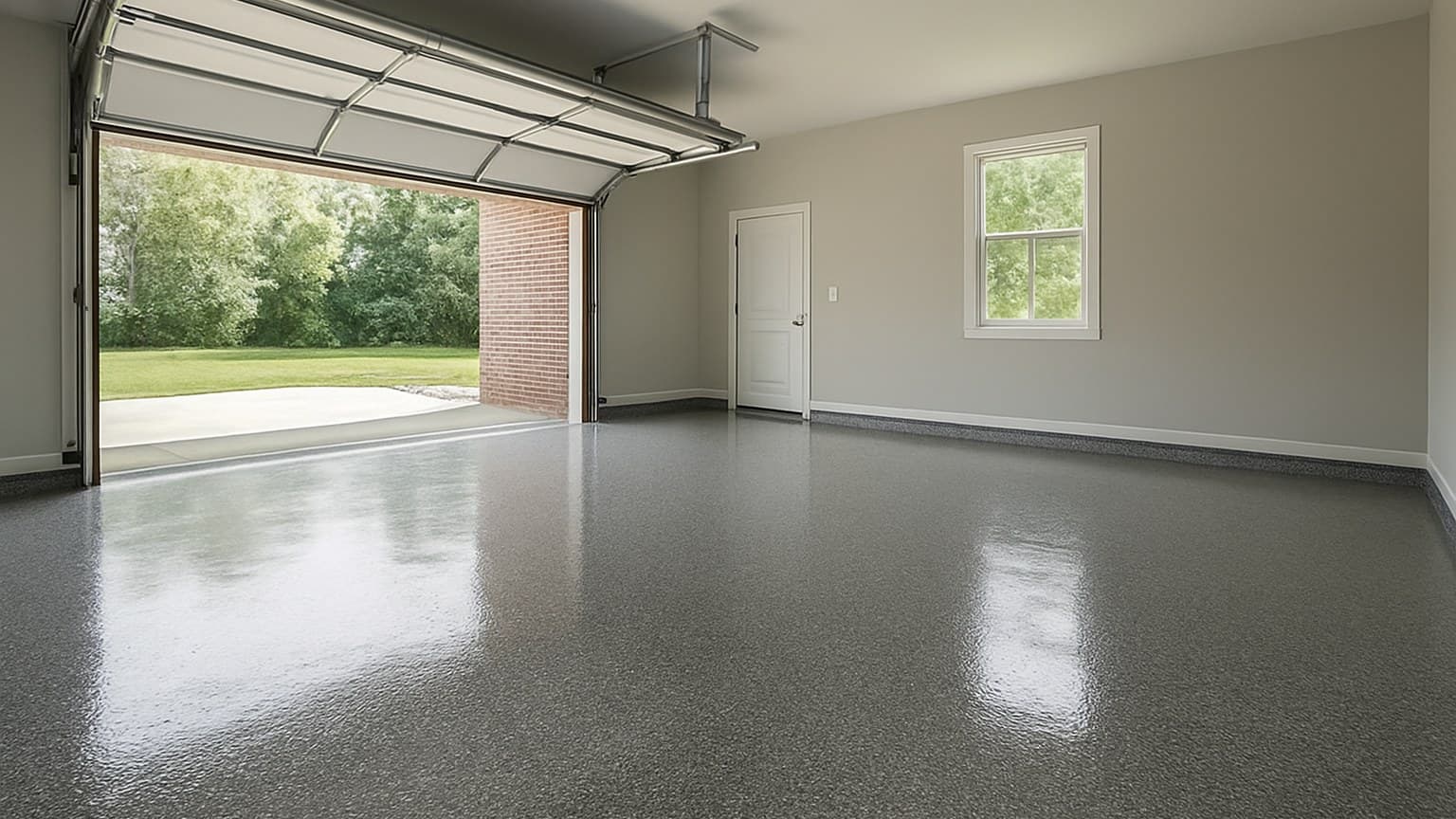
Rick in Dayton called me back eight months after I coated his garage floor because the epoxy was lifting at every tire track. That callback, and others like it, showed me the same pattern: bad concrete prep undoes even a premium coating every time. Epoxy floor coating runs about $3 to $12 per square foot installed — this guide to how much epoxy flooring costs breaks down that full range by system — and that huge spread comes down to one thing nobody explains well, what the installer actually does to your concrete before any epoxy goes down. Get that part wrong and the price on the bid stops telling you much at all.
Key takeaways
- Pro-installed epoxy runs about $3-$12 per square foot for materials plus labor, and a 2-car garage lands roughly $1,600-$7,000 depending mostly on prep and finish.
- Surface prep is the biggest single swing: a clean slab needs only a light etch, but a cracked, oily, or damp floor adds grinding and patching that can double the labor.
- Solid color is the cheapest finish; flake, quartz, and metallic systems cost the most per square foot.
- DIY kits cut the price 50-80%, but moisture testing, glue-heavy prep, and multi-coat systems are where hiring a pro usually pays off.
- Judge a bid by mil thickness, coat count, topcoat type, and warranty, not just the per-foot number.
What Epoxy Floor Coating Costs Per Square Foot in 2026 (and Why the Spread)
Pro-installed epoxy runs about $3 to $12 per square foot, split roughly as $1.50 to $5 in materials and $2 to $5 in labor. For a standard 2-car garage of around 480 square feet, that lands anywhere from $1,600 to $7,000. This epoxy floor installation cost guide walks through what pushes a job toward either end of that range.
That 4x spread is real, and it's where most homeowners get lost. A HomeGuide-style estimate lands you near $1,600. A quote off a nice metallic-system showroom job hits $7,000 for the exact same garage. Nobody reconciles the two, so people assume someone is gouging them.
Here's the one-line reason: the low number is a clean slab getting a light etch and a thin solid-color kit. The high number is grinding, crack patching, and a flake or metallic system with a premium topcoat on top. Same floor, completely different amount of work.
The rest of this page hands you the formula to find your own number, plus the five drivers that decide where on that range you land. If you want to see rough kit versus installed pricing side by side first, the epoxy floor price guide breaks that out.
Range of total installed cost for a 2-car garage in 2026, by system type, DIY kit through pro metallic.
Do the Math: A Simple Formula for Your Own Floor
The quickest way to sanity-check any quote is to build the number yourself. The formula is plain:
Total = square footage x (materials per sq ft + labor per sq ft) + prep add-ons + fixed costs
Name every piece with a realistic figure:
- Square footage: measure it, don't eyeball it. A 2-car garage is often around 480 sq ft.
- Materials per sq ft: about $1.50 to $3 for a 100% solids kit with flake.
- Labor per sq ft: roughly $2 to $5 for a pro.
- Prep add-ons: a light etch is cheap; grinding a sealed or oily slab adds real hours (more on this next section).
- Fixed costs: a crack-patch kit and a moisture test, usually $50 to $250 together.
Here's a 480 sq ft garage worked end to end.
| Step | Value |
|---|---|
| Area | 480 sq ft |
| Materials per sq ft (100% solids + flake) | $1.50 - $3.00 |
| Labor per sq ft (pro) | $2.00 - $5.00 |
| Subtotal (area x per-sq-ft) | $1,680 - $3,840 |
| Prep add-on (light etch to grind) | $240 - $1,440 |
| Fixed costs (crack patch, moisture test) | $50 - $250 |
| Estimated total | $1,970 - $5,530 |
Source: my own garage epoxy jobs
Worked estimate for a 480 sq ft 2-car garage, materials plus labor, before regional swings.
One thing the flat per-foot math hides: the open middle of a room is the cheap part. I used to quote straight square footage until a job packed with closets, doorways, and a bay window ate a whole extra day. Now I count the cut-heavy areas, steps, and thresholds separately, because that trim work is where the labor hours actually go, not the wide-open field.
For a tighter dollars-per-square-foot breakdown and the odd edge cases, the epoxy floor cost per square foot guide goes deeper than there's room for here.
Price Driver 1: Surface Prep Condition
Prep is the single biggest swing in any epoxy quote, and it's the honest reason two bids for the same garage can differ by thousands. The coating is almost never the variable. The concrete is. As this breakdown of why the concrete underneath decides if an epoxy floor lasts lays out, the slab itself is really what you're paying to prepare, not the paint you eventually choose.
On a clean, sound slab, an installer can get away with a light acid etch, which is just a chemical wash that opens the surface so the epoxy grips. That's fast and cheap. On a slab that's sealed, painted, or soaked with old oil, you need diamond grinding instead, which means mechanically sanding the top layer off the concrete with a weighted machine. That's slower, dustier, and it shows up in the labor line.
Then there are cracks, pitting, and moisture. Cracks and divots get patched and cured before any coating. And a basement or ground-level slab that feels damp needs a moisture test first, sometimes a vapor barrier under the system. Skip that step and the coating peels off in sheets later, no matter how good it was.
| Slab condition | Labor add per sq ft |
|---|---|
| Clean, sound slab (light acid etch) | $0.50 - $1.00 |
| Minor cracks and pitting to patch | $1.00 - $2.00 |
| Sealed or oily slab (diamond grinding) | $1.00 - $3.00 |
| Moisture issues (test + vapor barrier) | $2.00 - $4.00 |
Extra labor cost per square foot by slab condition, on top of the base labor rate.
This is also why the manufacturer's warranty quietly hinges on prep, not the product. Read the fine print on almost any kit and the coverage assumes a properly ground, moisture-tested slab. The coating you picked is the easy part.
Price Driver 2: Where You Live
Labor, not materials, is what moves with your zip code. The kits ship at roughly the same price everywhere, so a gallon of 100% solids costs about the same in rural Ohio as it does in San Francisco. What changes is the hourly rate of the crew laying it down.
| Region | Labor only, per sq ft |
|---|---|
| Rural / low-cost areas | $3 - $5 |
| Mid-size metro | $5 - $8 |
| High-cost coastal metro | $7 - $12 |
| Texas (wide statewide range) | $5 - $15 |
Pro labor rate per square foot by region; materials stay roughly flat nationwide.
Texas is a good example of how wide even one state runs, from about $5 up to $15 per square foot depending on the metro and the demand. That's not price gouging, it's local labor cost. The takeaway: a national average is close to useless for budgeting. Get two or three local quotes and compare those against the formula above.
Price Driver 3: Coat Count and Finish
A real epoxy floor is a system of layers, not one coat of paint. That distinction is most of what separates a $1,600 job from a $4,000 one. A proper build is a primer coat, an epoxy base coat, a color or flake coat, and a topcoat, each doing a job.
Here's the part the marketing skips. Yes, the cured coating itself resists water. But adhesion doesn't fail across the middle of the slab where the film is thick. It fails at the edges, cracks, and hot-tire contact points, where coats are thinnest and the bond is weakest. A "waterproof" film means little if the seams and perimeter were rushed.
The topcoat is where a lot of the money and the durability live. A polyaspartic topcoat, a fast-curing plastic coating applied over the epoxy, costs more than leaving bare epoxy exposed, and so does a polyurethane topcoat, but both buy you real UV resistance so the floor doesn't yellow, plus better abrasion resistance underfoot. A mil is just one-thousandth of an inch, and on Rust-Oleum's RockSolid spec sheet, more coats and a thicker mil topcoat build cost more up front but last longer, which is what makes the cost-per-year math work out.
The layers of a full epoxy system, outermost first, with typical thickness of each coat per Rust-Oleum RockSolid's 2-part epoxy spec sheet.
Price Driver 4: Epoxy Type
The type of epoxy you pick sets a floor and a ceiling on the whole job. Water-based and solvent-based are the cheapest, 100% solids sits in the middle, and flake, quartz, and metallic sit at the top.
Here's what the extra money actually buys. A 100% solids kit like Rust-Oleum RockSolid cures to a thicker mil build than water-based paint, so it wears longer. Metallic adds a swirled, designer look that's all about appearance. Quartz mixes fine sand into the coat for real grip and toughness, which is why it shows up in kitchens and entryways. Water-based has lower VOC content than solvent-based or 100% solids systems, a category the EPA regulates under its national VOC emission standards for architectural coatings, meaning fewer fumes while it cures, but it lays down thinner than 100% solids, so you trade some durability for easier application.
| Epoxy type | Cost per sq ft (materials + labor) |
|---|---|
| Water-based | $2 - $4 |
| Solvent-based | $3 - $5 |
| 100% solids | $4 - $7 |
| Flake | $5 - $8 |
| Quartz | $7 - $10 |
| Metallic | $8 - $12 |
Installed cost per square foot by epoxy type, materials and labor combined.
Rough expected lifespan in years across six epoxy types, least durable to most durable, durability tracks closely with the price tiers in the table above.
Price Driver 5: Size and Application (Garage, Basement, Patio and More)
Where the floor goes changes the per-foot price, and bigger is usually cheaper per square foot. Setup, mixing, and mobilization cost the same whether the room is 200 or 1,200 square feet, so those fixed hours spread thinner over a large open floor. A small patio or landing pays the highest per-foot rate because it's all edges and setup with almost no open field to average it out.
| Application | Installed cost per sq ft |
|---|---|
| Large open floor (1,000+ sq ft) | $3 - $5 |
| 2-car garage (~480 sq ft) | $3 - $7 |
| Basement | $4 - $8 |
| Small patio, porch, or landing | $5 - $10 |
Source: my own jobs across garages, basements, and shop floors
Cost per square foot by application; larger open areas run cheaper per foot than small, cut-heavy spaces.
A basement sits higher than a garage of the same size for one reason: moisture. Ground-level and below-grade slabs are far more likely to need a moisture test and a vapor barrier, and that prep premium is on top of the labor, not baked into it. Budget a basement above an open garage even when the square footage matches.
If you're pricing a specific space, these room guides go deeper than a single table can: the epoxy garage floor cost guide for garages, the residential epoxy flooring cost guide for basements and living areas, and the industrial epoxy flooring guide if you're looking at a shop, warehouse, or heavy-use floor.