
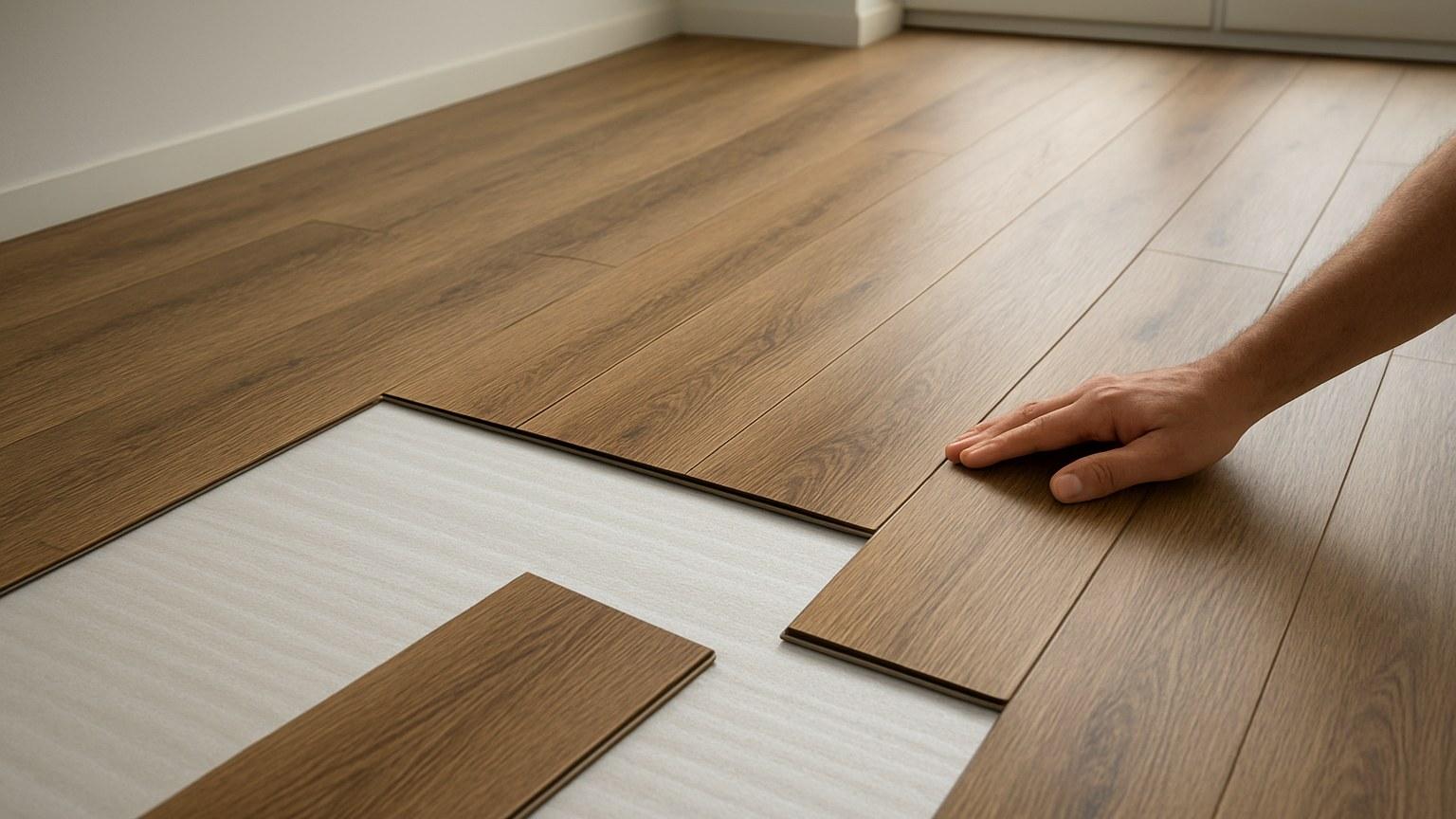
Whether you need vinyl flooring underlayment comes down to one check: many rigid-core LVP (luxury vinyl plank) planks already ship with a pad attached, and if yours does, adding another layer can void the warranty. The box rarely makes this obvious, which is why so many buyers grab a roll they don't need. Get it wrong and you either waste money or work your click joints loose.
Key takeaways
- Many rigid-core LVP (luxury vinyl plank) planks ship with an attached pad, so adding separate underlayment on top can void the warranty. Read the maker's install sheet before you buy anything.
- For LVP without a pad, keep total underlayment at 2-3 mm and never above 3 mm, a limit bestbuyfloorsinc.com cites. Thicker flexes the click joints and causes seam failures.
- Over a concrete slab, lay a 6-mil poly vapor barrier and run a 24-hour plastic-sheet moisture test before anything else, per bestbuyfloorsinc.com.
- Glue-down LVP gets no underlayment. The adhesive has to bond straight to a flat, clean, prepped subfloor.
- Material runs about $0.30-$0.50 per sq ft for foam and $0.75-$1.25 for cork (yard-compass.com); having it installed runs $4.38-$5.27 per sq ft (homewyse.com).
Start Here: Do You Even Need Underlayment?
A lot of rigid-core LVP already has a pad stuck to the back, and laying a second layer on top can void the maker's warranty. So before you buy anything, read the plank's install sheet. That one check settles the question for a lot of buyers.
Underlayment is a thin layer that sits between your subfloor and the planks. It softens footstep sound, adds a bit of cushion, smooths tiny bumps in the subfloor, and over concrete it carries a moisture barrier.
Here's the 30-second check. Look on the box or spec sheet for the words "attached pad" or "attached underlayment." It's often a foam called IXPE. If your plank has one, you usually add nothing over a wood subfloor, and only a vapor barrier over concrete.
Why does doubling up backfire? A pad plus a separate underlayment gives the floor too much bounce. It reads hollow when you walk it, and that flex slowly works the click joints apart.
Do You Need to Put Anything Under Click-Lock Flooring?
Only if the plank has no attached pad. Click-lock LVP with a factory pad goes straight down over a prepped wood subfloor. Over concrete, you still add a vapor barrier under even a padded plank, because the pad handles sound and comfort, not slab moisture.
What Underlayment Actually Does
Underlayment dampens footstep sound, blocks slab moisture over concrete, adds slight comfort and warmth, smooths tiny surface flaws, and helps a floating floor sit stable.
What it won't do is fix a bad subfloor. It won't flatten a wavy slab and it won't dry out a wet one. The subfloor still has to come in flat within 3/16 inch over a 10-foot span before any pad goes down, that flatness standard comes from bestbuyfloorsinc.com. In the work I've done, the floors that come back are almost always a prep problem under the plank, not the plank itself.
One thing people blur: waterproof and water-resistant aren't the same. A vapor barrier protects the subfloor from moisture rising up through a slab. It doesn't seal the floor. Water spilled on top can still traverse the seams or the perimeter gap, accumulating on the subfloor underneath. The plank material may be waterproof; the floor as a whole isn't. That same perimeter gap is where LVP transition strips earn their keep, covering the expansion space while still letting the floor move.
Underlayment Types and What They Cost
Pick the type that matches the job: cushioning, moisture control, sound reduction, or durability.
| Type | Material cost (per sq ft) | Best for |
|---|---|---|
| Foam (standard) | $0.30-$0.50 | Dry wood subfloor, basic cushion |
| Foam + vapor barrier (combo) | $0.50-$0.75 | Over concrete, built-in moisture layer |
| Felt (sound-dampening) | $0.60-$1 | Rooms where quiet matters |
| Cork | $0.75-$1.25 | Firm support plus strong sound numbers |
Source: yard-compass.com
Rubber is the outlier, running about $1.50-$4 per square foot installed according to usrubber.com, and it's overkill for a home bedroom.
Which type is best depends on your subfloor and how quiet you need the room. Foam covers most wood-subfloor bedrooms and living rooms. Combo or cork earns its price over concrete, or anywhere you need real quiet. The vinyl flooring itself matters just as much as what's underneath it, and our guide to what makes vinyl flooring last covers the other factors that decide whether it holds up for five years or twenty.
How Thick Should the Underlayment Be?
For LVP without an attached pad, use 2-3 mm, and keep the total under 3 mm, bestbuyfloorsinc.com caps it there. That's the whole rule.
Go thicker and the floor fails in a predictable way. Too much give lets the planks flex every time you step. That flex pops the click joints, and you start seeing gaps, peaking, and split seams months later. Thick cork sold at 1/4 inch or 1/2 inch is built for other floors, not floating vinyl plank.
The thickness limit is clear.
| Thickness | Material cost (per sq ft) | OK for LVP? |
|---|---|---|
| 1/8 inch (~3 mm) | $0.48-$0.55 | Yes, at the 3 mm limit |
| 1/4 inch (~6 mm) | $0.99-$1.14 | No, too thick |
| 1/2 inch (~13 mm) | $1.98-$2.27 | No, meant for other floors |
Source: widgetco.com
Only the 1/8-inch cork stays near the 3 mm ceiling. The thicker grades are too tall for vinyl plank.
Match the Underlayment to Your Subfloor
Your subfloor drives the moisture decision more than anything else, so sort out what you're laying over before you pick a product. A floor that would be fine over dry plywood can fail fast over a damp slab.
Does Vinyl Flooring Need Underlayment on Concrete?
Over concrete you always need a moisture layer, even under a padded plank. Lay a 6-mil poly vapor barrier, bestbuyfloorsinc.com specifies this thickness for use over concrete, overlap the seams and tape them, and run the barrier up the wall a couple of inches behind the baseboard. Before any of that, do the moisture test: tape plastic sheeting to the bare slab, leave it 24 hours, and if you find condensation or a dark ring underneath, the slab is too wet to cover yet. That sequence follows bestbuyfloorsinc.com's guidance, and I run it on every slab job.
Wood and Plywood Subfloors
A dry, flat wood or plywood subfloor is the easy case. If your plank has an attached pad, you often need nothing. If it doesn't, roll out standard foam for a little cushion and sound. No vapor barrier is needed over wood above grade. From there, laying the planks themselves follows a predictable sequence, and our step-by-step vinyl plank installation guide walks through the whole process from the first row to the last cut.
Basements and Below-Grade Floors
Basements are below grade, so moisture pushes up through the slab year round. Treat these like the concrete case: moisture test first, then a vapor barrier, then a padded or combo layer if the plank calls for it. This is where I've pulled up floors a homeowner laid straight on a basement slab with no barrier, and the subfloor was the problem every time.
Radiant Heat Floors
Over radiant heat, check two things with the plank maker first: the maximum surface temperature the LVP allows, and whether any underlayment is permitted at all. Many pads insulate, which fights the heat you're paying to run, so some systems want the plank right over the heat layer with nothing between.
Floating vs Glue-Down: What Changes
Floating click-lock LVP is where underlayment lives. If that plank has no attached pad, this is the install type that needs one. The planks lock to each other and float over the pad, so the cushion matters.
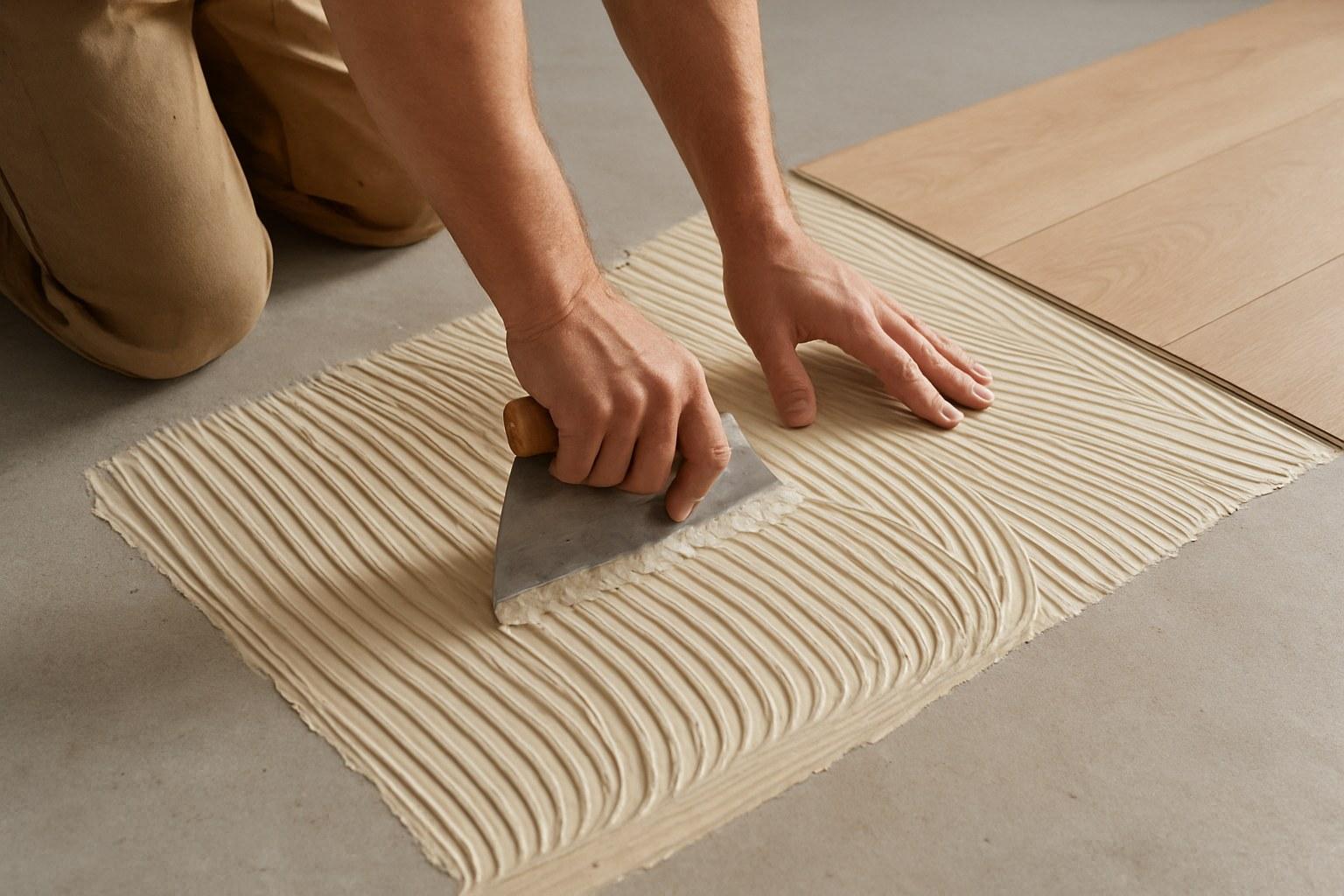
Glue-down LVP gets no separate underlayment at all. The adhesive has to bond straight to a flat, clean, prepped subfloor, and a pad between them would wreck that bond. If you're weighing the two methods by room, our guide to glue-down vs floating vinyl plank breaks down where each one wins.
On DIY versus hiring out: click-lock floating over rolled foam is a realistic job for a handy homeowner, and our luxury vinyl plank installation guide walks the whole process. Glue-down, stairs, and big open-plan floors that cross a moisture transition are where I'd tell you to hire a pro. The bond and the transitions are unforgiving, and mistakes there are expensive to redo.
Materials for the underlayment itself run $0.30-$1.25 per square foot, the same range shown in the table above, depending on the type you pick. Labor is what pushes the total up: homewyse.com puts the full installed job, underlayment plus the labor to lay it, at $4.38-$5.27 per square foot. But rolling out foam over a flat wood subfloor is simple, so most of that labor cost is work you can do yourself if you're already laying the floor.
Sound Ratings: IIC and STC Targets
Two ratings decide whether a floor is quiet enough. IIC, short for Impact Insulation Class, measures how well the floor blocks footstep and impact noise reaching the room below. STC, Sound Transmission Class, measures airborne sound like voices and the TV.
A standard single-family home aims for 50 or better on both IIC and STC, while condos and apartments often require 65 or higher IIC, those numbers come from bestbuyfloorsinc.com. Basic foam tends to hit the low end of those numbers. Cork, felt, and rubber reach the higher ones.
Check your building's rule before you buy. Many condo HOAs set a minimum IIC in writing, and if you pick foam when the rule wants 65, you'll be pulling it back up.
Pick Your Underlayment: A Quick Guide
Walk these six checks in order. The first one ends the shopping trip for a lot of buyers.
- Read the plank's install sheet. If it has an attached pad, don't add a second cushion layer. Skip to step 3 only if you're going over concrete.
- Confirm the install type. Glue-down gets no underlayment, period. Floating click-lock with no pad is the only case that needs a bought layer.
- Test and treat the subfloor. Over concrete or in a basement, run the 24-hour plastic-sheet moisture test, then lay a 6-mil poly vapor barrier. Over dry wood, check flatness to 3/16 inch over 10 feet.
- Match the type to the job. Foam for dry wood rooms, combo or cork over concrete, cork or felt where you need quiet.
- Keep it 2-3 mm, never over 3 mm. Thicker flexes the joints and splits seams.
- Check your sound target. Single-family aim for 50+ IIC and STC; condos often need 65+ IIC, so match the material to the rule.
If you're getting ready to lay the planks after this, our step-by-step guide to installing LVP picks up right where the underlayment stops and walks the first row through the last cut.