
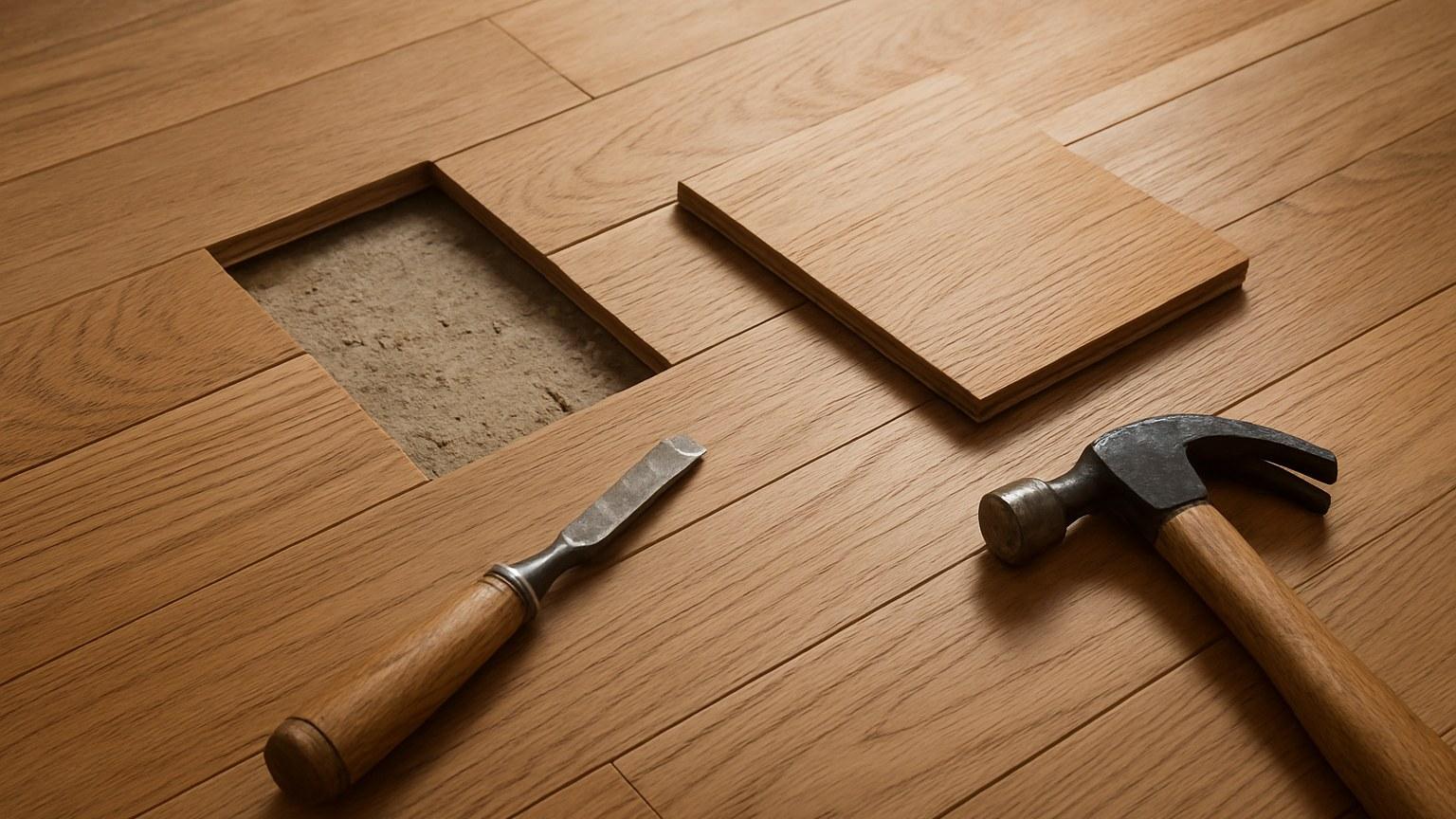
Almost all solid hardwood damage is repairable, and matching the right fix to the right symptom is what keeps a repair far cheaper than replacing the floor. Splits, gaps, and cupping can look alike but come from different causes, so the wrong fix either fails fast or turns into a whole-room job you never needed.
Key takeaways
- Most solid hardwood damage is fixable, and a single-board swap or a buff-and-recoat usually beats replacing the whole floor on both cost and mess.
- Buff-and-recoat runs about $1-$2 per sq ft and a full sand-and-refinish $3-$8, per hallmarkfloors.com and modernize.com; the specific fix drives the price, not the room's size.
- Cupping and buckling are moisture problems first, so find and stop the water before repairing boards or the damage comes back.
- New boards never match an aged floor right away; a swapped board stays obvious until the wood around it is sanded and refinished with it.
- Scratch touch-ups and one loose board are weekend DIY; color-matched board swaps, moisture-driven cupping, and full-room sanding are usually worth hiring out.
Can a Hardwood Floor Be Repaired?
Yes. Most hardwood problems, from split boards to deep scratches to water stains, can be fixed without tearing up the floor. A well-matched repair almost always costs less than ripping everything out and installing new wood.
The method this guide follows is simple. Name what you're looking at, work out what caused it, then pick between a spot patch, a refinish, or a board swap. Get the diagnosis right and the fix follows.
There's one real limit. Engineered wood with a thin veneer and laminate can't be sanded back the way solid oak can, so badly damaged boards there get swapped out, not refinished. With engineered, the maker's published veneer thickness caps how many times you can refinish at all, so check that number before you count on sanding. If you're still deciding which to install in the first place, our guide to solid vs. engineered hardwood walks through how that veneer thickness factors into species and room choice.
A spot repair and a full refinish are two different jobs. One is a patch; the other resurfaces the whole room. They carry different costs and different mess, so matching the fix to the damage is the entire game here.
Reading the Damage: Symptom, Cause, and Fix
Start by naming the symptom. Each one points to a likely cause and a usual fix, and most of them tell you right away whether it's a weekend job or a call to a pro.
| Symptom | Likely cause | Typical fix | DIY or pro |
|---|---|---|---|
| Split or cracked board | Dropped weight, drying, or old age | Putty a hairline; cut out and replace a structural crack | DIY for putty, pro for replacement |
| Gaps between boards | Seasonal humidity swing (normal) or moisture/install issue (not) | Leave seasonal gaps; fill or re-lay year-round gaps | Pro for anything beyond cosmetic filler |
| Cupping or buckling | Moisture under or around the boards | Dry out the source, then sand flat or replace boards | Pro |
| Loose or squeaky board | Lost fastening or subfloor movement | Re-nail with angled finish nails or screw from below | DIY if accessible |
| Worn finish or scratches | Foot traffic, grit, sun fade | Scratch kit, buff-and-recoat, or full refinish | DIY for touch-ups, pro for refinish |
| Water-damaged board (dark stain, swelling) | Leak, spill, or flooding | Replace the board once the subfloor is dry | Pro |
Each row maps a common hardwood problem to its likely cause, the usual repair, and whether it's a realistic DIY.
Splits and cracks. A hairline split takes wood putty and a few minutes. A board that's cracked clean through is structural, so it gets cut out and a new board set in its place. If a board is just lifting at one end, you can often re-seat it with angled finish nails driven near the edge, then fill the nail holes.
Gaps. Thin gaps that open in dry winter and shrink back in humid summer are normal seasonal movement, and you leave them alone. Wide gaps that never close are a different story; they point to a moisture or installation problem, and filler just hides the symptom.
Loose or squeaky boards are usually a fastening that let go or a subfloor that moves. If you can reach the joint from below, a screw into the subfloor can pull it tight. From the top, angled finish nails do the same job.
Scratches and a Worn Finish
A light scratch that catches your fingernail but hasn't cut through the finish is a touch-up, not a repair. A color-matched scratch kit or a dab of finish handles it.
When the whole floor has gone dull and covered in fine scratches but the wood underneath is still sealed, that's a buff-and-recoat, not a sanding. The buffer scuffs the old finish just enough for a fresh coat to grab. Once the wood is bare, gray, or gouged down past the finish, you're into a full sand-and-refinish.
That job means running a drum or orbital sander over every board down to bare wood, hooked to a dust containment setup so the fine dust doesn't coat the whole house. After sanding, you stain if you want a color change, then seal it with oil-based or water-based polyurethane. Oil-based ambers as it ages and takes longer between coats; water-based stays clearer and dries faster. Either way, the floor needs time to acclimate and cure before furniture or rugs go back down.
Water-Damaged Boards
Dark staining and swelling mean water, and the water comes first. Replacing a swollen board over a wet subfloor just rots the new board too.
Find the leak or spill source, dry the subfloor out fully, then swap the damaged boards. This is a pro job most of the time, because judging whether the subfloor is truly dry takes a moisture meter, not a guess.
Replacing a Board and Matching the Color
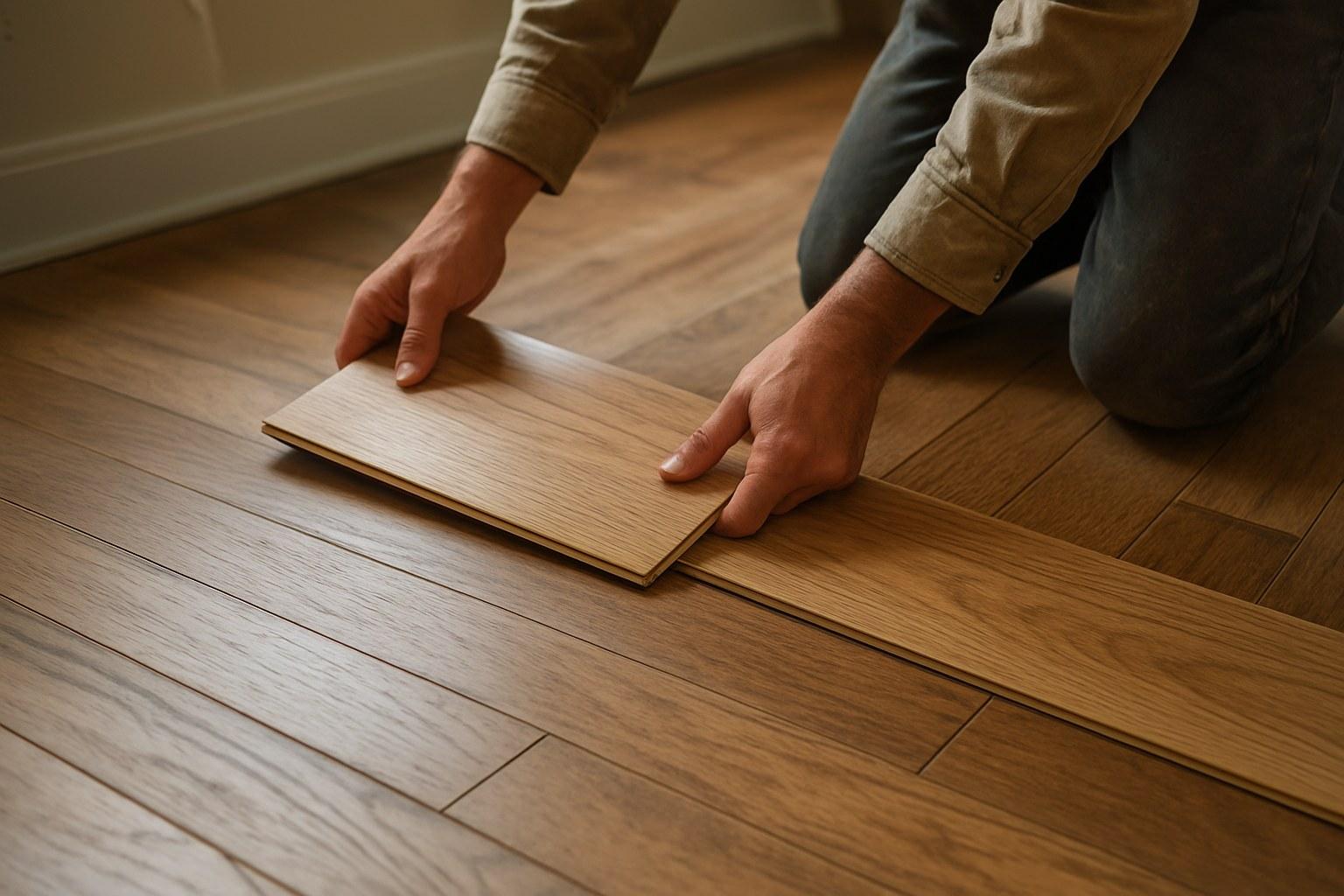
Yes, you can replace just one board. The installer cuts the damaged board out of the field, clears the groove, and locks or face-nails a fresh board into the gap.
Cutting it in is the easy part. Matching it is where single-board repairs get hard. The species, the board width, the grain pattern, and the finish sheen all have to line up with the floor around it. Old or discontinued widths sometimes have to be milled to fit, which adds time and cost.
Then there's color. I swapped a damaged board in a dining room up near Columbus once, same oak, same width, and the new piece came in noticeably paler than the aged floor around it. The seam sat right in the doorway where you couldn't miss it, and it nagged the homeowner for weeks. Now I tell people straight: aged wood never matches a new board right away, and to make a swap disappear you often have to sand and refinish the whole area so everything takes stain and light the same way.
For the step-by-step on cutting in a replacement board, fastening it, and when the job needs a spline, see our guide to installing hardwood flooring, since the repair uses the same cut-in method.
What Hardwood Floor Repair Costs
Typical hardwood repairs run about $1-$10 per square foot, according to modernize.com, hallmarkfloors.com, and yelp.com, and where you land depends on the fix, not the size of the room. A buff-and-recoat is cheap per foot; a water-damage board swap with subfloor work is not.
| Fix | Cost per sq ft | Source |
|---|---|---|
| Buff and recoat | $1-$2 | hallmarkfloors.com |
| Light scratch repair | $1-$3 | modernize.com |
| Deeper scratch and dent repair | $3-$8 | modernize.com |
| Full sand-and-refinish | $3-$8 | modernize.com, hallmarkfloors.com |
| Subfloor repair | $3-$10 | hallmarkfloors.com |
| Water-damage board replacement | $5-$10 | yelp.com |
Species moves the number too. angi.com puts maple floor repair at $4-$15 per square foot and red oak at $5-$11, because harder, pricier woods cost more to patch and sand.
One thing these per-foot rates hide: small spot jobs carry a minimum charge. Fixing one 6-inch gouge might cost more per foot than refinishing a whole room, because the crew still has to show up, set up, and clean up for a tiny repair.
Repair, Refinish, or Replace?
The decision rule is short. Isolated damage over an otherwise sound floor means a spot repair. Surface-wide dullness and fine scratches with the wood still sealed means a buff-and-recoat. Bare or gray wood, deep gouges across the room, or a lot of bad boards means a full sand-and-refinish.
Guides disagree on where the line sits, and the truth is in the middle. A spot patch genuinely holds when the damage is isolated and the existing finish still matches a fresh board. But once you're patching several boards, or a new patch won't blend into the old finish no matter what you do, that patch realistically becomes a whole-room refinish anyway. At that point you stop fighting individual boards and resurface the floor as one.
A buff-and-recoat is the move people forget. It restores a tired floor without sanding, by scuffing the old finish and laying a new coat over it. It's the cheapest fix on the list and the least mess, but it only works while the wood below is still protected. Once traffic has worn through to bare wood, a recoat has nothing to bond to and you're sanding.
Replacing the entire floor rarely wins on cost against a refinish, as long as the boards have enough thickness left to sand. If you're weighing a gut job anyway, it's worth reading our comparison of LVP (luxury vinyl plank) and hardwood before you commit, since replacing a whole room is the one moment switching materials is actually on the table.