
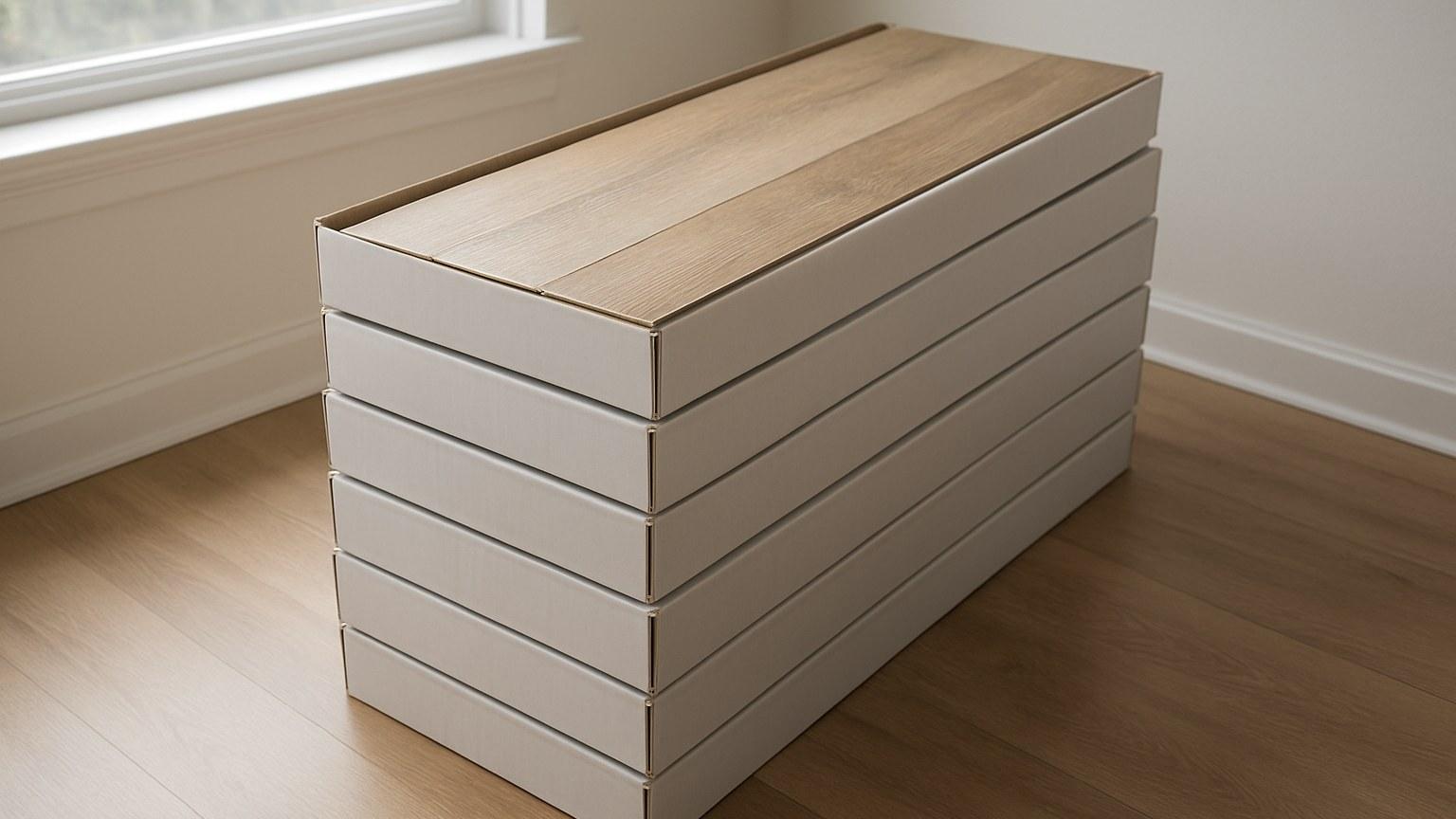
A waterproof vinyl flooring clearance buy is worth it only when the lot and dye numbers match across every box and the per-square-foot price truly beats regular stock. The discount sign is the easy part. Discontinued runs can't be reordered, so a warped plank or a color mismatch becomes your problem for keeps. Finding the cheapest place to buy LVP (luxury vinyl plank) in the first place still matters, since even a good clearance deal should beat typical retail pricing.
Key takeaways
- The one check that matters most: confirm lot and dye numbers match across every box, because a discontinued clearance run usually can't be reordered to fix a mismatch later.
- Buy about 10% extra for waste, then add at least one full box as attic stock for future repairs you can't reorder.
- Open boxes and look for warped or cupped planks, water stains, and sheen that doesn't match between boxes before you pay; clearance sales are often final.
- Expect clearance vinyl materials around $2-$7 per square foot and pro labor around $2-$5 per square foot (per carpetexchange.com and estimators.us); compare the per-square-foot price, not the 'up to 80% off' sign.
- SPC (stone plastic composite) rides harder and denser, WPC (wood plastic composite) is warmer and softer underfoot; both are rigid-core and both still need a flat, dry subfloor under them.
Why Waterproof Vinyl Ends Up on Clearance
Most clearance waterproof vinyl is not junk. It's discontinued colors, overstock, open-box returns, or a line being phased out. The catch is simple: once it's gone, you usually can't order more. If you'd rather skip the clearance hunt entirely, a guide to cheap LVP flooring options covers what's genuinely affordable in new stock.
Four things explain why a box lands on the discount aisle, and what each one means for you.
Discontinued colors or lines. The maker launched new collections and cleared out last year's looks. The vinyl is fine, but the quantity on the shelf is all there will ever be. Tracking down more of that exact run after the shelf empties usually means hunting through resellers and liquidation lots, a search covered in finding discontinued vinyl flooring for sale.
Overstock. A store bought too much. This is the lowest-risk clearance, because it's current product that may still be reorderable for a while.
Open-box returns. Someone bought it, opened it, and brought it back. Inspect these harder, since planks may be mixed from different lots or already damaged.
End-of-run remnants. The last pallets of a line that's being dropped. Treat the stated quantity as final.
A true clearance run is different from a vinyl flooring sale. A sale restocks when it sells out. A clearance run is whatever is left, and that's it. Don't get fooled by a clearance tag slapped on slow-moving stock the store can still reorder, that's just a sale with a scarier sign. Below is the checklist I run before I let a customer buy any of it.
The Checklist: What to Inspect Before You Buy a Clearance Box
Check the lot and dye numbers first, because that's the one mistake you can't fix later. Those numbers are printed on the box ends, and they tell you which batch and color run the planks came from. If they don't match across every box, you can get a visible color or sheen shift running across the finished floor.
On a clearance run you can't just grab a matching box later. Match them in the store, box by box, before anything goes in the cart.
I watched this exact mismatch play out on a kitchen floor in Beavercreek a while back. The homeowner, Theresa, had grabbed four boxes of clearance SPC (stone plastic composite) pulled from two different pallets at the store, thinking they were all one run. Three boxes shared a dye lot number; the fourth was off by a single digit.
Once we clicked the first few rows together under the window light, that fourth box read a shade warmer and glossier than the rest, you could trace exactly where the seam ran across the floor. We pulled that box before it went down and swapped in a spare she'd bought from the matching lot. If she hadn't picked up that extra box, the mismatch would have stayed in her kitchen floor for good.
Next, open at least one box per lot and actually look:
- Warped, cupped, or bowed planks. Set one on a flat surface and see if the edges lift.
- Crushed or chipped locking edges. A damaged click edge won't lock tight and the seam will gap.
- Water stains or moisture inside the box.
- Sheen that doesn't match between boxes, even when the pattern looks the same.
Then read the label for the spec clearance tags love to hide: whether it's SPC (stone-polymer core) or WPC (wood-polymer core), and the wear layer, which the maker lists in mils (thousandths of an inch). The wear layer is the clear top coat that takes the scuffs and foot traffic, and a thicker one holds up longer in a busy room. Clearance pricing doesn't change what that number is, so find it.
Before you check out, ask the store two more things: whether that clearance or open-box run still carries the maker's full warranty or a shortened one, and what happens if you need to return or exchange a box once the lot sells out. Clearance and discontinued stock is often sold as-is, with the warranty reduced or dropped and no exchange once the shelf is empty, because the store has no way to pull a replacement from a lot that no longer exists. Get that answer from the store, in writing if you can, before you buy enough for the whole room.
One thing I've learned pulling up failed floors: people assume rigid-core vinyl hides a lumpy subfloor because it feels flexible. It does the opposite, it telegraphs every hump and ridge straight through. I've had seams peak up over a small rise a homeowner swore was flat. Pair a warped clearance plank with a subfloor that isn't level and you've bought yourself peaked seams on day one.
And don't judge the whole floor from a tiny showroom sample. I had a customer pick a color off a sample smaller than her hand and hate it once a full room was down, because it read busier and yellower across a big floor. A clearance box in your hands is the better preview.
Drawing is not to scale; it shows what to check on a clearance plank, not real sizes.
SPC vs WPC vs Standard LVP: What's Actually Worth Buying on Clearance
Judge "best clearance vinyl" by core type, not brand. SPC (stone-polymer core) is the densest and hardest. WPC (wood-polymer core) is rigid too, but softer and warmer underfoot. Standard flexible LVP (luxury vinyl plank) is the thinnest and cheapest. Thickness changes the math too, and 8mm vinyl plank flooring prices typically sit above the thinner standard LVP options.
SPC and WPC show up on clearance a lot because new collections push last year's colors out. That means you're often getting a current-grade rigid core at a discontinued-color price.
According to estimators.us, the materials-only bands run like this.
| Core type | Materials $/sq ft | Feel underfoot | Best for |
|---|---|---|---|
| Standard LVP (flexible) | $2.50-$7 | Thinner, can flex over small bumps | Light to moderate traffic over a flat subfloor |
| SPC (stone-polymer core) | $3-$6.50 | Rigid and dense, hard underfoot | High traffic and dent resistance; still telegraphs humps |
| WPC (wood-polymer core) | $3.50-$7 | Rigid but softer, warmer underfoot | Comfort and quieter rooms |
Source: estimators.us
Materials-only price bands by vinyl core type.
Match the core to the room. SPC for a busy kitchen, entry, or mudroom where things get dropped and dragged. WPC for a bedroom or den where comfort and a little quiet matter more. Standard LVP works when the subfloor is already flat and the traffic is light. Core type is only one factor in the mix; other details like subfloor prep and moisture exposure are what really decide whether vinyl flooring lasts 5 years or 20.
For the complete material cost per square foot breakdown across grades, that's its own guide.
One caveat holds for every core type: a waterproof core plank is only as waterproof as its seams and the room's perimeter. The core won't swell, but water can still run down a seam or beside the edge and collect on the subfloor underneath. The core type doesn't change that.
How Much to Buy When You Can't Reorder a Discontinued Run
Buy about 10% extra for waste, then add at least one full box as attic stock. The math below lets you work out your own room. That extra material adds its own line to the final bill, and a line-by-line breakdown of installed clearance vinyl costs walks through exactly where those added boxes land in the total.
Boxes = (room square footage x 1.10 for waste) divided by the coverage printed on the box, rounded up. Then add your attic stock box.
| Step | Figure |
|---|---|
| 1. Room area | 200 sq ft (measure, don't guess) |
| 2. Add waste | 200 x 1.10 = 220 sq ft (10% for simple rooms; more for diagonal or lots of cuts) |
| 3. Divide by box coverage | 220 / 20 sq ft per box = 11 boxes (coverage varies by product, read the box) |
| 4. Add attic stock | 11 + 1 full box = 12 boxes, because a discontinued run can't be reordered |
Worked example for a 200 sq ft room with 10% waste and a box covering about 20 sq ft.
Attic stock matters more on clearance than on anything else. On a current product, you repair a damaged plank years later by ordering one more box. On a discontinued run, the only repair planks that will ever exist are the ones you carry home today. A gouge from a dropped pan or a dented edge by the fridge means you're either dipping into that spare box or living with the damage.
If your room has lots of angles, closets, or a diagonal layout, bump the waste above 10%. A flooring calculator handles odd shapes and diagonal runs better than a flat percentage.
Is It Actually a Deal? Clearance Prices vs Regular LVP
Compare the clearance price per square foot against normal materials prices, not against the inflated "original" number on the tag. "Up to 80% off" means nothing if the real price still lands at mid-range. Knowing the typical range for cheap vinyl flooring pricing makes it a lot easier to spot when a clearance tag is lying to you.
carpetexchange.com splits the cost into materials and labor like this.
| Line item | $/sq ft |
|---|---|
| Budget material only | $2-$3 |
| Mid-range material only | $3-$5 |
| High-end material only | $5-$7 |
| Professional install labor | $2-$5 |
| Total installed | $6-$10 |
Source: carpetexchange.com
Waterproof vinyl materials versus labor, per square foot.
The chart makes something obvious: labor runs the same whether the planks were clearance or full price. A cheap floor and a premium floor cost the installer the same time to cut, click, and trim. The discount only helps the materials line, not the labor line. For the full vinyl plank installation cost breakdown, that guide walks the whole job.
And labor isn't flat across the house. Stairs and basements run higher than an open room no matter how cheap the planks were, because of the extra cuts, transitions, and prep. A clearance bargain in the open living room can still turn into a normal-priced job once it wraps onto a stair.
Clearance Vinyl for Bathrooms, Kitchens, and Basements
Clearance waterproof vinyl is fine for bathrooms and kitchens. The failure point is almost never the plank face. It's the seams and the perimeter, where water sneaks under a floating floor and sits on the subfloor.
In a wet room, caulk the perimeter at the walls and tub, and think hard about whether a floating floor or a glue-down makes more sense over that specific slab or subfloor.
Cheap planks don't affect the prep work, and the prep is what the maker's warranty ultimately rests on. Before you buy anything, check two things about the floor it's going over:
- Flatness. Lay a long straightedge across the subfloor and look for dips and humps. Rigid-core vinyl won't hide them, it'll ride them. A warped clearance plank over an uneven floor is how you get peaked seams.
- Moisture. On a concrete slab, especially in a basement, run a moisture check before you commit. Vinyl is the floor, not a vapor barrier, and per EPA (Environmental Protection Agency) guidance on moisture control in buildings, moisture trapped beneath finish flooring has nowhere to go once it's sealed in by a floating floor.
Basements cost more to do right. The slab prep, the moisture control, and sometimes a vapor barrier all add up, so budget above an open main-floor room even when the vinyl was a steal. A dedicated LVP flooring cost guide breaks down material, labor, and total installed price per square foot if you want firmer numbers before setting that budget.
On the DIY question: click-lock (floating) LVP is realistic for most handy homeowners in a square room. Where I'd hire it out is glue-down, stairs, and large open-plan floors that cross a moisture transition, like a kitchen flowing into a slab-on-grade room. Those are where small mistakes turn into big callbacks.
Sources
- EPA guidance on moisture control in buildings and systems (PDF)
- TCNA Tile Handbook update notes, July/August 2015 (PDF)
- Carpetexchange.com
- Estimators.us