
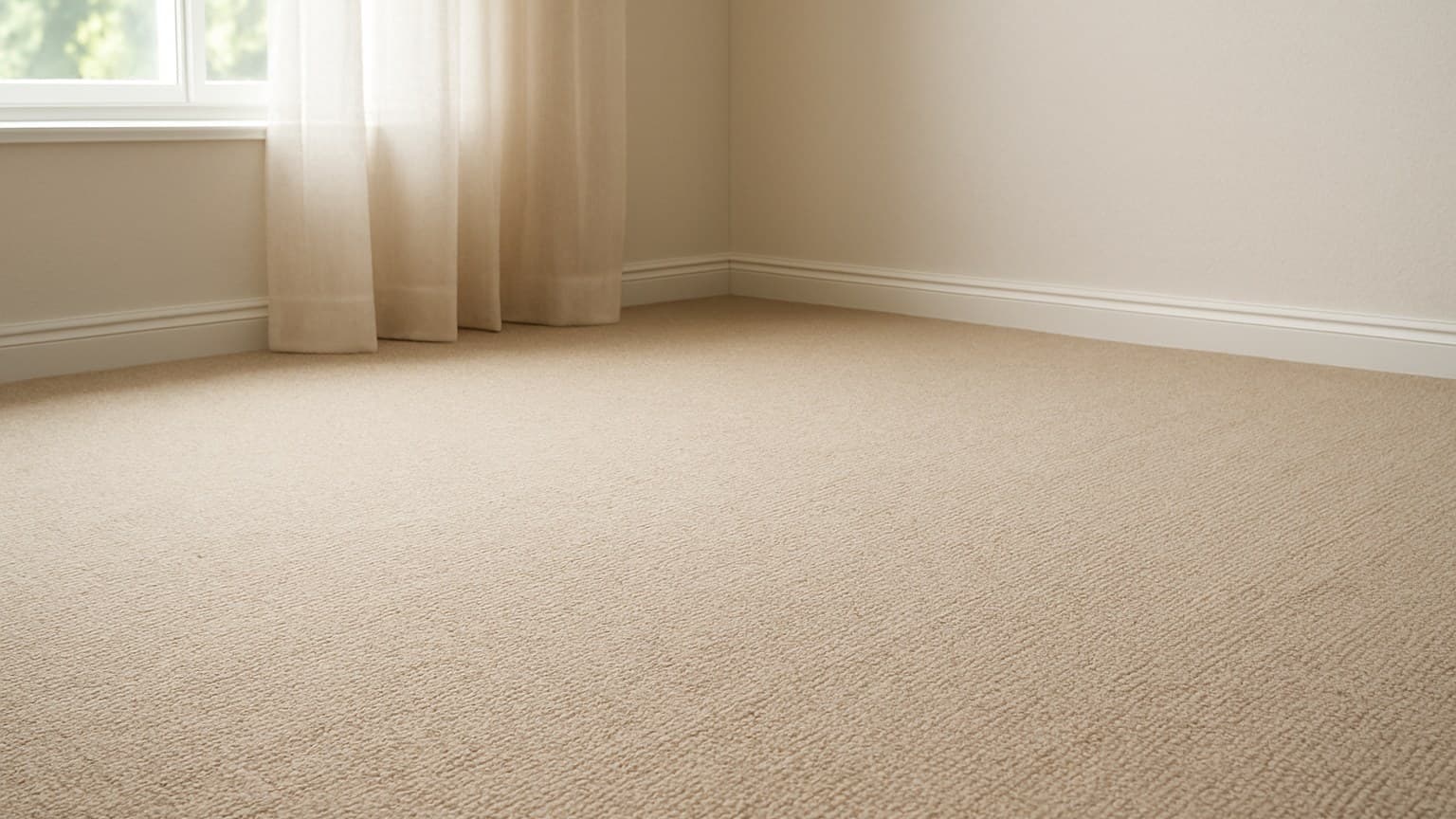
Here's the trap with low pile carpet: two samples can look equally short in the showroom and feel nothing alike a year later. The one that stays flat and tight isn't the shorter one, it's the denser one. Most store tags never put that number where you can see it.
Key takeaways
- Low pile means fibers under 1/4 inch tall; medium runs 1/4 to 1/2 inch and high pile is over 1/2 inch.
- Durability comes from density, not short height alone. Read face weight and density off the spec sheet, not just how short the carpet looks.
- Match construction to traffic: level loop and tight frieze for halls and stairs, softer plush only in low-traffic bedrooms.
- Mid-price nylon low pile runs about $3-$6 per sq ft in materials plus roughly $2-$4 per sq ft for labor and pad; basements and stairs cost more.
- Bend a showroom sample backward. If the backing grins through the fibers, the pile is too sparse to hold up.
Step 1: Nail Down What "Low Pile" Actually Means
Low pile carpet is carpet whose fibers stand under 1/4 inch tall. Medium runs 1/4 to 1/2 inch, and high pile (what people call plush or shag) is anything over 1/2 inch. "Short pile" and "flat pile" are just other names for low. "No pile" usually means a flat-woven rug with almost no standing yarn at all.
Pile height is simply how far the fibers rise off the backing, measured while the carpet is uncompressed. That last part matters, because a squished sample lies to you.
How to tell what you've got at home
Press a coin or your fingernail straight down into the carpet and eyeball how tall the fibers are. Or find a transition strip at a doorway and look at the cut edge. Under a quarter inch, and stiff underfoot, means you're standing on low pile.
The real trade-off
Low pile is easier to vacuum and deep-clean, and it hides foot traffic well. You can even run a rental machine over most of it without soaking a deep pile, which is why I point folks to a guide on renting a carpet cleaner for this kind of floor. The catch: it feels harder and less warm than a thick plush.
| Type | Fiber height | Feel | Best for |
|---|---|---|---|
| Low (short/flat) | Under 1/4 inch | Firm, low to the floor | Halls, stairs, offices, high-traffic rooms |
| Medium | 1/4 to 1/2 inch | Soft but still manageable | Living rooms, bedrooms |
| High (plush/shag) | Over 1/2 inch | Deep, cushy, warm | Low-traffic cozy rooms |
Fiber height bands and where each one earns its keep.
Step 2: Read Density and Face Weight, Not Just Pile Height
Here's what no retail page tells you: short does not mean durable. A low carpet with loosely packed yarn mats down fast. Density, meaning how tightly the yarn is stuffed into the backing, is what actually predicts wear.
Two numbers off the spec sheet tell the story. Face weight is how many ounces of fiber sit in a square yard, and more is usually better. Density is how tightly that fiber is packed in for its height. You want decent face weight AND tight density, not one without the other.
There's a real basis for this. According to the Carpet and Rug Institute (CRI), the carpet industry's trade association, dense, low-pile loop construction is specifically recommended for corridors, lobbies, offices, classrooms, and hotel rooms, and CRI's guidance ties durability to density and construction, not pile height alone. That's your tell: dense plus short is the combo that holds up under feet.
| Step | Value |
|---|---|
| Formula | Density = (face weight x 36) / pile height |
| Face weight | Ounces of yarn per square yard (off the spec sheet) |
| Pile height | Fiber height in inches |
| Result | Density in ounces per cubic yard; higher means packed tighter and wears longer |
| Worked example | 40 oz face weight, 0.2 in pile = (40 x 36) / 0.2 = 7,200 oz/yd3 |
Source: the Carpet and Rug Institute's average pile yarn density formula, which it draws from HUD/FHA publication UM-44d
How the density number is built from face weight and pile height.
I've pulled up plenty of carpets that still had decent pile height left. What gave out was the backing itself: yarn packed so loose and thin you could hold it to a window and see light through the rows. That loose backing is what flattens first in the main walking lane.
Step 3: Match the Construction to the Room's Traffic
How the yarn is finished decides where it belongs. Loop pile leaves the yarn as uncut loops, which is tough and hides dirt. Cut pile snips those loops into upright tufts, which feels softer but shows footprints. Cut-and-loop mixes both so the pattern hides soil.
Loop vs. cut pile for low pile floors
For halls, stairs, and busy family rooms, I steer people to level loop or a tight frieze. Frieze is a cut pile with the fibers twisted hard so they bounce back instead of lying down. Berber, which is a chunky loop, wears tough but snags on pet claws, so save it for lower-pet rooms. Plush and Saxony, both smooth straight-cut piles, only belong in low-traffic bedrooms where they won't show tracks. If you want the fuller room-by-room breakdown, including how cushions and installation choices factor in for each space, the room-by-room carpet selection guide walks through matching the right pile to every room in the house.
Best low pile by room
Put level loop in basements and hallways. Use a dense low frieze in a living room that takes real traffic. A soft but short cut pile is fine for a bedroom. Stairs are their own animal because the nose, the front edge of each step, is where the pile wears bald first. That nose-wear problem is worth reading up on in the guide to picking and installing carpet for stairs, and the loop specifics live in the Berber carpet guide.
One hard-won note from my own jobs: big Berber loops look great in the showroom and shred where a dog's nails catch the turn of a stair or a doorway. I've replaced more than one Columbus family room for exactly that reason.
| Construction | What it is | Wears | Best room |
|---|---|---|---|
| Level loop | Uncut loops, all one height | Very well, hides traffic | Halls, stairs, basements, offices |
| Frieze (twist) | Tightly twisted cut fibers | Well, hides footprints | Living rooms, busy areas |
| Berber | Large chunky loops | Tough but snags with pets | Low-pet family rooms |
| Cut-and-loop | Mix of cut tufts and loops | Well, pattern hides dirt | Living and dining rooms |
| Saxony/plush | Straight cut fibers | Shows tracks, flattens | Bedrooms, formal low-traffic rooms |
Common carpet constructions and the rooms they hold up in.
Step 4: Price It by Tier (Materials vs. Labor)
Low pile carpet splits into three price tiers, and both the material and the labor matter. Builder-grade polyester or olefin low pile is the cheap end at roughly $1-$3 per square foot in materials. Mid-price nylon, a common sweet spot for busy homes, runs about $3-$6 per square foot in materials. Premium nylon and solution-dyed carpet, where the color is locked into the fiber itself so it resists fading and even bleach, sits at roughly $5-$12. On top of any of these, figure roughly $2-$5 per square foot for labor and pad.
Basements and stairs cost more in labor than an open room. Stairs mean a cut and a wrap on every step. Basements need two checks before anything goes down: a moisture check on the slab, and a subfloor-flatness check to make sure there are no high or low spots that'll show through the pad, plus sometimes extra slab prep. For whole-room math, the carpet replacement cost breakdown and a full look at carpet installation cost will get you closer to a real number.
On DIY versus hiring: stretch-in carpet needs a knee kicker, a tool you bump with your knee to shove the carpet tight, plus a power stretcher, a longer tool you lever from wall to wall to pull the carpet drum-tight, and some seam work. Most people should hire that out. Stairs especially are worth paying for.
| Tier | Materials | Labor + pad |
|---|---|---|
| Builder-grade (polyester/olefin) | $1-$3 | $2-$4 |
| Mid-price nylon | $3-$6 | $2-$4 |
| Premium nylon / solution-dyed | $5-$12 | $2-$5 |
Source: the carpet jobs I bid around Dayton and Columbus
Low pile carpet price tiers, split into materials and labor plus pad.
| Tier | Total materials + labor, 300 sq ft room |
|---|---|
| Builder-grade (polyester/olefin) | $900-$2,100 |
| Mid-price nylon | $1,500-$3,000 |
| Premium nylon / solution-dyed | $2,100-$5,100 |
Estimated total cost for a typical 300-square-foot room, combining the materials and labor ranges from the tiers above. Basements and stairs run higher than this due to extra prep, cutting, and checks.
Step 5: Spot the Cheap Stuff Before You Buy It
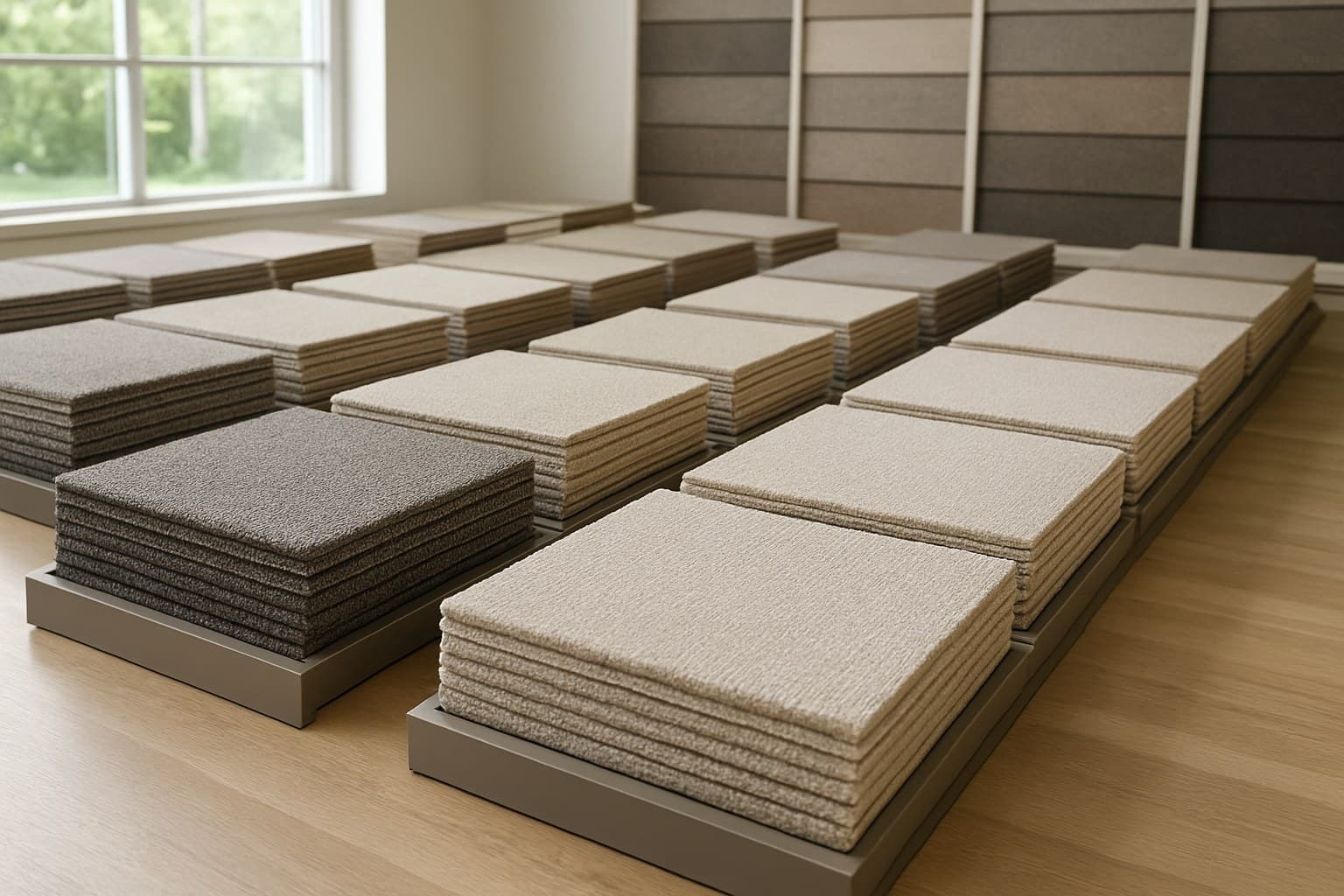
Bend a showroom sample backward over your fingers, pile facing out. If the backing grins through the fibers, meaning you can see rows of white backing opening up between the yarn, the pile is too sparse to hold up. A dense low pile stays closed when you bend it.
A few more checks before you commit:
- Heft it. A good low pile sample feels heavy for its size because the fiber is packed in. A light, floppy square is thin, no matter how short it looks.
- Rub your thumb hard across the face a dozen times. Fibers that fuzz, shed, or lie down and stay down are a bad sign.
- For cut pile, check the twist. Fibers twisted tight and heat-set hold their shape. Loose, untwisted ends flatten into that matted look fast.
- Ask for the spec sheet and read the face weight and density, not just the price. If the salesperson can't produce those numbers, treat that as the answer.
One habit that pays off years later: have your installer leave you a labeled box of offcuts and the product info. I've gotten calls about a gouged plank or a stained patch from a line nobody makes anymore, and the repair is easy when there's a scrap in the basement and impossible when there isn't. Prep and paperwork are cheap insurance on a floor you want to keep.
Sources
- Carpet and Rug Institute: Finding the Right Carpet for Commercial Spaces
- Carpet and Rug Institute: Carpet FAQ
- Carpet and Rug Institute: Selecting the Right Carpet for Your Home
- Carpet and Rug Institute: The Carpet Primer (PDF)
- Carpet and Rug Institute: Average Pile Yarn Density and the Importance of Correct Pile Measurement (PDF)