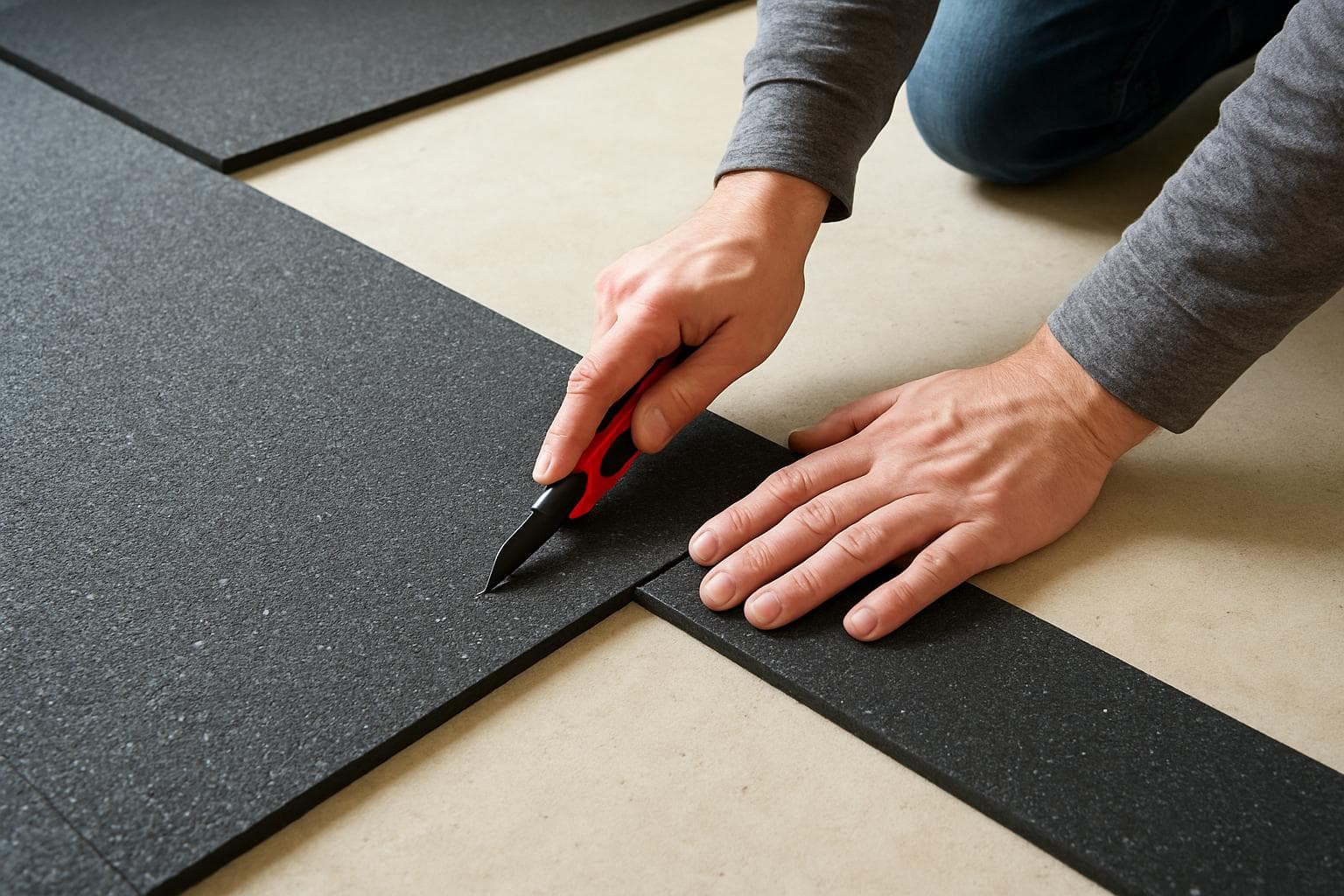
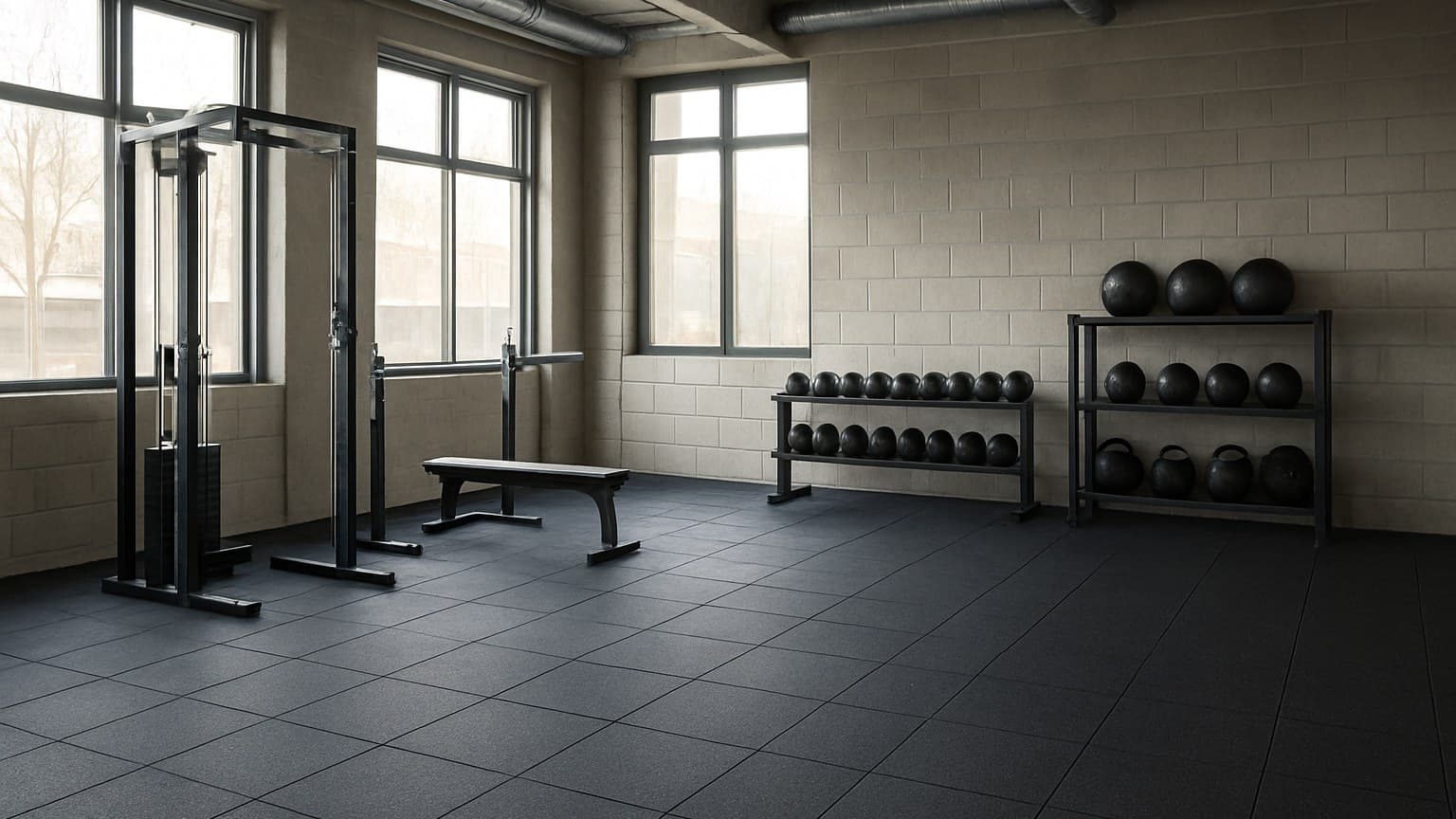
When Danny in Austin asked me to price his home-gym floor, one shop quoted him $12 a square foot and another quoted $3.50, and both bids were legit. Rubber flooring installation cost typically runs $3 to $12 per square foot installed, but where you land depends on the format and how big the room is. If you want the full math behind those numbers, I broke down complete cost totals for 100, 300, and 500 sq ft rooms in a separate line-item guide. Get the format or the subfloor prep wrong, and the number you found online won't match what's on your invoice.
Key takeaways
- Total installed cost drops as the job grows: figure roughly $6-12/sq ft for a 100 sq ft home gym, $4-8 for a 1,000 sq ft studio, and $3-6 for 5,000+ sq ft, because fixed costs spread over more floor.
- Materials usually cost more than labor on rubber: expect materials around $2-12/sq ft and labor around $1.50-6/sq ft, with poured-in-place at the top of both.
- Format follows scale: interlocking tiles for small DIY rooms, glue-down rolls for big seamless floors, poured-in-place for custom safety surfaces.
- Basement and stair jobs cost more than open rooms; budget separately for a moisture barrier, leveling, delivery, and hauling out the old floor.
- Online 'averages' clash ($3-15/sq ft vs $15-75+/sq ft) because they mix material-only prices, small jobs, and poured commercial safety floors into one number.
Rubber Flooring Installation Cost at a Glance
The short version: total cost per square foot drops as the job gets bigger. A small home gym runs roughly $6-12 per square foot installed, a mid-size studio $4-8, and a big rec or commercial floor $3-6. Same material, different per-foot price, because the fixed costs spread out — for a deeper breakdown, see this rubber tile price worksheet by use case.
| Project | Typical format | Material ($/sq ft) | Labor ($/sq ft) | Total installed ($/sq ft) |
|---|---|---|---|---|
| 100 sq ft home gym | Interlocking tiles (loose-lay) | $2-8 | $1.50-4 | $6-12 |
| 1,000 sq ft studio | Glue-down rolls | $2-6 | $1.50-4 | $4-8 |
| 5,000+ sq ft rec/commercial | Rolls or poured-in-place | $2-10 | $1-4 | $3-6 |
Source: the three rubber jobs I keep as my go-to bids: a spare-bedroom gym, a dance studio floor, and a warehouse rec room
Installed cost per square foot for three common rubber jobs, split into material, labor, and total.
Here's why the online numbers fight each other. The $3-15 per square foot camp is quoting small tile and roll jobs. The $15-75-plus camp is quoting poured-in-place commercial safety floors that buy a specific fall-height rating. Neither is wrong, they're pricing different products.
To place your own job, start with three things: how many square feet, which format, and whether the room needs a moisture barrier. Match those to a row above, and a quote that looked crazy usually starts to make sense.
Cost by Format: Tiles, Rolls, and Poured-in-Place
Format decides most of your material price, and each format exists for a reason. Interlocking tiles are made for small DIY rooms, glue-down rolls for big seamless floors, and poured-in-place for playgrounds and custom safety surfaces where a certified fall height matters. If you're still not sure which category fits your space, this rubber flooring type guide breaks down the differences before you start pricing.
Recycled crumb-rubber (ground-up tire rubber) is the cheapest fill. Virgin rubber and EPDM (a colorfast synthetic rubber that holds bright colors and smells less) cost more. That price gap is mostly about color and odor, not how long the floor lasts.
Don't shop by sticker price alone. Tiles cut labor on small rooms, rolls cut seams on big ones, and poured costs the most because you're paying a crew to mix binder and rubber granules on site. For picking a format by room, my rubber flooring by type guide and the home gym thickness guide go deeper than I can here on cost alone.
| Format | Material only ($/sq ft) |
|---|---|
| Rolls | $1.50-6 |
| Interlocking tiles | $2-8 |
| Glue-down tiles | $3-9 |
| Poured-in-place | $8-20 |
Relative material cost by format, lowest to highest, see the table above for the exact $/sq ft ranges.
Material vs Labor: Where Your Money Actually Goes
On rubber floors, materials usually cost more than labor. That's the opposite of carpet, where the labor to stretch and seam it can eat the bigger share. Expect materials around $2-12 per square foot and labor around $1.50-6.
The labor number swings on format. Loose-lay interlocking tiles are fast to snap down, so that labor line stays low. Glue-down and poured-in-place are where labor climbs, because someone is spreading adhesive or mixing material by hand.
Skill matters too. A poured floor needs a crew that mixes binder and granules on site and levels it before it sets, so that labor line isn't comparable to snapping tiles together. If one quote's labor is suspiciously low, read it twice. The prep probably got left off the sheet, not that you found a bargain.
| Cost line | Range ($/sq ft) |
|---|---|
| Labor | $1.50-6 |
| Materials | $2-12 |
Typical share of total cost that goes to materials versus labor on a rubber floor, based on the ranges in the table above.
What Really Drives the Price Up or Down
A few things move a quote more than the rubber itself: the shape of your subfloor, the thickness you need, and where in the house the floor goes.
Subfloor Flatness and Moisture
This is where the money hides, and it comes before any rubber goes down. An out-of-flat slab needs leveling compound, and a basement or ground-floor slab often needs a moisture and vapor barrier. Both add real dollars per square foot.
I learned to never skip the moisture test the hard way on a basement job for Renee in Tulsa. She talked me out of testing her slab to save an afternoon, and I let her. That floor cupped before the season was out, and I relaid it on my own dime rather than argue about whose call it was. Test first, every time.
Thickness, Density, and Design Complexity
Match thickness to the load, not to a rule of thumb. A thinner tile, around 6mm, is generally suited to light foot traffic, like a home gym with bodyweight work. For dropped weights, thicker rolls (around 8mm) or heavier tiles (3/4-inch, about 19mm) are typically better suited to take the hit, and thicker rubber costs more per square foot. Design extras like inlaid colors or logos in a poured floor also add to both material and labor. The home gym thickness guide breaks down what actually stops cracks and noise.
Basements, Stairs, and Outdoor Premiums
Location adds cost. Basements run higher than open rooms because of the moisture checks and barriers, and not every room in the house is even a good candidate for rubber in the first place — my breakdown of which rooms suit rubber tiles walks through where it fits and where it doesn't. Stairs cost more per step because every piece is hand-cut and glued, and there's no fast way to do that. Outdoor and patio rubber carries its own drainage and edging story, which I cover in the outdoor interlocking tiles guide.
Regional Labor Rates
Every range in this article is a national one, and labor is the piece that moves most by region. A crew in a high-cost metro can charge close to double what the same square footage runs in a smaller market, even with identical material and format, because local wages and demand set the labor line, not the rubber. Treat the numbers here as a starting point, not a quote, and get two or three bids from installers in your own area before you set a budget, that's the only way to know what the job actually costs where you live.
A Sample Itemized Quote (Small Gym vs Studio)
Here's the part most price pages skip: an example line-item breakdown for two jobs side by side. Look at how the small gym carries a higher per-foot total, even though it's far cheaper overall.
| Line item | 100 sq ft gym | 1,000 sq ft studio |
|---|---|---|
| Rubber material | $350 | $3,500 |
| Install labor | $250 | $2,000 |
| Subfloor prep / leveling | $75 | $600 |
| Moisture barrier / primer | $40 | $400 |
| Delivery | $90 | $200 |
| Old floor disposal | $60 | $350 |
| Tax (est.) | $40 | $250 |
| Total |
Full line-item breakdown for a small gym and a mid-size studio, including the costs people forget to budget.
Notice the fixed costs. Delivery is $90 on the gym and only $200 on a job ten times the size. A minimum labor call doesn't shrink to fit a small room, so it lands harder per foot.
The math is simple: divide total by square footage. The gym works out to about $9.05 per square foot, the studio about $7.30. If your own quote lands far outside that, ask which line item is driving it.
DIY vs Hiring It Out (and What to Ask First)
Loose-lay interlocking tiles are a realistic DIY, and doing it yourself saves the entire labor share. Snap them together over a flat, hard floor and you're done. Glue-down rolls, stairs, and poured-in-place are where hiring out is usually worth it, because a bad glue spread or a mixed-on-site pour is hard to undo.
One thing to plan for on any DIY rubber job: the smell. New rubber, especially recycled crumb, off-gasses at first. I tell people up front to ventilate the room for a while. It's normal and it fades, but a surprise odor turns into a complaint fast, so open windows and give it air.
Before you sign anything, ask a few questions. Does the quote include subfloor leveling and a moisture barrier, or are those extra? Is old-floor disposal in the price? What thickness and format are they quoting, and why that one for your room? If you're weighing tile against roll for your own space, my rubber plank flooring guide walks through the tradeoffs.