Ask how much rubber surfacing costs per square foot and the answers swing from about $8 to $38, like nobody agrees. The catch is that one name covers four different products, and quoting the wrong one for your site gets expensive fast.
Key takeaways
- Rubber surfacing is really four products at four prices: poured-in-place wet pour, bonded rubber mulch, interlocking tiles or pavers, and loose-fill rubber mulch.
- The broadly shared typical installed range is about $10 to $18 per square foot (Robertson Surfaces, Adventure Turf, rubberresurfacing.com); WillyGoat's branded 3-layer system at $28 to $38 is the high outlier, not the norm.
- Price your own job with area x installed method rate, plus about $3 to $6 per square foot for a new base (Robertson Surfaces) when there is no sound slab.
- EPDM rubber costs roughly 4x SBR (Robertson Surfaces), and custom colors or patterns push you to the top of every range.
- For a public playground, wet pour is usually the pick because it can meet fall-height and accessibility rules; for a DIY patio, interlocking tiles cost far less.
Why Rubber Surfacing Runs From $8 to $38 a Square Foot
The price swing isn't confusion. Four different products all get sold under the same rubber surfacing label, and the cost follows the product, not the name.
Rubber surfacing can mean poured-in-place (also called wet pour or PIP), bonded rubber mulch, interlocking rubber tiles or pavers, or loose-fill rubber mulch. Each is built differently, so each is priced differently. The $8 to $38 gap is a product gap, not a quote that got out of hand.
For a typical installed wet pour job, most sources land around $10 to $18 per square foot. Material (the rubber crumb and binder) makes up a smaller share of that number, with labor for mixing, troweling, and finishing on site accounting for the larger share. rubberresurfacing.com lists $8 to $15 for residential work, and Robertson Surfaces and Adventure Turf cluster near $10 to $15. WillyGoat's branded 3-layer system at $28 to $38 is the outlier, not the going rate.
These are installed numbers, meaning material and labor combined into one job price. Wet pour is mixed and troweled on site, so crews quote it as a single number rather than itemizing material and labor separately. That single-number approach is also how most installers price rubber flooring generally, and installation costs by project size breaks down what that looks like at different scales.
| Method | Price band | What the number buys | Best use | DIY or hire |
|---|---|---|---|---|
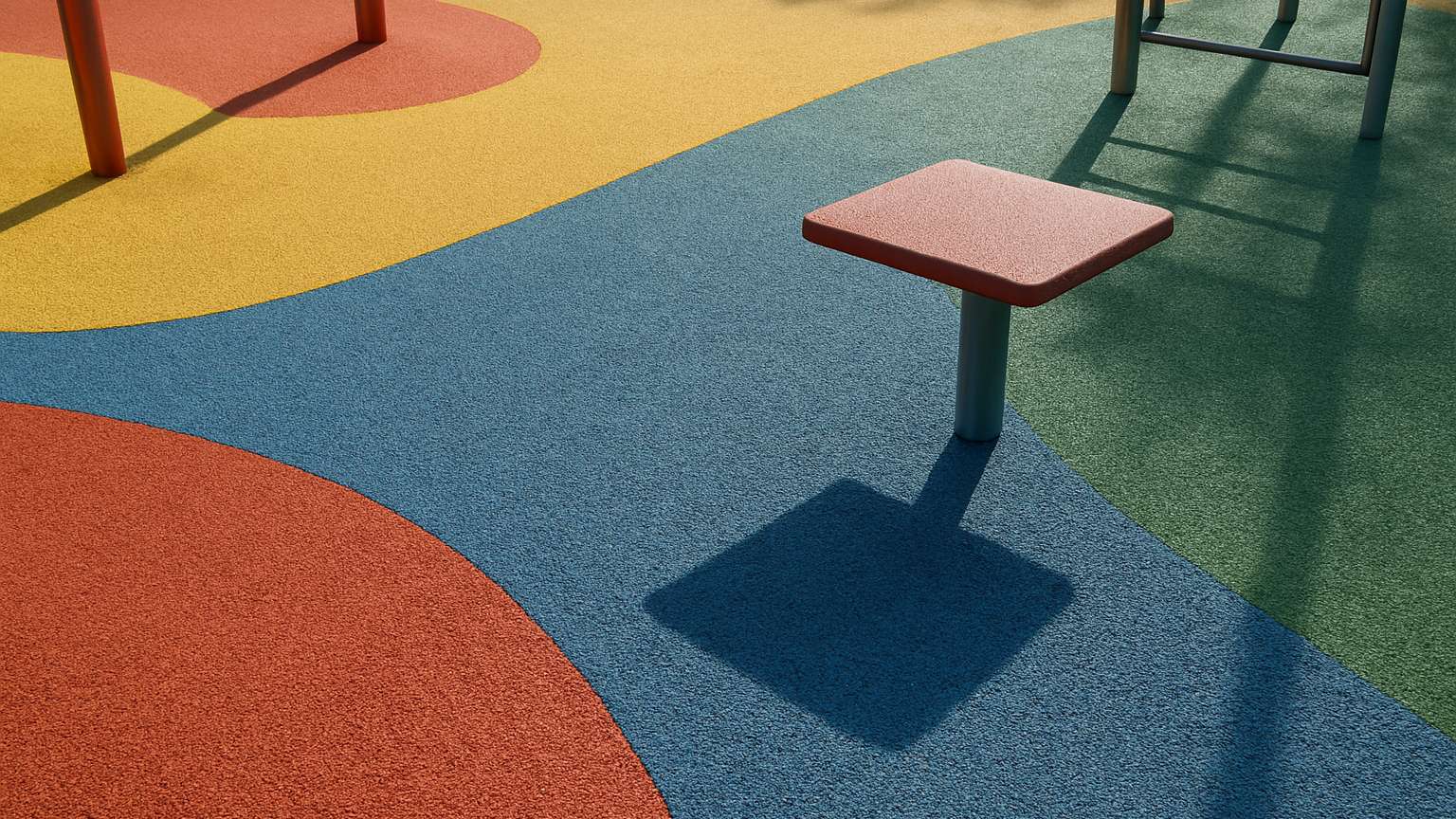
| Poured-in-place / wet pour (PIP) | About $10-$18/sq ft installed, material and labor combined (rubberresurfacing.com $8-$15 residential; Robertson Surfaces and Adventure Turf near $10-$15) | Seamless EPDM (colored rubber) wear layer over an SBR (black recycled rubber) cushion base, custom colors | Playgrounds, pool decks, splash pads | Hire |
| Bonded rubber mulch | Quoted like the lower end of wet pour, material and labor together; get a local bid (no reliable published rate) | Looser, mulch-look surface held together with binder | Garden paths, tree rings, backyard play areas | Hire or advanced DIY |
| Interlocking rubber tiles / pavers | About $2-$10+/sq ft, material roughly $2-$7, labor $0-$3+ if you hire the glue-down | Pre-made tiles you lay dry or glue down | Patios, gyms, decks | DIY (loose-lay) or hire (glue-down) |
| Loose-fill rubber mulch | Cheapest per sq ft, sold by the bag, almost all material cost, since labor is just your own time | Loose shredded rubber, no binder, needs a border | Budget play areas, borders | DIY |
The four products commonly sold as rubber surfacing, with price bands, use, and install reality.
If the tile route is what you're after, we break those numbers down in our guide to what rubber tiles cost. Once you've settled on pricing, where to buy outdoor rubber tiles is worth checking before you place an order.
Those wet pour bands shift with job size and region. Lined up, they look like this:
| Scenario | Installed price band |
|---|---|
| Large-volume job (rubberresurfacing.com) | $7-$12 |
| Midwest wet pour (rubberresurfacing.com) | $8-$12 |
| Residential wet pour (rubberresurfacing.com) | $8-$15 |
| Typical installed (Robertson, Adventure Turf) | $10-$15 |
| Playground, 1,000+ sq ft (Adventure Turf) | $9-$18 |
| Urban / California (rubberresurfacing.com) | $12-$18 |
| Branded 3-layer system (WillyGoat) | $28-$38 |
Installed wet pour price bands by job size and region, plotted to scale against the $0-$40 axis; each bar spans the low to high of that quote.
Work Out Your Own Cost Per Square Foot
Pricing your own job is simple arithmetic once you know which product you're buying. Total cost equals your area in square feet times the installed method rate, plus a site-prep rate per square foot when there's no sound base to work over.
Measure length times width, then add 5 to 10% for waste and odd corners. Pick your method rate. Add site prep only if you need a new base.
The EPA's Decking Alternatives Cost Calculator uses a comparable framework for recycled-material projects, breaking costs into materials, installation, and disposal line items rather than one lump sum, a useful model to borrow when you're sanity-checking a rubber surfacing quote piece by piece.
| Input | How to figure it |
|---|---|
| Formula | Total = area (sq ft) x installed method rate, + site prep per sq ft when there is no sound base |
| Area | Measure length x width, then add 5-10% for waste and odd corners |
| Method rate | Wet pour about $10-$15/sq ft installed, material and labor combined (Robertson Surfaces, Adventure Turf); playground PIP $9-$18 (Adventure Turf); tiles about $2-$10+, mostly material unless you hire the glue-down |
| Site prep | Add about $3-$6/sq ft for a new aggregate base and grading (Robertson Surfaces); skip it if a sound slab already exists |
| Color / design | Single color sits low; custom logos or patterns push toward $20-$30+/sq ft (WillyGoat) |
| Example 1 | 300 sq ft patio over sound concrete, wet pour, single color |
| Example 2 | 500 sq ft play area needing a new base |
The inputs and two worked examples for pricing a rubber surfacing job.
Here's Example 1 run end to end. A 300 square foot patio sits over sound concrete, so no new base is needed. At $12 per square foot installed for a single-color wet pour, that's 300 x $12 = $3,600 total, with no added prep.
Example 2 needs a base. A 500 square foot play area at $13 per square foot installed is 500 x $13 = $6,500 for the surface. The new aggregate base at $4 per square foot adds 500 x $4 = $2,000. Total is $6,500 + $2,000 = $8,500.
Two warnings before you commit. Small jobs, stairs, and tight corners cost more per foot than a big open rectangle, because setup and cutting eat the same hours over fewer feet. And before any pour or glue-down, the base gets checked for both flatness and moisture. For wet pour over an existing slab, the concrete needs to be sound, level, and dry, since dips and trapped moisture telegraph straight through the finished surface.
The prep underneath is what the installer's warranty actually depends on, not the rubber on top. Pay for the base.
On the DIY question, loose-fill mulch and loose-lay interlocking tiles are realistic weekend jobs. Wet pour, bonded mulch, and any glue-down install are worth hiring out, because mixing ratios, fall-height depth, and a seamless finish are easy to get wrong.
What Pushes the Price Up or Down
Two things move the price more than anything else: how thick the surface has to be, and what rubber goes into it.
Depth is the big lever. A higher fall-height, the distance a child could fall and still be protected, needs a thicker SBR (styrene-butadiene rubber) cushion base. More rubber means more cost. That's why a playground pour runs more than a flat patio of the same size.
Rubber choice comes next. An EPDM (ethylene propylene diene monomer) wear layer, the colored top you walk on, costs roughly four times as much as SBR, the black recycled crumb underneath (Robertson Surfaces). Custom colors add on top of that. Much of that SBR base starts out as recycled tires; the EPA's GreenScapes program has documented unit costs for using recycled rubber in landscaping and surfacing applications as part of its broader push to divert scrap tires from landfills.
Binder matters too. Aromatic binder is cheaper but ambers, meaning it yellows, under sun over time. Aliphatic binder holds its color under UV but costs more. For a bright custom color in full sun, the aliphatic binder is worth paying for.
Site prep and region round it out. A new aggregate base and grading add cost, and jobs in urban areas or California tend to run higher than the Midwest (rubberresurfacing.com).
Which Method for Which Project
Match the product to the job and the price sorts itself out.
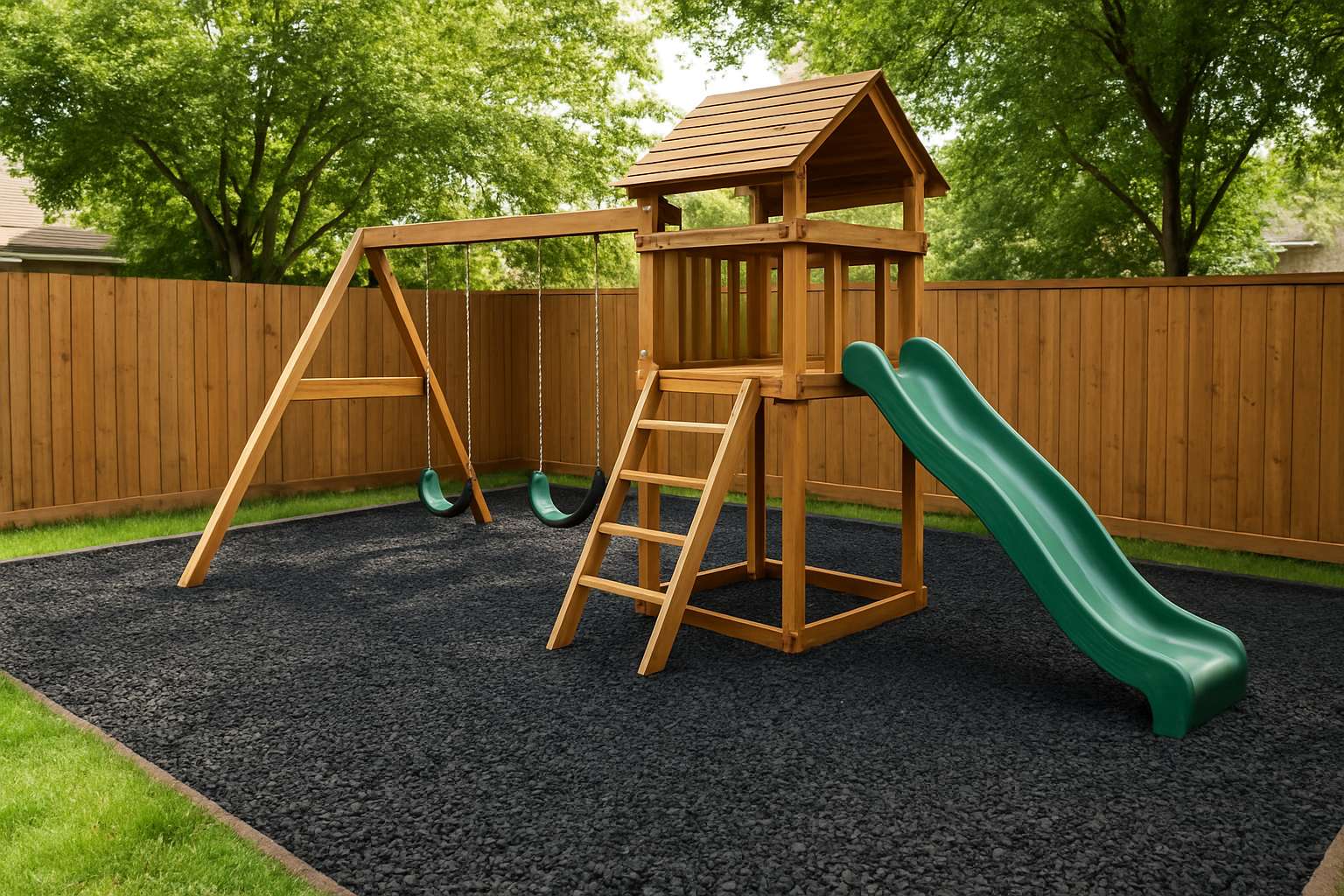
Backyard play area: wet pour gives a seamless, cushioned surface if the budget allows it. If it doesn't, loose-fill rubber mulch or interlocking tiles over proper depth do the job for far less.
Patio or pool deck: wet pour for a seamless look, or interlocking tiles when you want a DIY-friendly path and easy repairs. With tiles you lift and swap a worn piece instead of patching a pour. Let interlocking tiles sit flat at room temperature before you trim them, or curled edges from the roll never fully settle.
Commercial or public playground: poured-in-place is the usual call, because it can be built to meet ASTM F1292 (the standard drop test for fall-height safety) and ADA (the Americans with Disabilities Act, which sets rules for accessible routes). Loose tiles and mulch struggle with both at the seams and edges.
Driveway: plain poured concrete is usually cheaper and better suited to car weight. Rubber is for cushion and grip, not for carrying vehicles on a budget.
The short version: public and hard-used play areas, go wet pour; DIY patios and gyms, go interlocking tiles; budget borders and casual play, loose-fill mulch. If you're weighing tiles and want to know how often you'd actually replace one, read how long rubber tiles last before you buy. If you're setting up a home gym specifically, our breakdown of which rubber flooring type fits your space walks through the tradeoffs before you commit to tiles.