
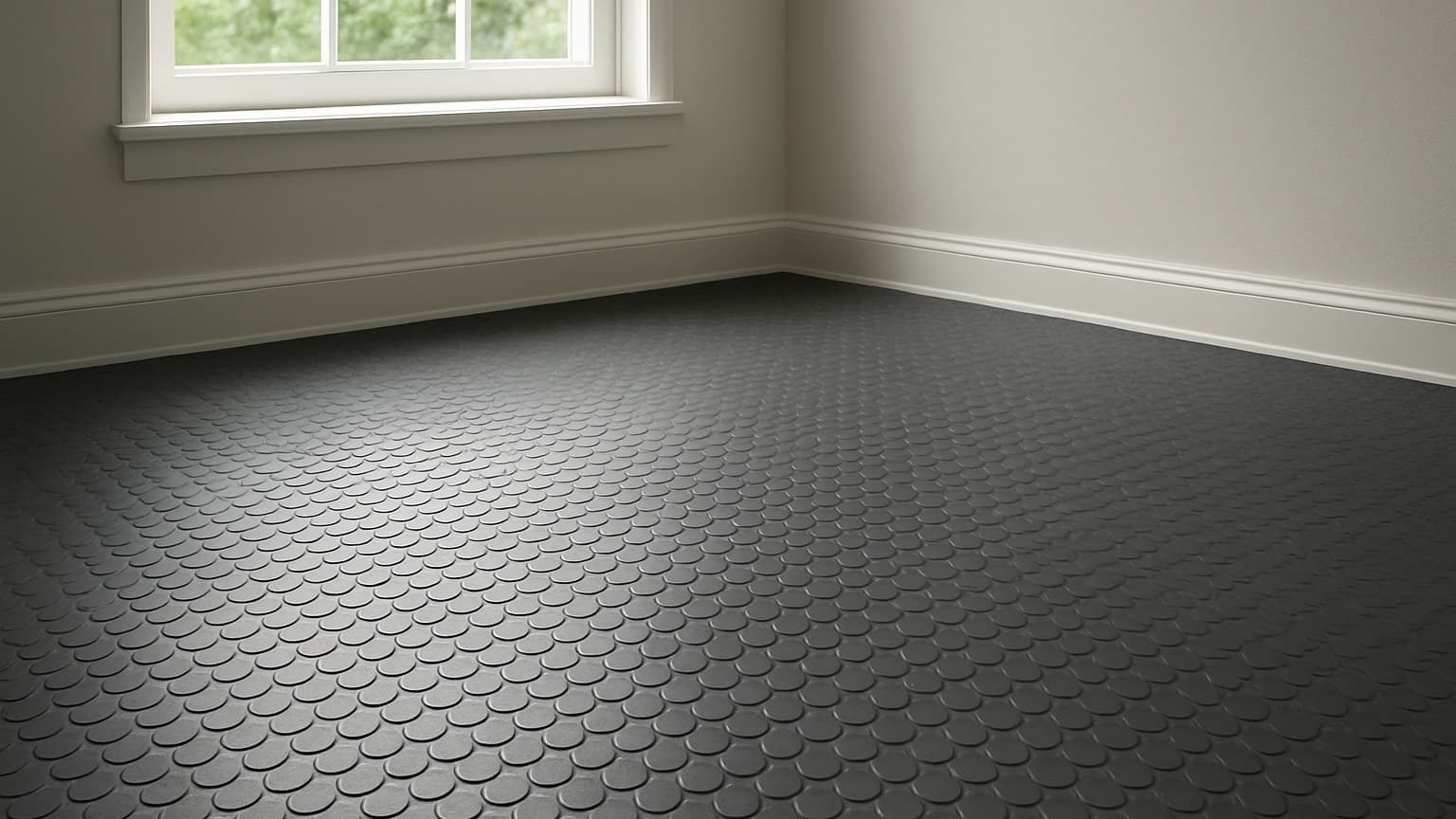
A rubber coin flooring product page throws numbers at you like 70 Durometer and 840 PSI and expects you to already know them. Most shoppers don't, so they buy on looks and only learn the hard way whether the floor survives a dropped weight. This guide turns each spec into a plain yes or no before you spend a dollar.
Key takeaways
- The coin pattern is raised round studs that break surface contact, so a wet boot or a car tire grips instead of sliding.
- 70 Durometer means firm-but-giving rubber; 840 PSI tensile and 280 PSI tear mean it resists stretching and gouging; 2mm is thin, good for rolling and foot loads but not for cushioning a dropped dumbbell.
- Much of what's sold as 'rubber' coin flooring is actually PVC (vinyl); true-rubber coin sheet is usually SBR, a different product with different smell, cost, and outdoor toughness.
- A 50 ft coin roll (48in wide, about 200 sq ft) runs roughly $512 to $585, which is about $2.56 to $2.93 per sq ft for materials before any labor.
- Double-sided tape is the renter-friendly DIY route; BASF Chemrex CX-941 adhesive is the permanent, high-traffic route, and both demand a flat, moisture-checked slab first.
What Rubber Coin Flooring Is, and What the Coins Actually Do
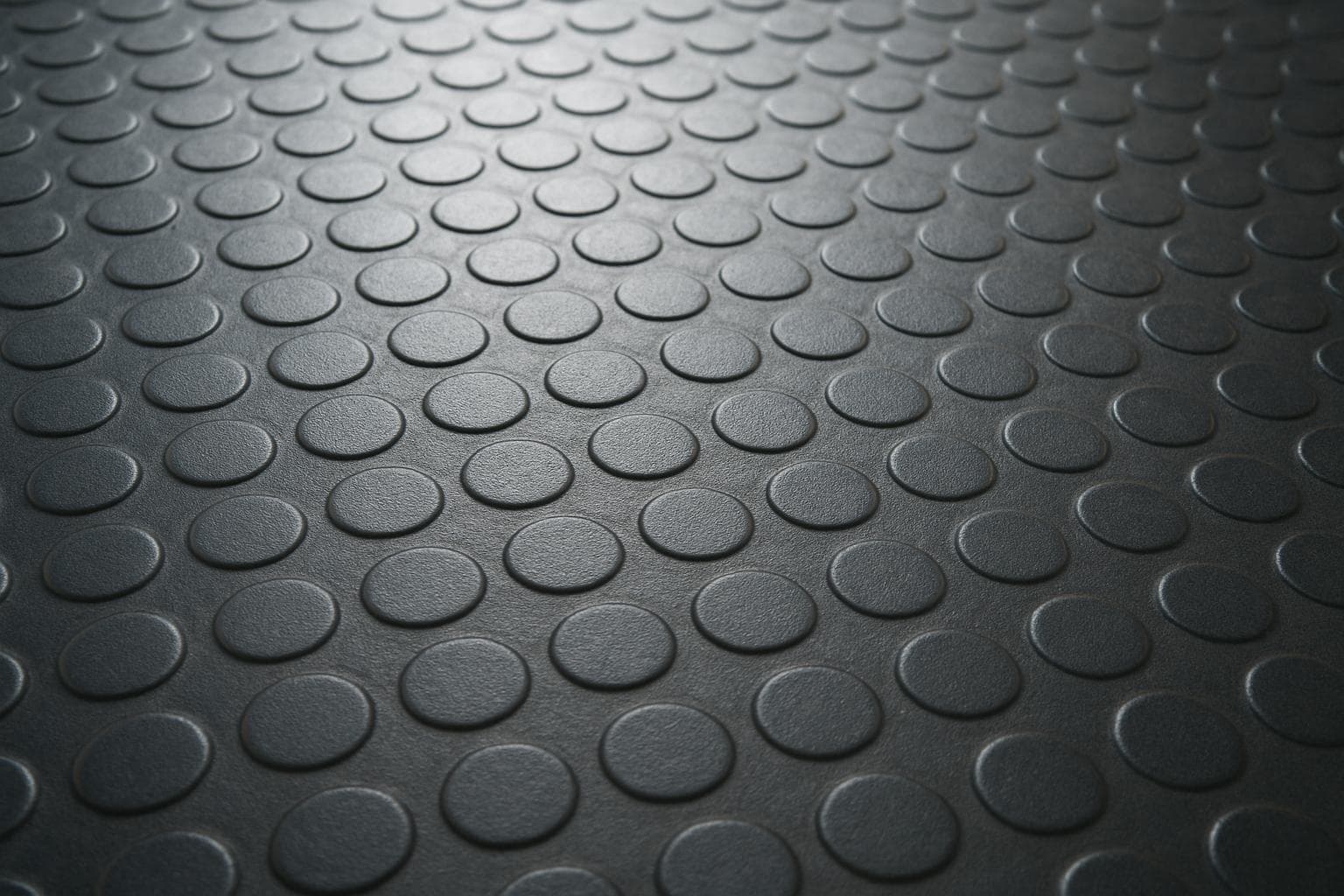
Rubber coin flooring is a thin rubber or PVC (vinyl) sheet stamped with raised round studs, the "coins," and it comes in rolls, not planks. You roll it out and cut it to fit, like a heavy mat for a whole room. If modular squares rather than a single roll make more sense for your space, this guide to rubber tiles for home lays out that alternative.
Those raised studs aren't a styling choice. They break the contact between your foot and whatever is on the floor, so water and dust can't form a slick film under your heel. A snowy boot or a car tire grips the tops of the studs instead of gliding across one flat sheet. That same raised-texture grip is exactly what heavy-duty mats rely on to keep footing safe on playground surfacing built for traction.
Raised coins also hide scuffs, dropped-tool marks, and tracked-in dirt better than a smooth floor, because your eye reads the texture before it reads the grime. Outdoor tiles lean on that same visual trick to mask the dirt and leaves that collect on a patio, which is covered in this look at rubber interlocking tiles made for outdoor use.
A typical roll is 48 inches wide and runs up to 50 feet long. You can buy a full roll or have it cut to a custom length off the roll, which matters if you're covering a short trailer floor or a single bay.
Reading Between the Lines of the Spec Sheet
These numbers aren't as confusing as they look once you strip out the jargon. Durometer is a hardness scale; tensile and tear strength measure how hard the rubber fights being stretched or gouged; thickness tells you whether it cushions anything.
Durometer 70 on the Shore A scale (the scale used for soft, flexible materials) is firm rubber that still gives a little underfoot. It dents less than a pencil eraser but it isn't rock hard, so a table leg or a jack stand won't leave a permanent pit.
840 PSI tensile strength and 280 PSI tear strength describe toughness. PSI means pounds per square inch, so 840 PSI tensile means it resists stretching and pulling apart, and 280 PSI tear means it resists gouging at cuts, edges, and seams. In plain terms, you can drag a loaded toolbox or roll a floor jack across it without ripping it. If you need that same level of toughness in mat form rather than a rolled sheet, this rundown of where to buy heavy duty rubber mats covers your options.
Then there's 2mm (0.08 inch), 0.7 pounds per square foot, and about 140 pounds for a 50-foot roll. That tells you two things: it's thin, and it's heavy. Thin is fine for tires and foot traffic, but 2mm won't absorb a dropped dumbbell. Heavy means a full roll is a two-person lift.
So tie every number to your real question. Will this hold up under a snowy boot? Yes. Under a dropped weight? No, and for that you want a thicker product. If a home gym is the plan, read my take on what thickness actually stops cracks and noise before you settle on 2mm coin.
| Spec | Value | What it means in plain words |
|---|---|---|
| Durometer hardness | 70 Shore A | Firm but not hard; gives slightly underfoot, resists denting from table legs and foot traffic |
| Tensile strength | 840 PSI | Resists stretching and pulling apart when you drag heavy gear across it |
| Tear strength | 280 PSI | Resists gouging and tearing at cuts, edges, and seams |
| Thickness | 2mm / 0.08in | Thin; fine for tires and foot traffic, not enough to absorb a dropped weight |
| Weight | 0.7 lbs/sq ft, 140 lbs per 50 ft roll | Dense and heavy, which helps it lie flat but makes a full roll a two-person lift |
Source: the spec sheet for a 2mm coin-grip rubber roll
If another coin roll's numbers drift far from this set, treat it as a different grade, not a straight swap, durometer and PSI vary by manufacturer even within coin-pattern rubber.
That inconsistency is part of why ASTM International is actively developing WK92410, officially described as a "new specification for thermoplastic rubber sheet floor covering without backing", an attempt to standardize exactly the hardness and strength numbers this guide just walked through, since no finalized industry-wide spec covers this category yet.
PVC vs SBR: Why "Rubber" Coin Flooring Is Often Vinyl
A lot of coin "rubber" rolls are actually PVC, which is vinyl, and that's why you'll see the same product sold as rubber vinyl flooring. True-rubber coin sheet is usually SBR, short for styrene-butadiene rubber, the recycled black rubber you see in gym mats.
The material changes how the floor behaves, not just the price. PVC holds brighter colors, wipes clean, and shrugs off many shop chemicals like oil and solvents, but it can give off a plasticky smell when it's fresh out of the roll.
SBR is cheaper and tougher outdoors, so it's a good pick for a patio edge or a spot that sees sun and rain. The trade is a stronger odor when new and a short list of colors, mostly black with fleck options.
That smell is worth planning for. New rubber, especially recycled SBR, airs out over time, but how long depends on the product and the airflow in the room, so crack a window and give it days, not minutes.
Because these are two different materials, the same spec number can behave differently in each. A 70 Durometer PVC and a 70 Durometer SBR feel similar underfoot but wear, clean, and smell differently, so read durometer and tensile in the context of which material you're actually buying.
Coin vs Diamond Plate vs Hexagon: Which Texture Grips
Coin does well on all-around grip and on hiding dirt. Its rounded studs shed water and don't trap grime in sharp corners, which is why it's a common default for a garage or basement.
Diamond plate gives that classic shop-floor look, but its raised ridges run in lines and can trap grease. It's harder to mop clean because dirt settles into the channels.
Hexagon reads more modern and sits flatter. It looks sharp in a display space, but a flatter profile means a touch less bite underfoot than coins give you.
The real differences show up in cleaning and cost more than in looks, so match the texture to how the room actually gets dirty. A messy work bay wants coin; a showroom floor can lean hexagon. If coin isn't actually the right fit, this breakdown of which rubber flooring type fits your space walks through the other options worth weighing.
| Pattern | Grip | Cleaning | Look | Best for |
|---|---|---|---|---|
| Coin | High; studs break wet contact | Easy; hides dirt and scuffs | Industrial, versatile | Garage, gym, basement, trailer |
| Diamond plate | Medium-high; directional ridges | Harder; ridges trap grease | Classic shop floor | Garages, workshops |
| Hexagon | Medium; flatter profile | Easy; fairly smooth | Modern, clean | Showrooms, display garages |
How the three common textures compare on grip, cleaning, look, and best use.
Installing It: Tape, Adhesive, and the Prep Nobody Skips
Prep comes before anything unrolls. The slab has to be flat and dry. Lay a straightedge across the floor to find high and low spots, because coin sheet is thin and telegraphs every bump, and run a moisture test on concrete before you commit the floor down.
Skipping the moisture test costs you later. I once laid rubber over a slab in a Dayton basement that read fine on a dry day but wept a little in humid weather. The trapped moisture under the mats turned musty, and the customer blamed the rubber. The slab was the problem, not the floor on top of it.
For the bond itself, there are two honest routes. Double-sided carpet tape is the temporary, renter-friendly way to hold a single room, and it's easy to pull up later. For a permanent, high-traffic floor, a two-part adhesive like BASF Chemrex CX-941 keeps the edges and seams from lifting under tires and foot traffic.
On DIY versus hiring out, be realistic. One garage roll laid with tape is a genuine weekend DIY job if the slab is flat. Large glue-down spans, stairs, and open-plan rooms with a moisture transition between concrete and wood are where the cutting and bonding get fussy, and that's usually worth hiring out. If you want format options beyond a roll, my guide to rubber plank flooring covers how planks change the install.
What Rubber Coin Flooring Costs (Materials vs Labor)
Expect roughly $2.56 to $2.93 per square foot for the material alone, before any labor. Roll pricing drops with volume: about $585 for 1 to 4 rolls, down to $511.88 each at 50 or more rolls, with each roll covering about 200 square feet (48 inches by 50 feet).
Custom cut lengths run about $14 to $16 per linear foot, since you're paying by the foot off the roll instead of for a full roll.
Labor only enters the picture if you glue it down. A tape install adds about $0.30 per square foot in material and costs nothing in labor if you do it yourself. An adhesive glue-down with tricky cuts adds roughly $1 to $3 per square foot in labor, so a glued garage lands around $3.56 to $5.93 per square foot all in, while a taped DIY floor stays close to the material price.
Basements and stairs cost more than an open garage. More edges, a moisture step between surfaces, and extra cutting all add time, and time is where the labor number climbs.
| Item | Material per sq ft | Labor per sq ft | Notes |
|---|---|---|---|
| Roll material (1-4 rolls) | $2.93 | n/a | $585 per 200 sq ft roll |
| Roll material (50+ rolls) | $2.56 | n/a | $511.88 per 200 sq ft roll |
| Tape install (temporary) | add ~$0.30 | $0 (DIY) | Renter-friendly, single room |
| Glue-down install | included above | $1 to $3 | Permanent, high traffic; hire for big spans |
| Custom cut length | $14 to $16 per linear foot | varies | Priced by the foot, not per sq ft |
Coin flooring material and labor costs by roll volume and install method.
For a fuller labor breakdown by project size, see real rubber flooring installation costs by project, which is the next read if you're pricing out a glue-down job.