
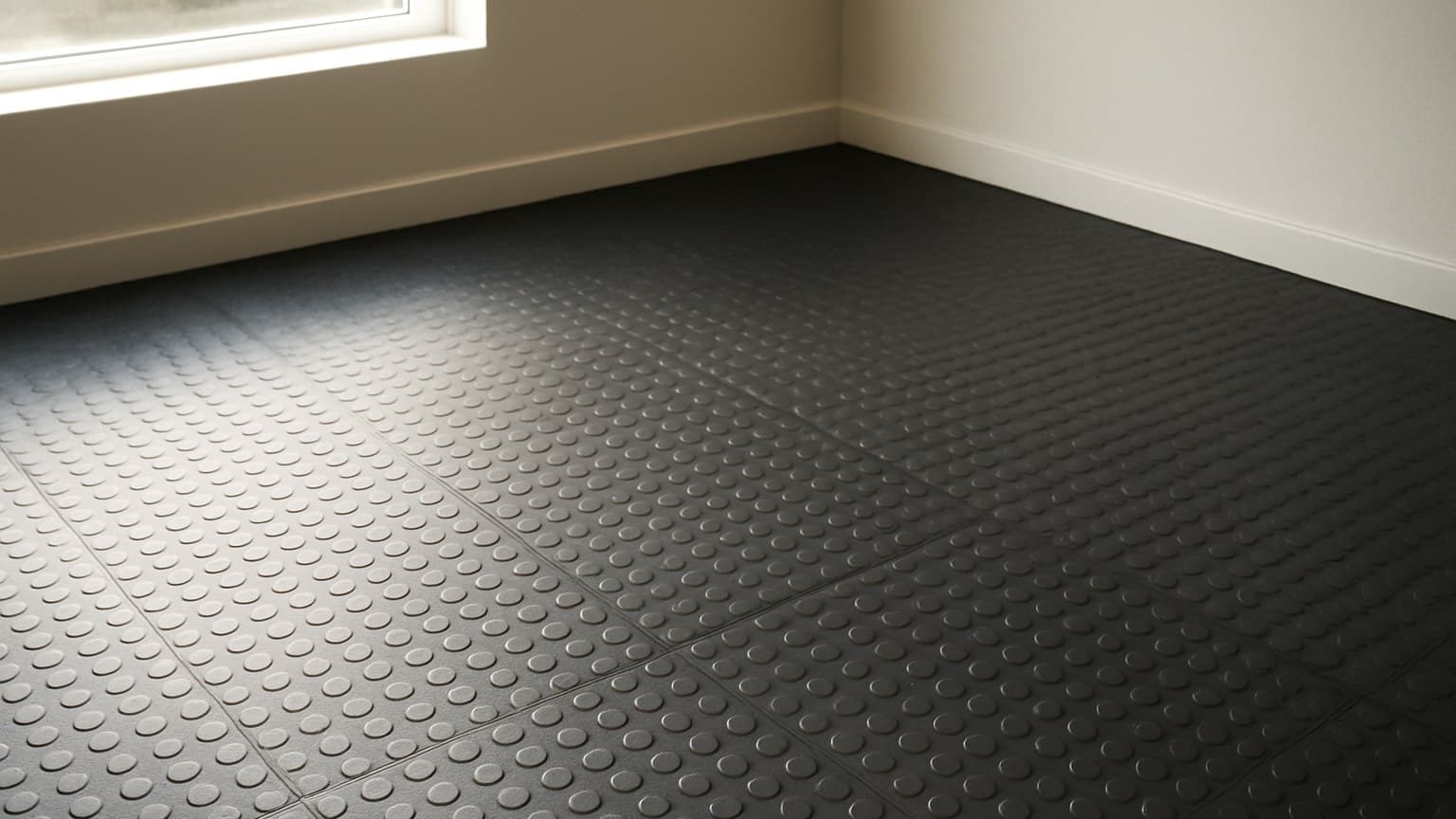
When Priya in Austin asked me to price rubber tile for her new home gym, the same tile she'd seen quoted under $2 a square foot for a garage came back past $10 a square foot for playground-grade material. That gap isn't a mistake, it comes down to thickness, material, and what goes underneath the tile, the same basics laid out in this general rundown on rubber tiles for home use. The real job here is matching the price to your actual room, not chasing a single figure.
Key takeaways
- Recycled crumb rubber interlocking tile (the black stuff made from ground tires) runs about $1.75-$4/sq ft in materials; colored virgin EPDM and thick playground tile push $8-$12+.
- Loose-lay interlocking is a realistic DIY, so labor can be $0; hiring a pro adds about $1-$2/sq ft for loose-lay and $2-$4/sq ft for glue-down.
- Rubber is heavy, so freight or delivery is a real line item most price pages skip; budget for it before you order.
- A 200 sq ft home-gym floor in mid-grade tile is roughly $630 in materials plus shipping if you DIY, or about $950-$1,050 installed.
- Playground and outdoor patio jobs cost more than an open garage because of thickness, EPDM color caps, and drainage base under them.
Why Rubber Tile Runs From Under $2 to Over $10 a Square Foot
Four things move the price, and once you know them the wide range stops looking random.
Thickness. Thin garage tile at 8-10 mm is cheap. Thick gym tile at 3/8" to 1/2" costs more, and a playground tile built to soften a fall can run 2" or thicker, which is why it sits at the top of every price list. If playground surfacing is the project, this guide to outdoor playground rubber tile options walks through the thickness and fall-height specifics in more depth.
Material. According to the EPA's GreenScapes program, scrap tires are commonly reprocessed into recycled crumb rubber for use in flooring and surfacing products. Most cheap tile is this recycled crumb rubber, which is old tires ground up into small bits and pressed back together. In the trade that base rubber is called SBR, short for styrene-butadiene rubber, and it's almost always black. The pricey stuff is virgin EPDM, short for ethylene propylene diene monomer, a synthetic rubber made in solid colors from scratch, and it costs several times more per square foot.
Format. Interlocking tiles that lock together like puzzle pieces and lay loose are the low-labor option. Glue-down tile costs more to install and usually more to buy.
Grade. Indoor tile is cheaper than outdoor and playground tile, which carry a fall rating (how far a kid can drop onto them safely) and hold up to sun and rain.
Everything in this section is materials only. Shipping, glue, and labor get added in the worksheet below, so don't budget off the tile price alone.
What Rubber Tiles Cost by Use Case (Materials vs. Labor)
Here's the short answer by room, split into what the tile costs and what it costs to put down. Loose-lay interlocking can be a $0 labor line if you do it yourself; a pro loose-lay adds about $1-$2 per square foot, and glue-down runs $2-$4.
| Use case | Typical thickness | Material $/sq ft | Labor $/sq ft | Installed total |
|---|---|---|---|---|
| Garage | 8-10 mm | $1.75-$4.00 | $0 DIY / $1-$2 pro loose-lay | $2-$5 |
| Home gym | 3/8"-1/2" | $2.50-$6.00 | $0 DIY / $1-$2 pro loose-lay | $3-$7 |
| Outdoor patio | 3/4"-1" EPDM top | $4-$8 | $2-$4 glue-down/base | $5-$10 |
| Playground | 2"-2.5" fall-rated | $6-$10 | $2-$4 base + set | $6-$12+ |
Source: garage rubber-tile quotes I've written for homeowners
The chart below shows how steeply the price climbs from garage to playground, without repeating every figure from the table above.
Playground and patio cost more than a garage for a few reasons: the tile is thicker, it carries a colored EPDM top instead of plain black crumb, and it needs a prepped drainage base under it so water runs off instead of pooling. A garage tile skips all three. If you're setting up outside, read up on the base and edging first in this guide to rubber interlocking tiles outdoors before you order, because that's where the real cost hides.
Work Your Own Number: Tiles + Shipping + Adhesive + Labor
Run your own room with one formula:
(room area x waste factor) x tile price + adhesive + freight + labor
- Room area is your square footage.
- Waste factor is 1.05 to 1.10, meaning 5-10% extra for cuts around walls and equipment. Odd-shaped rooms with lots of corners run higher.
- Tile price is your $/sq ft from the table above.
- Adhesive is near zero for loose-lay interlocking, more for glue-down.
- Freight is its own line. Rubber is heavy, so a pallet ships slower and costs more than the same area of vinyl or foam. Skip this and your budget's already wrong.
- Labor is $0 if you DIY loose-lay, or the pro rate from the table.
Here's a 200 sq ft home gym in mid-grade interlocking tile, worked end to end. If you haven't settled on a material yet, this rubber flooring guide for home gyms is worth a look before you buy.
| Line item | Cost |
|---|---|
| Tile (200 sq ft + 5% waste = 210 sq ft @ $3.00) | $630 |
| Adhesive / tape (loose-lay interlocking, minimal) | $0-$40 |
| Freight / delivery (heavy pallet) | $60-$120 |
| Labor - DIY loose-lay | $0 |
| Labor - hire a pro (~$1.50/sq ft) | ~$300 |
| DIY total | ~$690-$790 |
| Installed (hired) total | ~$990-$1,090 |
Source: how I tally materials, waste, and freight on a rubber-tile order
A full 200 sq ft home-gym tile order, materials and freight separated from labor.
Now scale it to a 400 sq ft two-car garage in 8 mm tile at $2.50. That's 420 sq ft with 5% waste, about $1,050 in tile, plus roughly $80-$150 in freight for the weight. DIY loose-lay keeps labor at $0, so you're around $1,100-$1,200 out the door. Hire a pro at $1.50 and add about $600 in labor, landing near $1,700-$1,800. I quoted almost exactly that for a garage over in Dayton back in the fall, and the freight line was the part the homeowner never saw coming.
DIY It or Hire It Out (and Prep First)
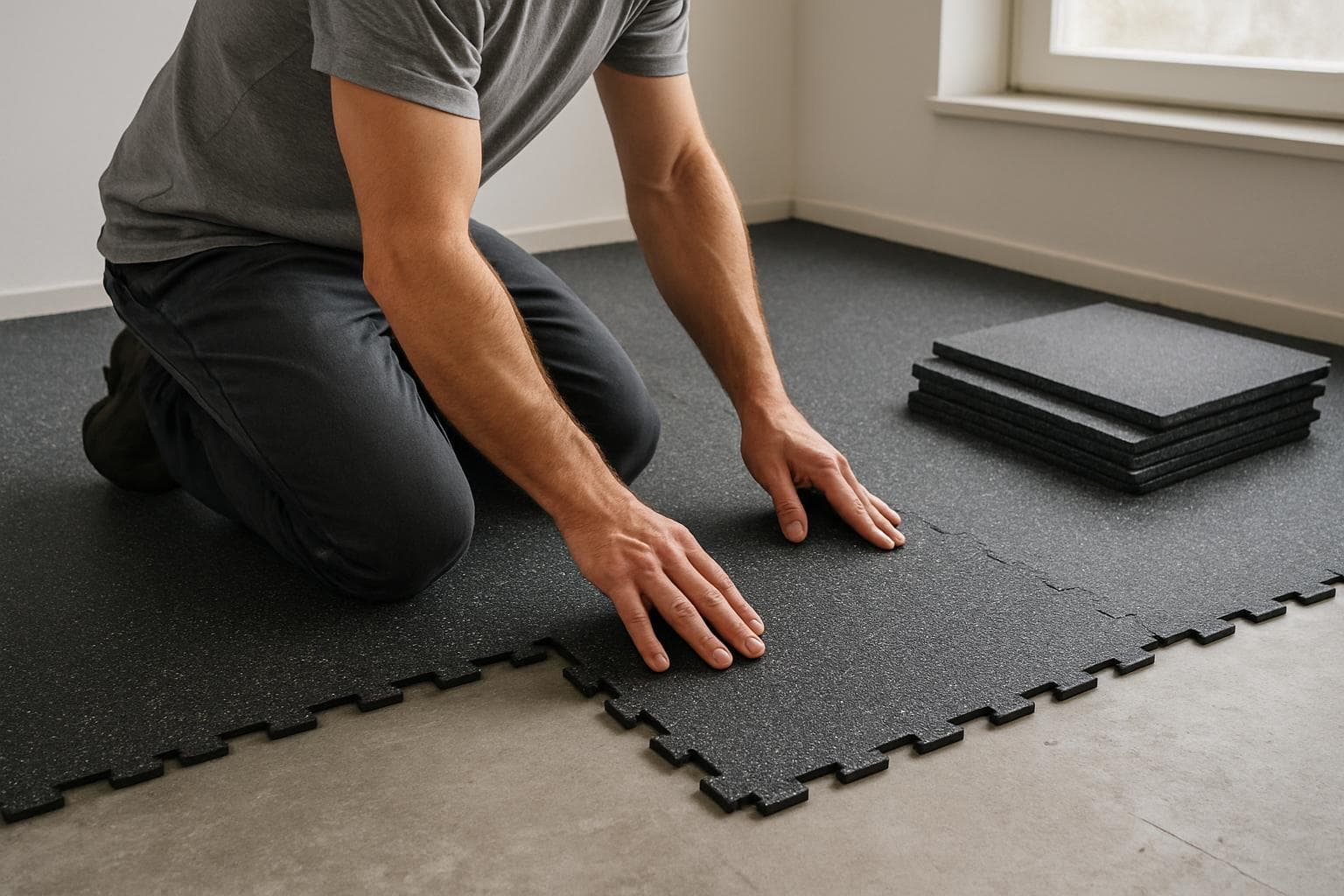
Interlocking loose-lay over a flat, hard floor is a realistic DIY, and it saves the entire labor line. If you can measure a room and cut a tile with a straightedge and utility knife, you can lay a gym or garage floor in an afternoon.
Where hiring pays off: large glue-down areas, any outdoor job that needs a drainage base built up under the tile, and poured rubber surfacing, which is a wet-applied system, not tiles at all. If you're weighing that route, the numbers live in this breakdown of rubber surfacing cost per square foot.
Before anything goes down, two checks come first. Your subfloor has to be flat, because a dished or humped slab makes tiles rock and gap. And you need a moisture check on any concrete, because rubber over a damp slab traps that moisture instead of letting it dry. I once let Rachel, a customer in Columbus, talk me out of a moisture test on her garage floor to save an afternoon, and the tile cupped before the season was out. I relaid it on my own dime. I don't skip that test anymore.
One more thing from experience: new rubber, especially recycled crumb, smells at first. It fades, but open the space up and run some air through it for a while so a fresh floor doesn't turn into a complaint. If your tiles are headed outdoors, they've also got their own base and edging needs, covered in whether rubber tiles can be used outside.
Cost Per Square Foot vs. Cost Per Year
A higher sticker price can be the cheaper floor. What matters is cost per year, and that's where rubber pulls ahead of the bargain options.
| Material | Upfront $/sq ft | Typical lifespan | Rough cost/year/sq ft |
|---|---|---|---|
| Recycled rubber tile | $1.75-$4 | 15-20+ yrs | $0.10-$0.25 |
| Foam interlocking mats | $0.50-$1.50 | 2-4 yrs | $0.20-$0.60 |
| Vinyl / LVP | $2-$5 | 10-20 yrs | $0.15-$0.40 |
Source: rubber floors I've torn out years later next to the foam mats they outlasted
Upfront price against rough lifespan to show yearly cost, not just the sticker.
Thin foam looks like the deal until it packs down flat and tears at the seams in a few years. Quality rubber tile keeps going, so even at three or four times the upfront price it can cost less per year. EPA guidance on flooring materials makes a similar point in general terms: longer-lasting floor coverings can mean fewer replacement cycles and less material sent to disposal compared with shorter-lived options. I've torn out foam mats that were shot while the rubber tile in the next room was still fine after years of use.
That said, keep it honest. For a light-use spare room or a rental you won't keep, a cheaper option can still be the right call. Spend for the long run only where the floor's going to earn it.