
On the Alvarez family's patio in Dayton, I laid colorfast EPDM tile three summers ago, and it still looks new under full sun today. Pick an outdoor rubber tile by price alone instead, and it fades, pools water, or buckles at the seams by its first winter. The right call comes down to your surface, not the label on the box, and if you're weighing options for other spots around the house too, my rubber tiles for home guide walks through that same indoor-outdoor decision.
Key takeaways
- Match the rubber to the sun: EPDM granules hold color in full sun, while cheaper recycled SBR (crumb rubber from tires) fades and can smell early, so save SBR for shaded or covered spots.
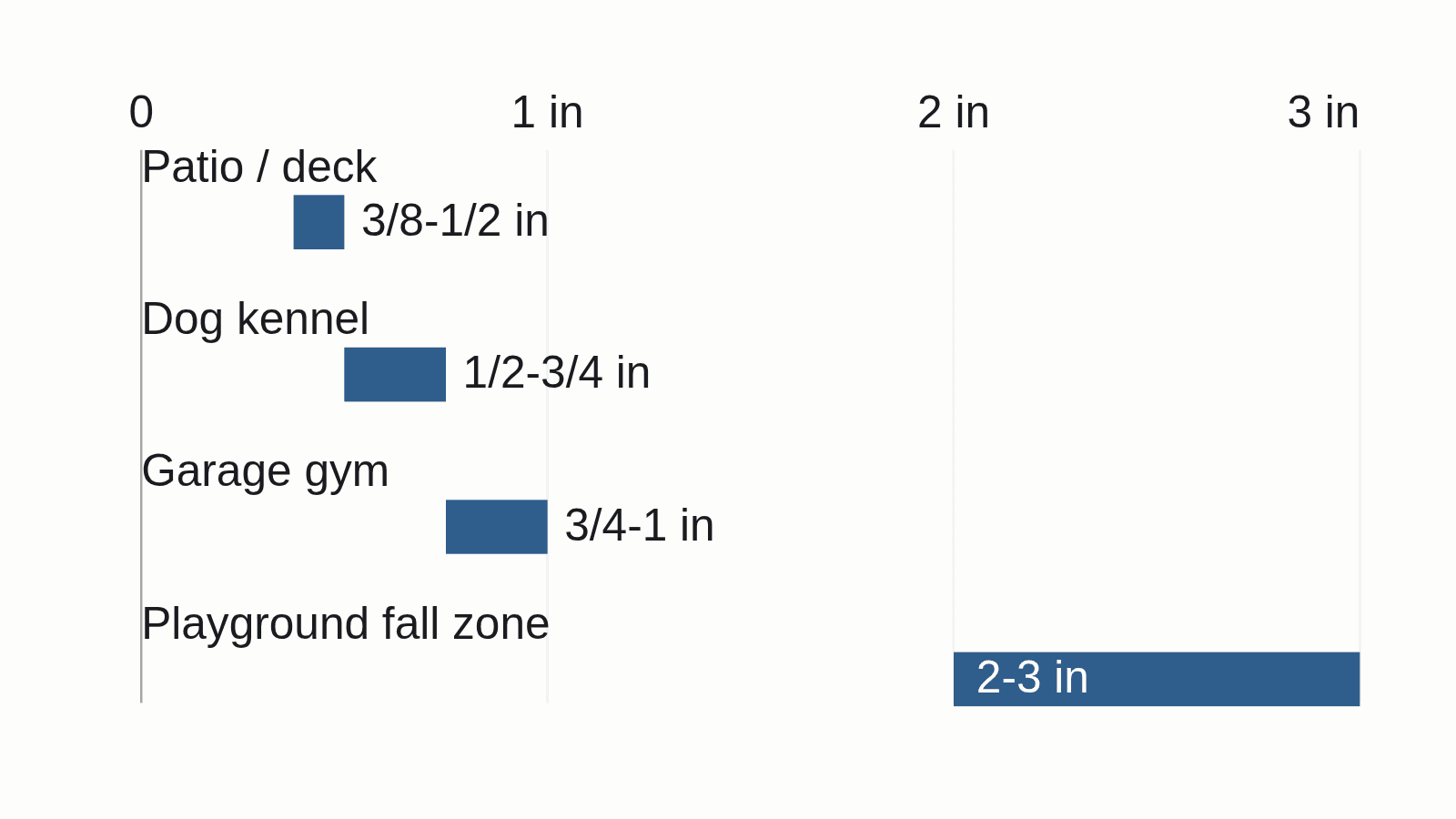
- Thickness by job: 3/8-1/2 in for patios and decks, 3/4-1 in under a squat rack, and 2-3 in for playground fall zones rated to fall height under ASTM F1292.
- Use drainage-hole tiles anywhere water sits (open patios, pool decks, kennels); solid tiles only over a surface that already sheds or slopes.
- Leave the perimeter expansion gap the maker specifies, or the tiles buckle at the seams when summer heat swells the rubber.
- Cost splits: materials run about $2-4/sq ft for thin SBR up to $8-15/sq ft for thick playground tile; loose-lay interlocking is a realistic DIY, but glue-down and big cut-heavy layouts are worth hiring.
Start Here: Match the Tile to the Surface, Not the Brand
The one decision that drives everything else is what sits under the tile and what happens on top of it: foot traffic, dropped weights, kids falling, dogs, and standing water. If swings and slides are the main use, it helps to know what makes a good outdoor rubber mat for a kids' play area before you commit. Get that pairing right and the rest is detail.
I learned this the hard way on two jobs the same summer. For the Alvarez family in Dayton I put colorfast tiles on a wide-open patio that bakes all afternoon, and three years on they still look new — basically a real-world answer to how long do rubber tiles last when the material matches the site. A cheaper black tile I'd used on a shaded side porch would have chalked and warped out there in one season. Same tile, wrong surface, and it would have been a callback.
So before you shop, find your surface in this table and read your call off it. The sections below explain the why behind each one.
| Surface | Material | Thickness | Drainage | Note |
|---|---|---|---|---|
| Open, sunny patio | EPDM, or EPDM top over SBR | 3/8-1/2 in | Drainage-hole | Slope the base so water leaves |
| Wood deck | SBR deck-style tile | 3/8-1/2 in | Drainage-hole | Needs airflow underneath so boards don't stay wet |
| Garage gym | Recycled SBR | 3/4-1 in under racks | Solid ok if floor drains | Thinner mat elsewhere to save money |
| Dog kennel/run | EPDM or sealed SBR | 1/2-3/4 in | Drainage-hole | Rinses clean; holes let waste water pass |
| Playground fall zone | EPDM cap over SBR | 2-3 in by fall height | Solid, rated tile | Verify ASTM F1292 impact rating |
Source: matching tiles to the surface on my own patio, kennel, and gym installs
Surface-by-surface pairing of material, thickness, and drainage for outdoor rubber interlocking tiles.
If you're still deciding whether tile even belongs outside your space at all, my rundown on whether rubber tiles can be used outside covers the go/no-go before you spend a dollar.
SBR vs EPDM: What the Sun and Rain Do to Each
The material choice comes down to two rubbers, and the sun decides which one you need. Buy EPDM (ethylene propylene diene monomer, a synthetic rubber) where the tile sits in direct sun, and save with SBR (styrene-butadiene rubber, made from recycled tires) where it's shaded, covered, or indoors.
SBR is recycled crumb rubber, old car tires ground up into little black bits and pressed into a tile. It's always black, it's the cheapest option, and it gives off a rubbery smell when new. Out in the weather it chalks and fades faster because raw tire rubber doesn't hold up well under steady UV, the sunlight that breaks down a lot of outdoor materials over time.
EPDM is the colored granule tile, the reds, greens, tans, and grays you see on playgrounds. It's built to hold its color in full sun and shrug off rain and UV, and it costs more for exactly that reason — it's the standard I reach for whenever I'm speccing rubber tiles for an outdoor playground. On an exposed patio or a playground cap, that price buys you years of not fading.
About the smell: new SBR outdoors does off-gas an odor, but it clears with airflow, and it clears faster outside than it would in a closed garage. Plan on a few weeks of airing out and it settles down.
If the tile lives in direct sun, pay for EPDM or at least a tile with an EPDM top layer over an SBR base. If it's under a roof or in a garage gym, plain SBR does the job for less.
How Thick? Foot Traffic, Dropped Weights, and Fall Height
Thickness is set by what hits the tile, not by looks. Match it to the job and you stop paying for rubber you don't need.
For foot-traffic surfaces like patios, decks, and walkways, 3/8 to 1/2 inch is plenty. Going thicker there just spends money for no gain.
In a garage gym, I set up jobs with 3/4 to 1 inch under the squat rack or drop zone, and thinner mat everywhere else, a split that this rubber flooring guide for home gyms breaks down in more detail if you're still picking a type. Paying for full thickness across the whole room is wasted rubber when only the drop area takes the abuse.
Kennels and pet runs land in the middle at 1/2 to 3/4 inch, enough cushion for the dogs and still easy to hose clean.
Playground fall zones are the one place thickness is not your call. It's set by fall height, the drop from the top of the equipment to the ground. Tiles 2 to 3 inches thick are typically rated to a specific fall height under ASTM (American Society for Testing and Materials) F1292, the impact-safety test that says how far a kid can fall onto that tile before it stops protecting them. Check the product's own chart against your equipment height before you buy, the exact rating comes from that product's own test data, not from thickness alone.
| Surface | Thickness |
|---|---|
| Patio / deck | 3/8-1/2 in |
| Dog kennel | 1/2-3/4 in |
| Garage gym | 3/4-1 in |
| Playground fall zone | 2-3 in |
Recommended tile thickness by surface, in inches, from thin patio tile to thick playground fall-zone tile.
Drainage Holes vs Solid Tiles (and the Freeze-Thaw Gap)
Use drainage-hole tiles anywhere water sits, and save solid tiles for a surface that already sheds water on its own. That choice decides whether your tiles stay put or float and freeze.
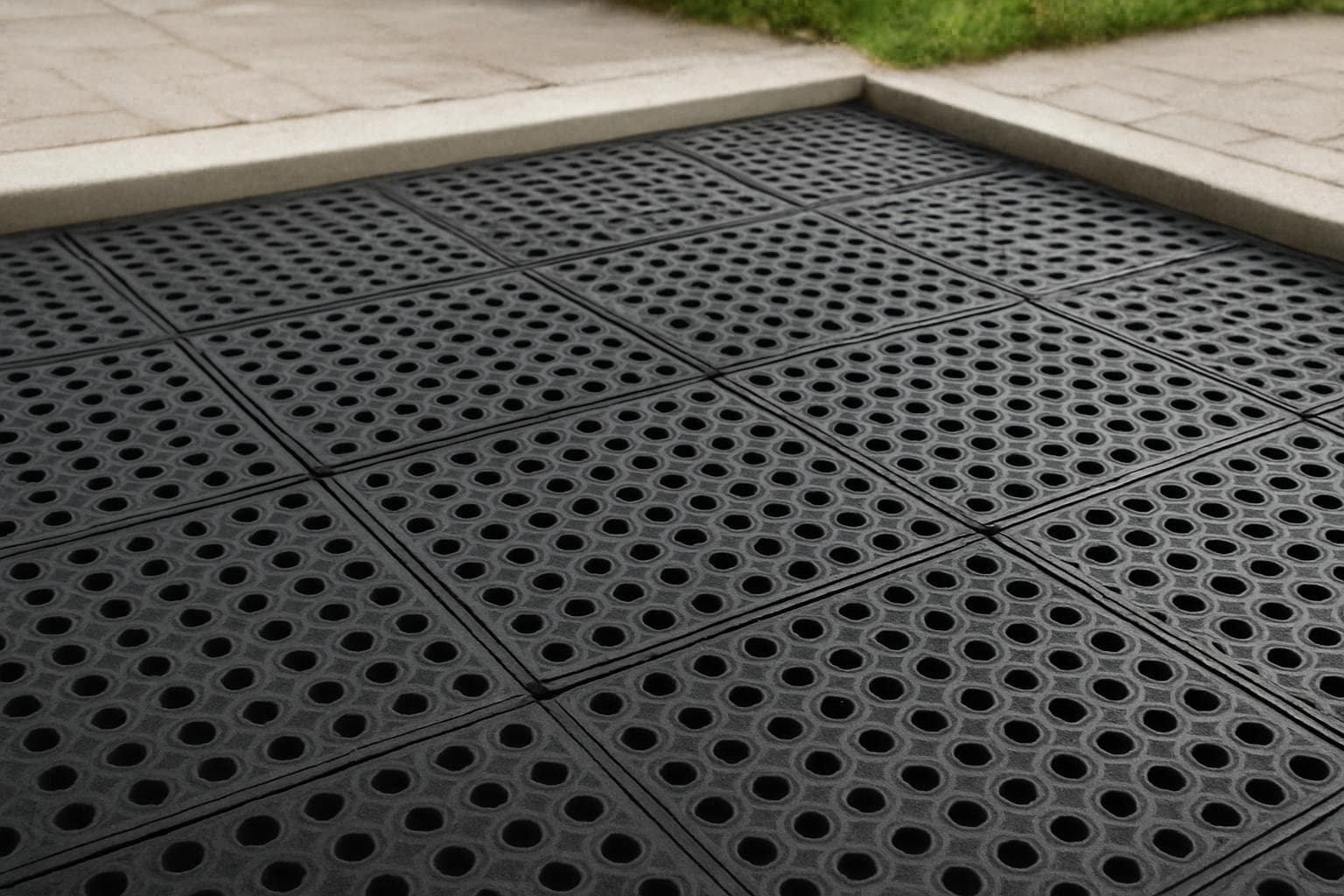
Drainage-hole tiles are exactly what they sound like: little holes let rain pass straight through to the base below. Open patios, pool decks, and kennels all need them because water lands and has nowhere else to go.
Solid tiles belong only over a surface that already gets rid of water, like a sloped concrete pad or a deck with air moving under it. Lay solid tiles on flat ground and water pools on top, grows mildew, and then freezes in it.
That freeze cycle is a real outdoor killer. Freeze-thaw just means rubber swells in summer heat and shrinks in winter cold, over and over. If you don't leave the perimeter expansion gap the maker specifies, that swelling has nowhere to go and the tiles buckle up at the seams. The exact gap is on the product's own sheet, so look it up rather than guessing.
Holes or no holes, slope the base roughly 1/4 inch per foot as a general guideline, check your local code or the tile maker's own spec for the exact figure, so water actually runs off instead of sitting under the tiles.
What Goes Under Outdoor Tiles: Subbase by Surface
What goes under the tile matters as much as the tile itself, and it changes with the surface. Get the base flat and draining and cheap tiles look great; skip it and the best tiles telegraph every dip.
Over concrete or pavers, you can lay tiles directly as long as the slab is flat and already slopes to drain. Fix any low spot that ponds water first, because a puddle under interlocking tile never dries out.
Over a wood deck, use deck-style tiles that leave air moving underneath. Trap moisture against the boards and they stay wet and rot, which is a far more expensive fix than the tiles.
Over grass or dirt, you have to build a base. Compact a few inches of gravel with landscape fabric under it, then set the tiles on that. Tiles laid straight on soil sink, heave with the seasons, and grow weeds up through the drainage holes.
Whatever the surface, check flatness and slope before you lay a single tile. I run a straightedge and, on concrete, a moisture meter, which is a handheld tool that reads how much water is in the slab. A hump or a damp low spot you ignore now shows through the tile and holds water on top later.
What It Really Costs: Materials vs Labor
Outdoor rubber tile costs split two ways, and the spread is wide, so price the exact product per square foot instead of trusting one flat number. Materials run from cheap thin SBR up to thick playground tile, and labor depends entirely on whether you lay it yourself.
Materials swing by rubber type and thickness. Thin SBR patio tile sits at the low end, EPDM and thick playground tile at the top. Add edge and border pieces to your count, because those ramped and finished trim tiles cost more than the field tiles.
Labor is where you decide DIY or hire. Loose-lay interlocking tile is a realistic weekend job for most people, with basically no labor cost. Glue-down installs, big open areas, and cut-heavy layouts are where hiring out pays off. A raised deck, a tight side yard, or a curvy layout with lots of trimming costs more to install than a flat, open patio, because all the edging and cutting eats hours.
| Item | Cost ($/sq ft) |
|---|---|
| Labor, loose-lay (hired) | $1-3 |
| SBR patio tile (materials) | $2-4 |
| Garage gym tile 3/4 in (materials) | $3-6 |
| Labor, glue-down (hired) | $3-6 |
| EPDM patio tile (materials) | $5-8 |
| Playground 2-3 in tile (materials) | $8-15 |
Note: these are general planning ranges, not fixed prices, actual cost depends on brand, region, and current material prices, so confirm with your supplier before budgeting.
Material and hired-labor cost ranges per square foot for outdoor rubber tile, priced separately so you can compare the exact product before you buy.
For the full breakdown on pricing by tile type, see my guide on how much rubber tile costs, and if you're pricing a poured or seamless option instead, how much rubber surfacing costs per square foot runs those numbers.