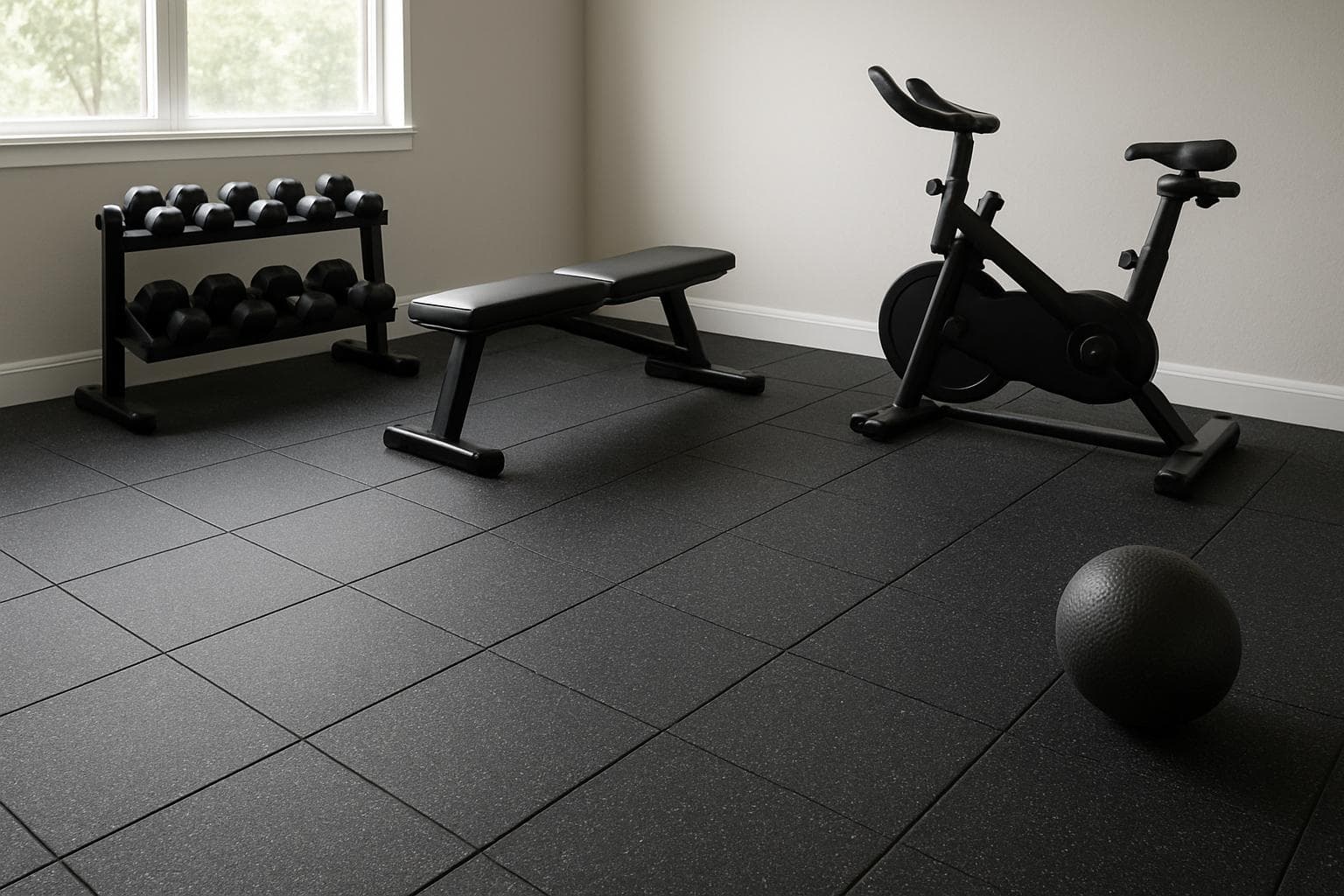
When Denise in Tulsa hired me to floor her basement gym in rubber tile, the number she found online wasn't the number she ended up paying, prep, tear-out, and delivery weren't on that per-square-foot sticker. Ask how much rubber tile costs and most vendor pages hand you a square-foot number, then leave prep, tear-out, and delivery off the sheet until they land on your invoice. Below I price her room top to bottom, line by line, so the total you plan for is the total you pay.
Key takeaways
- Rubber tile material runs about $2-8 per sq ft: recycled interlocking tile is the cheap end, colored virgin EPDM the top.
- The sticker price is roughly half the job. Add $0.50-3/sq ft prep, $1-3/sq ft tear-out, a $50-200 dump fee, and $50-150 delivery.
- A pro-installed 300 sq ft interlocking floor lands near $2,370 all-in (about $7.90/sq ft), and the per-sq-ft cost drops as the room grows because delivery and dump fees are fixed.
- DIY loose-lay interlocking tiles cut the $1-3/sq ft labor to near zero. Glue-down rolls, poured-in-place, and stairs are where hiring out pays.
- Poured-in-place rubber is the priciest at roughly $8-16/sq ft installed, while interlocking tiles let you pull and replace a single tile.
How Much Does Rubber Tile Cost per Square Foot?
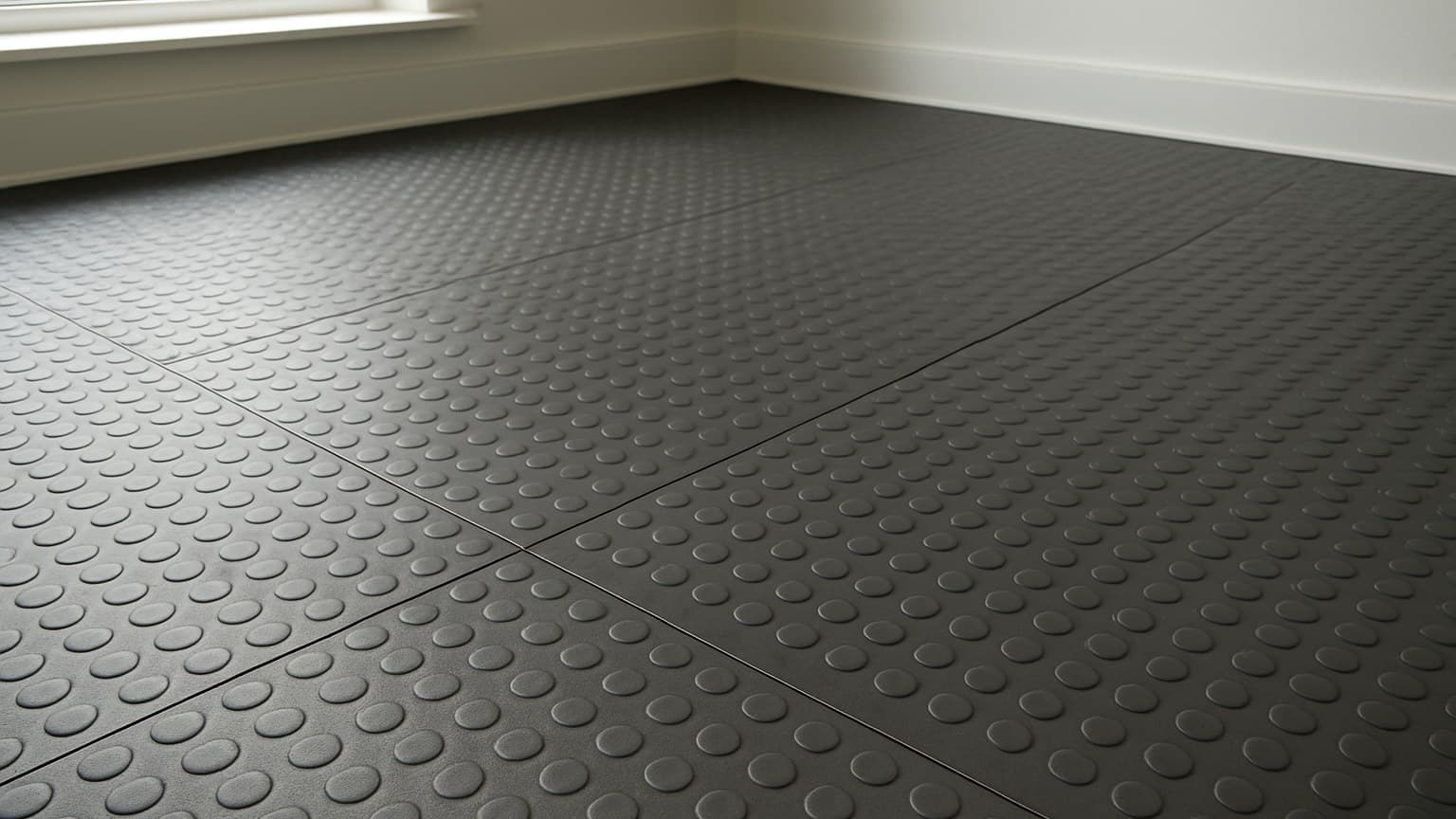
Rubber tile runs about $2-8 per square foot for the material alone. Recycled crumb rubber (ground-up tire rubber pressed into tiles) sits at the cheap end, and colored virgin EPDM, short for ethylene propylene diene monomer, a synthetic rubber made fresh instead of recycled, sits at the top, because that fresh-made rubber gives you real color choice instead of the flecked gray-black look of recycled tile.
That band lines up with the roughly $3 per square foot the EPA's archived flooring cost report uses as a baseline for rubber hard-flooring, which is a useful check against any single vendor's sticker. It's also worth cross-checking that baseline against retailers directly if you're trying to figure out where to buy outdoor rubber tiles, since outdoor-rated product often prices differently than the indoor tile the EPA number was built from.
Here is how the common formats stack up:
| Format | Material $/sq ft | Install $/sq ft |
|---|---|---|
| Interlocking recycled tile | $2-5 | DIY $0 / pro $1-3 |
| Virgin EPDM (colored) tile | $5-12 | pro $2-4 |
| Rubber rolls (glue-down) | $1.50-4 | pro $2-4 |
| Poured-in-place rubber | included | $8-16 installed |
Source: the EPA archive's ~$3/sq ft rubber hard-flooring baseline, checked against current supplier list prices
Material vs install price per square foot across the four common rubber floor formats.
Read that as material only. Installation and the line items nobody prints on the tile page come next, so the per-square-foot number above isn't your budget number.
The Costs the Sticker Price Hides
The sticker is roughly half the job. The other half is prep, tear-out, disposal, delivery, and any moisture barrier, and those are the items that turn a $350 tile order into a real bill. This holds even for a big-box purchase, if you're pricing out Home Depot's outdoor rubber tile line, the shelf price is still only the material half of the bill.
| Line item | Typical cost |
|---|---|
| Subfloor prep & leveling | $0.50-3 / sq ft |
| Tear-out of old flooring | $1-3 / sq ft |
| Disposal / dump fee | $50-200 per job |
| Delivery | $50-150 flat |
| Moisture barrier / underlayment | $0.30-1 / sq ft |
The add-on line items most vendor cost pages leave off the tile price.
This is where the room itself changes the number. When I write a quote, I count the cut-heavy areas separately from the open floor. On Denise's basement gym in Tulsa, a run of closets, a doorway, and a bay window ate a whole extra day that the open middle of the room never needed.
Access matters the same way. A basement job costs more than an open main-floor room because you're hauling heavy tile down stairs and the slab usually needs more moisture work first. Stairs cost more again, because every tread is its own cut and fit.
Total Cost Worked for 100, 300, and 500 Sq Ft
Here is a full pro-installed interlocking floor priced line by line, so you can read your own room off it instead of guessing. A 300 square foot floor lands near $2,370 all-in, about $7.90 per square foot, and if you want that same math carried out for smaller and larger rooms, my rubber flooring installation cost breakdown by project size lays out the full range.
| Line | 100 sq ft | 300 sq ft | 500 sq ft |
|---|---|---|---|
| Material (~$3.50/sq ft) | $350 | $1,050 | $1,750 |
| Labor (pro ~$2/sq ft) | $200 | $600 | $1,000 |
| Subfloor prep (~$1/sq ft) | $100 | $300 | $500 |
| Tear-out + disposal | $150 | $300 | $450 |
| Delivery | $100 | $120 | $150 |
| All-in total | $900 | $2,370 | $3,850 |
| Per sq ft, all-in | $9.00 | $7.90 | $7.70 |
Source: a 100/300/500 sq ft interlocking-tile job priced the way I write a customer quote
A 100/300/500 sq ft interlocking-tile job priced the way I write a customer quote.
Notice the per-square-foot number drops as the room grows, from $9.00 at 100 square feet to $7.70 at 500. That's because delivery and the dump fee are fixed. You pay them once whether you cover a closet or a basement, so they weigh far more on a small floor.
The arithmetic is plain. Take (material $/sq ft + labor $/sq ft + prep $/sq ft) and multiply by your floor area, then add tear-out, disposal, and delivery on top.
Worked out for the 300 square foot room: ($3.50 + $2.00 + $1.00) x 300 = $1,950, plus $300 tear-out and disposal and $120 delivery, which is $2,370. Swap in your own room size and local rates and the same three steps give you a real number.
What Drives the Price Up or Down
Thickness moves the price first. Tiles rated to take a dropped weight cost more than thin tiles built for foot traffic, so match the thickness to what the floor actually does, not to the cheapest box on the shelf.
Material is the next lever. Recycled crumb rubber is the budget floor. Virgin EPDM runs well above it, and the extra buys real color choice, less odor out of the box, and a cleaner, more uniform look.
Then there's what's underneath. Poor flatness or a damp slab adds prep dollars before a single tile goes down, and this isn't optional spending, most interlocking-tile manufacturers make proper subfloor prep a condition of the warranty, not just a recommendation. That same underneath-the-tile question gets even more important outdoors on bare ground, and my guide to rubber pavers over dirt covers when skipping a base actually holds up and when it doesn't.
Last, format and region. Glue-down rolls and poured systems carry more labor than loose-lay tiles, and labor rates swing by where you live, so the same tile can cost noticeably more to install in one metro than another.
DIY vs. Hiring a Pro
Loose-lay interlocking tiles are a realistic DIY over a flat, hard surface, and doing your own cuts drops the $1-3 per square foot labor to near zero. On a 300 square foot room that's roughly $600 back in your pocket.
Where I tell people to hire out is glue-down rolls, poured-in-place rubber, and anything on stairs or with tricky transitions between rooms. Those need adhesive skill, level control, or a lot of precise cuts, and that's exactly where a weekend install goes sideways.
Be honest with yourself about the prep, too. A botched self-leveling pour or a moisture check you skipped costs far more to tear up and redo than the labor you saved. If the slab is questionable, that's money worth spending on a pro.
Cost by Use Case: Gym, Garage, Playground, and Outdoor Paths
What you're covering decides both the tile and the total.
For a home gym, go thicker interlocking tile to absorb dropped weight and quiet the room. This is one place I always steer people toward interlocking tiles over a glued floor, because if one tile gets chewed up by a dropped dumbbell or the basement floods, you pull and replace that single tile instead of tearing up the whole floor. If you're dialing in the exact thickness that stops cracks and noise, my breakdown on rubber flooring for a home gym walks the drop test and the numbers.
A garage wants heavier tiles or mats that handle rolling loads and vehicle weight, and those price near the top of the tile band. A playground or school jumps higher again, because thick safety rubber or a poured-in-place surface is priced to a fall-height rating, and that safety spec is what drives the cost, not the look. If you're speccing that kind of surface, my heavy duty outdoor rubber mats for playgrounds breakdown covers the thickness charts and safety standards that set those fall-height numbers in the first place.
Outdoor paths and patios are their own lane, using EPDM and landscape rubber that most tile cost pages skip entirely, the EPA's GreenScapes program has tracked recycled-rubber paving and walkway costs separately from indoor flooring for exactly this reason. Before you buy, it's worth settling whether your tile can even handle sun, rain, and freeze-thaw cycles, and a material and climate guide for outdoor rubber tiles breaks down what decides that. If that's your project, rubber interlocking tiles for outdoor use covers what changes once the floor lives in the weather, and there's a fuller per-square-foot look at rubber surfacing costs for poured outdoor work.
Long-Term Maintenance Cost
Rubber is low maintenance year to year. A damp mop and the odd scrub is most of it, so the running cost is small next to carpet or the refinishing a wood floor eventually needs, and our guide to rubber tiles for home covers the day-to-day upkeep in more detail if you want the full picture before you buy.
The repair story is where interlocking tile wins on cost. When one tile fails, you swap that one tile for a few dollars. A glued floor or a poured surface means patching or re-pouring a whole area, and that gap in lifetime cost is real even when the day-one price looks similar.