
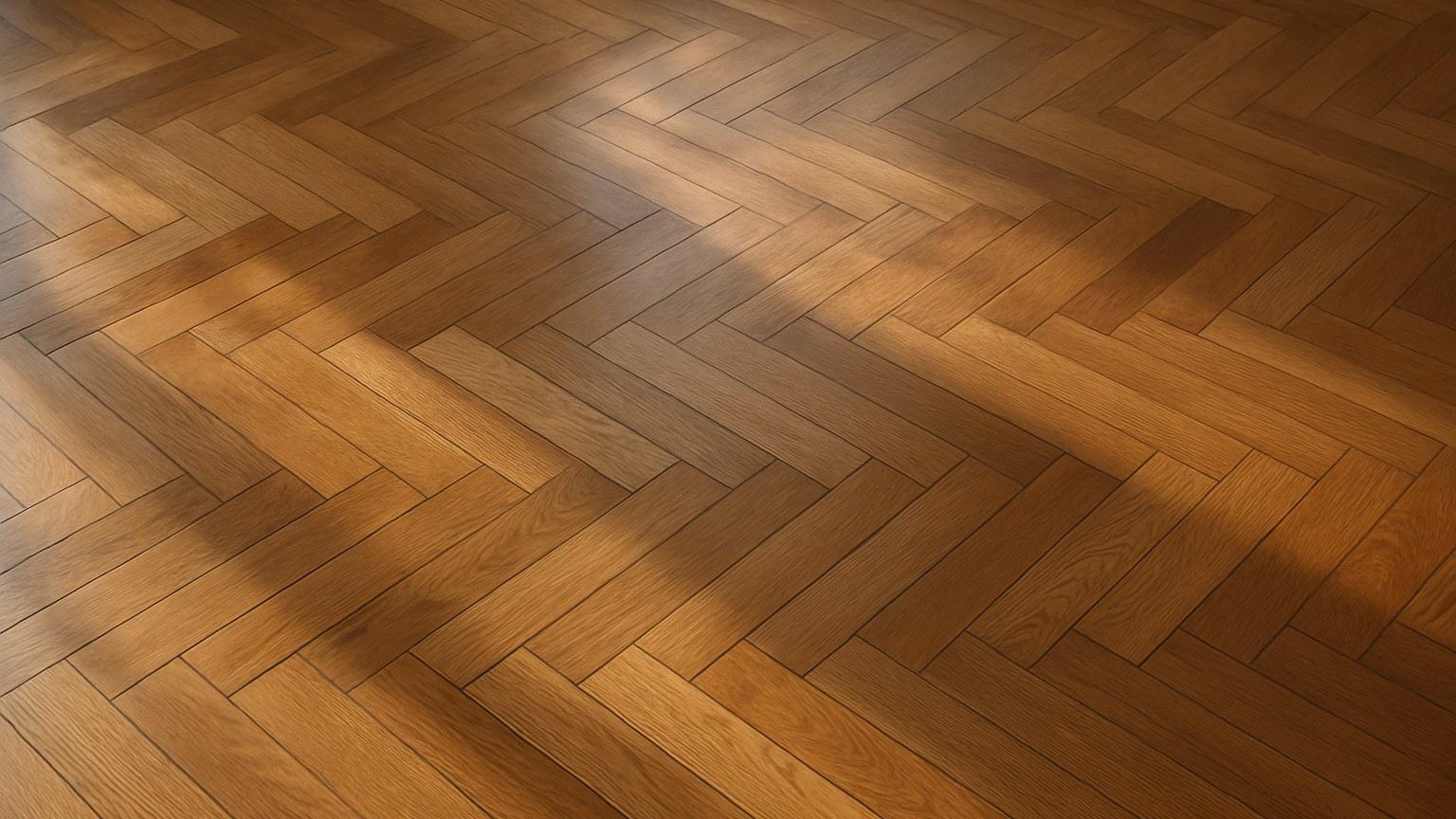
Parquet flooring is real wood laid in a repeating geometric pattern, so what you pay hinges less on the wood itself and more on the pattern you pick. A plain brick tile glues down in rows; a chevron is slow, mitered cutting. That labor gap is where most homeowners get caught off guard.
Key takeaways
- Parquet is real wood, solid or engineered, laid in a repeating geometric pattern; it's sold as pre-made tiles or single strips, and it's a hardwood floor, not a separate material.
- The pattern drives the labor: brick and finger tiles go down fast, while herringbone, chevron and Versailles are slow, precise work that pushes the price up.
- Installed cost runs $6-25 per square foot (hallmarkfloors.com); homewyse.com puts a 2026 job at $13.19-16.72 per square foot.
- Refinishing runs about $3-5 per square foot (nerdwallet.com), with parquet-specific refinishing at $3.50-6 (yelp.com) because the grain runs in several directions.
- Engineered parquet is the stable pick over concrete and below grade; solid parquet refinishes more times but shouldn't go below grade.
What Parquet Flooring Is, and Whether Anyone Still Installs It
Parquet is a hardwood floor. It's the same oak, walnut, or maple you'd find in plank form, just cut into smaller pieces and arranged in a pattern instead of long parallel boards. So when people ask whether parquet is a different kind of flooring from "real wood," the answer is no. It is real wood. The pattern is what makes it parquet. Oak shows up most often in parquet tile, which is why it pays to know how to tell a quality oak floor from an overpriced one.
It shows up two ways on the market. The common one is pre-assembled tiles, usually 12x12 or 9x9 wood squares with the little slats already glued into a pattern. Those glue straight to the subfloor and go down fast. The other way is individual strips, cut and set one at a time on site, which is how the fancy patterns get built.
The look goes back to 1600s France. The famous one is the parquet de Versailles, large woven squares framed by borders, installed in the palace to replace marble that kept rotting the beams beneath it. That's where the name and the reputation come from.
Does Parquet Flooring Still Exist?
Yes. Parquet never disappeared, it just went out of fashion for a stretch after the glued-down tile floors of the 1960s and 70s got a dated reputation. You can still buy both the pre-made tiles and strip material today, and installers still lay herringbone and chevron in formal rooms. It reads as classic now, not dated, especially in a real-wood finish rather than the thin veneer tiles of that era. A lighter finish in particular tends to read modern rather than retro, which is the same reasoning behind choosing light wood flooring for a room in the first place.
Parquet Patterns, and Why the Pattern Decides Your Labor Bill
The pattern you choose is the single biggest thing that moves your install cost. Not the wood species, not the room size. The pattern. Some patterns glue down in simple rows, and some need every end cut to an exact angle, piece by piece. That's hours of skilled labor, and it lands on your bill. Even though species matters less for pattern cost, it still matters for durability, which is one reason wide plank hickory flooring gets picked for high-traffic rooms.
Here are the patterns you'll actually be choosing between:
- Herringbone: rectangles meeting at 90 degrees, staggered so each one points off the last. Square-cut ends, but every piece gets placed by hand.
- Chevron: the ends are cut to a point so the rows form a continuous zigzag, like rows of Vs. Every single end is mitered, which makes it the slowest of the bunch.
- Versailles: large framed squares of woven strips. These often come as big pre-made panels, but laying them square and even still takes careful work.
- Brick and mosaic: simple offset blocks or slats. The budget-friendly, fast-install end.
You'll also run into brand pattern names: Canterbury, Chaucer, Haddon Hall, Monticello, Parallel, Rhombs, Saxony, Bondwood. Don't let the names intimidate you. Most of those are mosaic tiles that install like brick, in rows, not board by board. They cost and lay more like the easy end than the hard end.
One thing I tell every client before they commit: look at a full tile, not a showroom chip. I had a customer pick a floor off a tiny sample square once, and when the whole room went down it looked far busier and more yellow than she expected. Parquet repeats a pattern across the entire floor, so a small swatch hides what it really does to a room. See a full tile in your own light first. The same thing happens with Brazilian cherry hardwood floors, which keep darkening for months after installation regardless of the pattern.
| Pattern | Look | Install labor | Best fit |
|---|---|---|---|
| Herringbone | Staggered rectangles, square ends | High, board by board | Living and dining rooms, formal spaces |
| Chevron | Angled ends meeting in a point, V zigzag | Highest, every end mitered | Showpiece rooms where budget allows |
| Versailles | Large framed woven squares | High, large pre-made panels still need careful layout | Grand or period rooms |
| Brick / Mosaic | Simple offset blocks or slats | Low, tiles glue down in rows | Budget jobs, DIY-friendly rooms |
| 6-finger / basketweave | Groups of slats turned 90 degrees | Low, comes as square tiles | Retro looks, hallways, dens |
Each pattern rated by look, install difficulty, and the rooms it suits best.
What Is 6-Finger Parquet?
A 6-finger tile is a square made of groups of narrow slats, six fingers to a group, with each group turned 90 degrees from the one next to it. It's the classic basketweave look people picture when they think of a 1970s parquet floor. Because it comes as a finished square tile, it installs the easy way, glued down in rows like any mosaic tile, not pieced together slat by slat.
Solid, Engineered, or Laminate Parquet
Engineered parquet is the stable modern default, and it's the one I'd steer most people toward, especially when there's a concrete slab underneath or the space is below ground. Solid wood parquet is for authenticity and for getting more refinishes out of the floor over its life. Laminate and vinyl "parquet" are printed look-alikes, cheaper, but not real wood. The same solid-versus-engineered tradeoffs and species choices that apply to straight-plank floors carry over almost one-to-one, which is why it helps to see them laid out on their own in solid vs engineered hardwood.
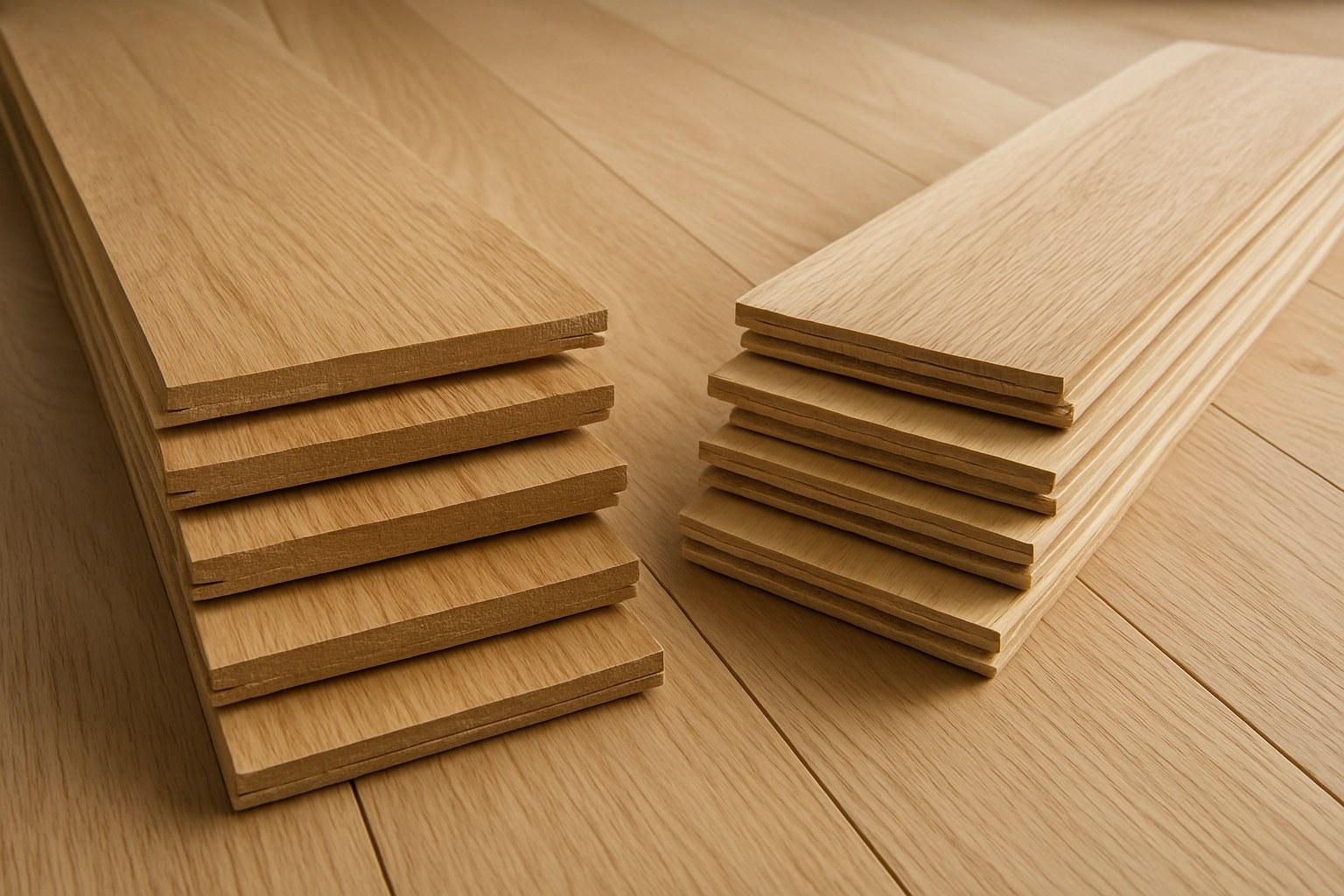
Engineered parquet is built from a thin layer of real hardwood on top, over a core of plywood layers glued at right angles to each other, with a backing layer underneath. That cross-layered core is what keeps the tile from swelling and shrinking the way a solid piece does, which is exactly why it can sit over concrete where solid wood isn't recommended.
How many times you can sand and refinish an engineered floor comes down to the thickness of that top veneer, and the manufacturer documents that specification. So "can I refinish this later" is a spec question for the specific product, not a simple yes or no. A thick veneer might give you a couple of sandings; a thin one might give you none. Check the sheet before you buy.
If you're really weighing a wood-look floor against the real thing, the choice between printed and genuine is worth its own read. Laminate parquet belongs to the broader category covered in which rooms laminate flooring actually works in, and the full durability-versus-water tradeoff is laid out in LVP (luxury vinyl plank) vs hardwood. No sense re-arguing it here.
How a Parquet Floor Actually Gets Laid
A good installer does not start at a wall. Walls are rarely straight, and a parquet pattern that follows a crooked wall looks crooked across the whole room. Instead you find the center of the room, snap chalk lines through it, and build the pattern outward from there so it stays square.
Before any of that, two checks decide whether the floor lasts, and the manufacturer's warranty quietly hinges on both. First, the subfloor has to be flat. A floating or glued parquet floor's quality is entirely dependent on the base underneath. Second, run a moisture meter, especially on concrete, because moisture coming up through a slab will ruin a wood floor from below. You also leave an expansion gap around the perimeter and acclimate the wood, but the exact gap size and whether acclimation is even needed come from the product's own sheet, not a rule of thumb.
The layout tools the National Wood Flooring Association (the trade group that sets the install standards) describes are simpler than they sound. Working lines are just chalk guides snapped on the subfloor. Trammel points are a basic compass trick, two pins on a stick, used to swing an exact 45-degree line off the center so the pattern lands true. Center layout beats wall layout for one reason: it hides the out-of-square walls in the cut border, not in the pattern.
As for how it attaches: parquet tiles usually glue down. Strip patterns can be nailed or glued. True floating parquet is less common.
| Step | What happens |
|---|---|
| 1. Check the subfloor | Confirm it's flat and dry with a moisture meter before anything goes down |
| 2. Acclimate the wood | Let the boxes sit in the room only if and as long as the product's sheet requires |
| 3. Find the center | Snap two chalk working lines through the room's middle, squared to each other |
| 4. Swing the 45-degree line | Use trammel points to mark an exact 45-degree layout line off the center |
| 5. Dry-lay from center out | Set the pattern loose first to check cuts and borders before glue |
| 6. Glue or nail outward | Work from the center lines toward the walls, keeping the pattern tight |
| 7. Gap, trim, and finish | Leave the perimeter expansion gap, add trim, then sand and finish if unfinished |
Source: NWFA installation guidelines
The layout sequence a parquet install follows, from subfloor check to finish.
So, DIY or hire? A brick or finger tile glued down is realistic for a patient DIYer who can snap a square center line and work clean. Herringbone, chevron, Versailles, and anything with a moisture transition between rooms are worth hiring out. Those are where a small error in angle multiplies across the floor and shows. If you want to understand the prep and finish side before deciding, the full walkthrough in installing hardwood flooring covers the same checks that apply here.
What Does Parquet Flooring Cost?
Installed, parquet runs about $6-25 per square foot according to hallmarkfloors.com, and homewyse.com puts a 2026 job at $13.19-16.72 per square foot. Where you land in that band is driven mostly by the pattern and the species.
The two cost drivers pull in different directions. Materials swing with the wood species: a common Red Oak engineered tile costs far less than a solid White Oak, and solid generally costs more than engineered. Labor swings with the pattern, and that's the bigger surprise. A plain brick tile and a hand-laid chevron in the same room can cost very different amounts, and the gap is almost all labor, not wood.
Is parquet expensive? Compared with a straight plank wood floor or a click-lock LVP (luxury vinyl plank), yes. But the extra money is buying installer hours for the pattern, not fancier lumber.
Refinishing is its own line. nerdwallet.com puts general wood floor refinishing at about $3-5 per square foot, and yelp.com lists parquet-specific refinishing a bit higher at $3.50-6 per square foot. Parquet costs more to refinish because the grain runs in several directions across one floor, so a sander can't just go with the grain the way it does on plank. It takes more care to avoid swirl marks.
| Cost item | Per square foot |
|---|---|
| Installed, typical range | $6 - 25 |
| Installed, 2026 job estimate | $13.19 - 16.72 |
| Refinishing, general wood floor | $3 - 5 |
| Refinishing, parquet | $3.50 - 6 |
Published cost ranges for parquet install and refinishing, per square foot.
Two things nudge these numbers up. Basements and below-grade rooms cost more because they need the moisture work and usually engineered material. And stairs cost more per square foot than any open room, since each tread is cut, fit, and often edged by hand. Per-square-foot pricing drops on big open rooms and climbs on small, cut-up spaces.