
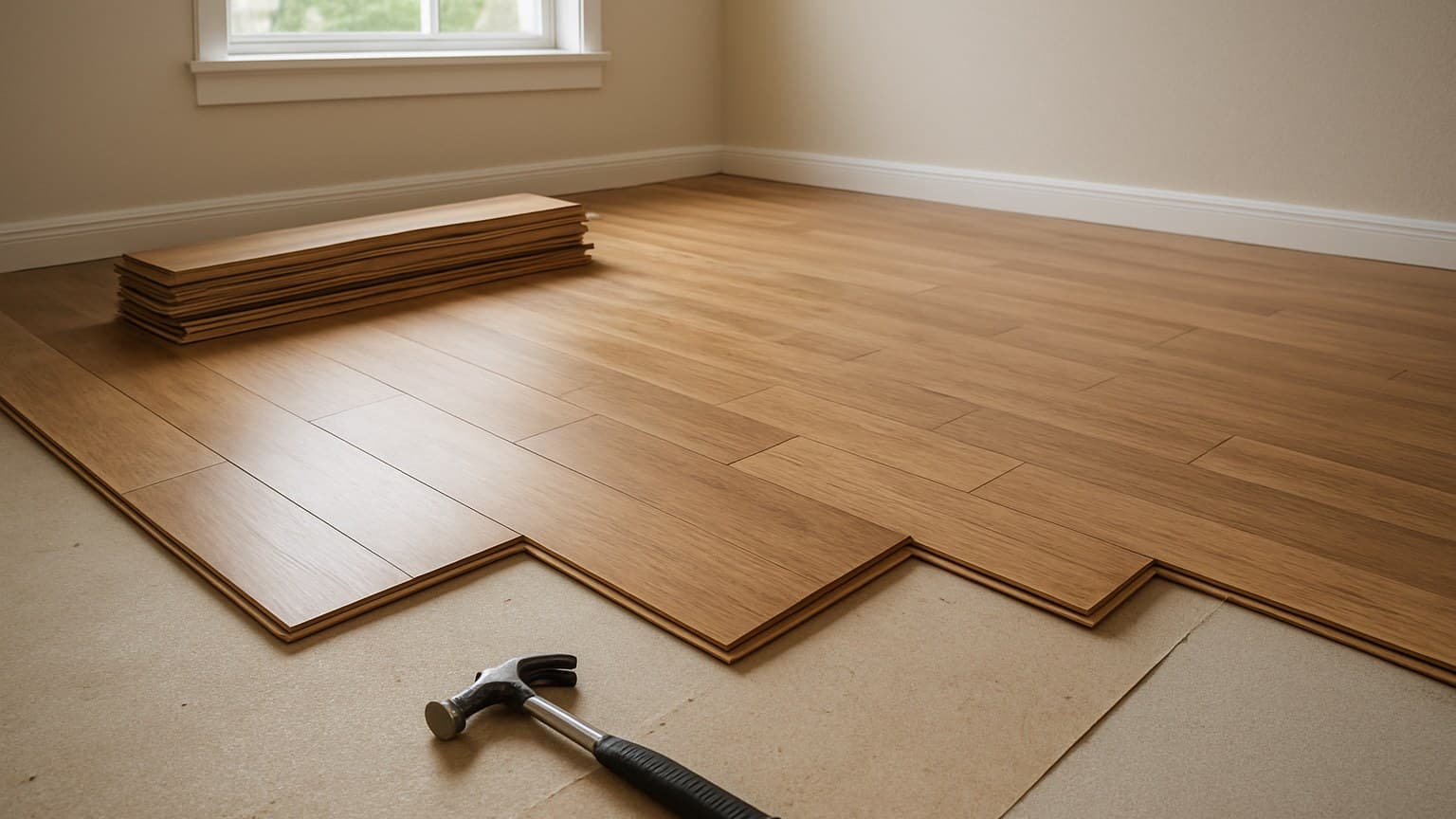
I floated a run of engineered oak for a customer in Dayton, Ohio, over a slab that looked bone dry, and it buckled at the seams three weeks later because nobody tested the concrete first. That job is why I say floating engineered hardwood is a subfloor question first, a looks-and-budget question second. Get the subfloor read wrong and no plank saves you. Before you even get to subfloor prep, it pays to settle the solid vs. engineered hardwood guide question first, since that choice shapes which installation methods are even on the table.
Key takeaways
- Floating works over almost any flat, dry subfloor, but glue-down over a concrete slab feels more solid underfoot and kills the hollow sound floating floors can make.
- Nail-down needs a wood subfloor; you can't nail into concrete, which is why slabs and basements usually get floated or glued.
- Before you float, the subfloor has to pass a flatness check (NWFA calls for no more than 3/16 inch of gap over 10 feet) and a moisture test on any slab.
- The old 'engineered can't be refinished' line is outdated: the NWFA Engineered Refinishable Program (2023) certifies specific lines you can sand, so check the exact product, not the category.
- Cost splits by method: materials run the same across all three, but glue-down and nail-down labor cost more per square foot than a click-lock float, and basements and stairs cost more than open rooms.
Float, Glue, or Nail? Match the Method to Your Subfloor
The subfloor under your feet decides the method more than the plank you fell in love with or the price tag does. Read what you're standing on first, then pick.
Concrete slab, whether on grade or a basement floor, means you float or glue down. You can't nail into concrete, full stop. A plywood or OSB (that's the chip-board wood sheeting a lot of houses use) subfloor above grade opens all three doors, and nail-down is the traditional pick there. Over radiant heat, you float or glue only, and only with a plank the maker rates for it, because nails driven through the heat lines are a leak waiting to happen.
Here's the quick read by subfloor:
| Subfloor | Float | Glue-down | Nail-down |
|---|---|---|---|
| Concrete slab (on/above grade) | Yes | Yes (most solid feel) | No |
| Basement (below grade) | Yes, with vapor barrier | Yes, moisture-tested first | No |
| Plywood / OSB (wood) | Yes | Yes | Yes, traditional |
| Over radiant heat | Yes, if rated | Yes, if rated | No |
Source: NWFA installation guidelines for engineered wood over each subfloor type
That table covers the four subfloors I see most on residential jobs.
Floating vs Glue-Down vs Nail-Down: The Real Trade-offs
Floating locks plank to plank and rests on the subfloor, so the whole floor moves as one sheet and goes down fastest. Glue-down bonds each plank to the subfloor, so it feels firmer and quieter but takes more labor and is a real mess to pull up later. Nail-down fastens into a wood subfloor and is the old-school standard where you've got one.
How click-lock floating floors hold together
Each plank has a shaped edge: a tongue on one side, a groove on the other. The tongue angles into the next plank's groove and snaps down flat, and once locked the planks can't lift or spread apart. Nothing glues to the subfloor. The real-wood veneer on top is the sandable layer, and its thickness, not the fact that it floats, sets how much refinishing life you get.
Sound and feel: the hollow-floor complaint
A floated floor can sound hollow, and I'll be straight about why: it's almost always a subfloor that isn't flat or an underlayment pad that's too thin. Glue-down feels closest to solid wood because there's no air gap under it. If a dead-solid step matters to you and you're over concrete, glue-down earns its extra labor.
On the DIY question, click-lock floating is realistic for most handy homeowners. Glue-down and nail-down are where hiring a pro pays off, between the adhesive cleanup, the cut work, and the fasteners.
Concrete, Basements, and Radiant Heat
Concrete is the make-or-break subfloor. It looks bone dry and still wicks moisture up from the ground, so you test it before you float, not after the floor cups.
A floated floor isn't more moisture-proof than a glued one. It just tolerates small subfloor movement better because it isn't bonded down. The plank's own seams and edges are still the weak point on a damp slab, and that's where water gets in and swells the wood. Floating buys you movement tolerance, not a waterproof floor. If true water resistance is what you're after, dedicated waterproof engineered hardwood options are built to handle that differently than a standard floating install.
Floating engineered hardwood on concrete
Before you float over a slab, run a real moisture test, don't eyeball it. Lay a vapor barrier if the maker calls for one, confirm the slab passes the flatness check, and for a basement below grade expect both a vapor barrier and a slab moisture test. If the numbers come back high, some homeowners switch to a named waterproof-core LVP line like COREtec Pro Plus instead of forcing wood onto a wet slab, just know that a waterproof core doesn't mean the seams and edges are sealed too, so those still need attention. That trade-off is exactly what the 9 facts that settle engineered hardwood vs LVP walks through if you're on the fence.
Radiant heat: check the plank's thermal rating
Radiant heat is a spec-sheet question, not a rule of thumb. Check the specific plank's thermal rating and its max surface temperature before you buy. A thick or high-resistance floor can block the heat from reaching the room, so the maker's own numbers govern here.
Subfloor Prep, Moisture Checks, and Acclimation (NWFA)
Flatness comes first, always. According to the NWFA Installation Guidelines, subfloor flatness should show no more than 3/16 inch of gap over a 10-foot span. Lay a long straightedge across the floor, grind down the high spots, and fill the low spots with leveling compound before a single plank goes down. This is the step people skip, and it's the one that causes the hollow sound and the failed locks.
For moisture, use a moisture meter, a handheld tool that reads how wet the wood or slab is, on both the subfloor and the planks. The NWFA's installation guidance calls for backing that up on a slab with a calcium chloride kit (a small dish of powder taped under plastic for a day or more that measures how much moisture the slab gives off) or an in-slab humidity probe (a small sensor set into a drilled hole that reads the humidity inside the concrete), because the surface can read fine while the slab underneath is still giving off water.
Acclimation varies by product. Some engineered lines want days sitting in the room; others say it's flat-out unnecessary. The box's own sheet governs, never online folklore. Same goes for the pad and the expansion gap: most floating floors need an underlayment for sound and a gap around the whole perimeter, and the exact gap size is the maker's number, not a universal one. Denser exotic species like Brazilian cherry tend to need the longest acclimation windows, which is one of several details worth settling before you buy that wood, as the Brazilian cherry engineered hardwood buying guide lays out.
Can You Refinish a Floated Engineered Floor?
Whether you can refinish comes down to the wear layer, the real-wood top, not the fact that the floor floats. Floating changes nothing about sanding.
The old "engineered can't be refinished" line is outdated. According to the NWFA Engineered Refinishable Program, launched in 2023, 23 manufacturers, including Mirage and Preverco, now offer engineered lines certified as sandable and refinishable, so the blanket category claim doesn't hold. But never trust the category: look up the exact product's veneer thickness, because that sets how many sandings, if any, it can take.
I've seen this go wrong on solid oak too, sanded down to the tongue in one corner before the homeowner caught it, and thin-veneer engineered gives you even less room. A budget floor with a thin top may only take a screen-and-recoat, a light buff and fresh finish coat, not a full sand. Worth knowing before you buy, and the 7 best engineered hardwood flooring brands ranked by the numbers lists wear-layer thickness line by line.
What It Costs: Materials vs Labor by Method
Split every figure. The planks cost about the same no matter how they go down; the install method mostly moves the labor line. Floating is the cheapest to install because it's the fastest. Glue-down and nail-down add labor per square foot. Before you sign anything, run those line items against the engineered hardwood flooring cost guide so you know which numbers on a quote deserve a second look.
Here's one room priced end to end so you can run your own:
| Step | Figure |
|---|---|
| Room size | 300 sq ft |
| Planks (materials) | $6/sq ft x 300 = $1,800 |
| Float labor | $3/sq ft x 300 = $900 |
| Float total | $2,700 |
| Same room, glue-down labor | $5/sq ft x 300 = $1,500, so $3,300 total |
Source: the per-square-foot rates I quote engineered jobs at, always confirmed against local bids
That's a 300 sq ft room priced float vs glue-down, using mid-range material and labor rates I quote on residential jobs. Your local rates will move these.
One more thing the flat national numbers hide: basements, stairs, and rooms packed with closets and doorways cost more than an open room. I used to quote flat by the square foot until a job full of doorways and a bay window ate a whole extra day. The open middle of a room is never where the hours go, the cut-heavy edges are, so a basement or a staircase carries a real labor premium over that clean 300-square-foot box.