
In a split-level outside Boise, homeowner Denise Callahan had one flooring rep tell her the engineered oak in her sample box would refinish three times, and another rep looking at that same spec sheet swear it could never be sanded at all. Both were reading the identical wear-layer number and calling it two different things. That millimeter figure is what decides how many real refinishes a floor gets, here's how to read it so you don't get burned.
Key takeaways
- The wear layer is the real-wood top veneer; only it can be sanded and refinished, never the plywood or HDF core under it.
- Sanding takes off roughly 1mm per pass and you can't sand to zero, so a 2mm layer buys about 1 refinish, 3mm about 1-2, 4mm about 2-3, and 6mm about 3-4.
- NWFA's Refinishable certification is the honest way to settle conflicting brand claims; look for it instead of trusting a printed refinish count.
- A tough finish coat (aluminum oxide, UV-cured) fights scratches as much as raw millimeters; a thick veneer with a weak finish still wears through.
- For most homes 3-4mm is the sweet spot; materials run about $3-12/sq ft and labor about $2-8/sq ft, with basement and stair jobs costing more.
The Layers Under Your Feet: What a Wear Layer Actually Is
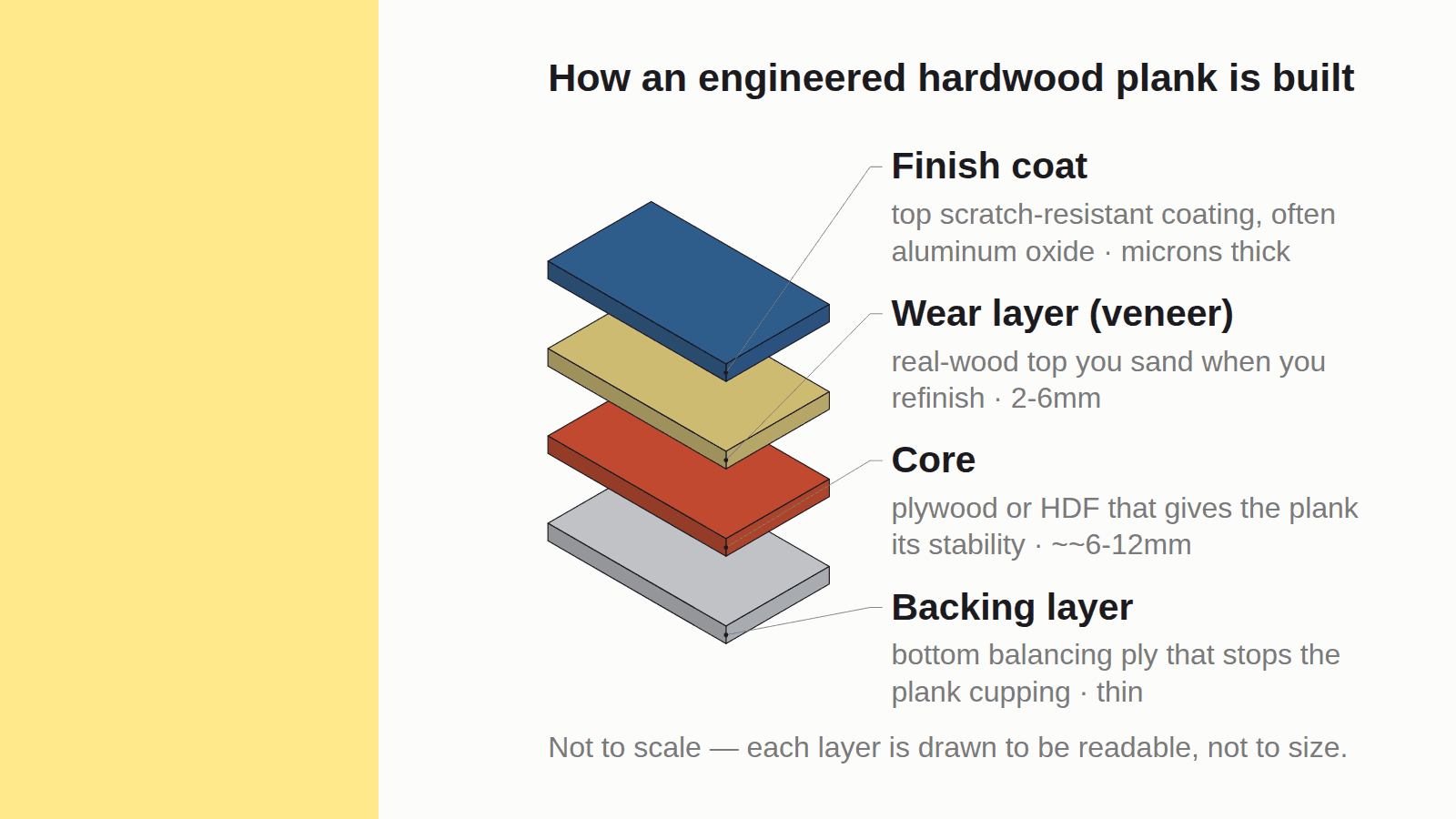
The wear layer is the top slice of real wood on an engineered plank, and it's the only part you can ever sand and refinish. Everything under it is there for stability, not for sanding.
An engineered board is built in a stack. On top sits a thin factory finish coat, the clear stuff that takes your daily scuffs. Just below that is the wear layer, the real-wood veneer, usually 2mm to 6mm thick. Under the veneer is the core, a plywood or HDF (high-density fiberboard, a dense pressed-wood board) layer that gives the plank its backbone. At the very bottom is a thin backing layer that balances the board so it doesn't cup. Stack that same construction up against a vinyl plank's layers, and the engineered hardwood vs LVP breakdown makes the tradeoffs a lot clearer.
That build is the whole difference from solid hardwood. A solid board is one piece of wood, so it's wearable almost all the way down. An engineered board is only wearable down to the veneer. Sand past that and you hit glue and plywood, and the floor is done. Which construction actually belongs in which room is its own decision, and engineered hardwood vs. hardwood room-by-room picks walks through that call floor by floor.
Wear Layer vs Total Board Thickness
Don't confuse the two. A plank might measure 12mm from top to bottom but carry only a 2mm wear layer. The other 10mm is core and backing you can never refinish. The refinish number that matters is the veneer thickness alone, so that's the spec to hunt down before you buy. That's also the exact gap sellers exploit on marked-down stock, so spotting a real discount engineered hardwood bargain means checking that number yourself before a clearance sticker talks you into a downgrade.
Thickness, Sanding, and How Many Refinishes You Really Get
A full sand-and-refinish pass takes off roughly 1mm of wood each time, and you can't sand to zero, so you always get fewer real passes than the raw millimeter number suggests. You need veneer left over the core, or the floor fails.
That's why brand claims clash. One maker prints "refinish up to three times" on a 3mm floor; another says a 3mm veneer is a recoat-only floor. The honest referee is the NWFA (National Wood Flooring Association), whose Refinishable Program sets published certification criteria a product must meet before it can be marketed as refinishable, a documented standard rather than a marketing line. According to the NWFA's Refinishable Program criteria, the ranges below reflect realistic, generalized expectations for how wear-layer thickness translates into refinish potential; the named products are illustrative examples of typical specs at each thickness tier, and you should always confirm the current wear-layer number on that specific product's own spec sheet before buying.
| Wear layer | Realistic refinishes | Notes |
|---|---|---|
| 2mm (Mohawk UltraWood Elements) | about 1 | Recoat, don't deep-sand; one honest pass |
| 3mm (Somerset Classic) | about 1-2 | Common residential sweet spot |
| 4mm (Mullican Wexford) | about 2-3 | Room for a full sand plus later touch-ups |
| 6mm (DuChateau Longboards) | about 3-4 | Closest engineered gets to solid-board life |
Source: NWFA refinishing guidance set against the engineered floors I've sanded back for clients
Refinish ranges are generalized against the NWFA Refinishable Program's certification thresholds; the wear-layer figures listed for Mohawk UltraWood Elements, Somerset Classic, Mullican Wexford, and DuChateau Longboards are commonly cited specs that can change by production run, so verify them on the current spec sheet.
Realistic refinish counts for four named engineered lines, benchmarked against NWFA Refinishable Program thresholds.
For comparison, solid hardwood, a single piece of wood with no veneer-to-core boundary to sand down to, is commonly cited as good for roughly 3-5 refinishes over its life, which is the figure most of the "how many times can I refinish" claims are actually measuring against. Engineered's 1-4 refinishes, scaled to wear-layer thickness, is the ceiling you trade for the added dimensional stability engineered gives you over concrete and radiant heat; even the thickest 6mm sawn veneer only closes most of that gap, not all of it. If you're still weighing which build and which species actually suit your room, our guide to picking solid vs. engineered hardwood floors walks through that decision in more depth.
One thing a refinish won't fix is color shift. Some species keep moving even after you sand them. A rug pulled up can reveal a bright rectangle no refinish can even out, because the wood around it darkened in the sun over the years. A sand evens scratches, not sunlight, so if you're set on that wood, read 8 Things to Settle Before You Buy Brazilian Cherry Engineered Hardwood first.
Finish Quality Matters as Much as the Millimeters
The wear layer tells you how many times you can refinish; the finish coat tells you how long before you need to. That's the point most guides skip. Your everyday scratches and dulling happen in the factory finish on top, not in the raw veneer under it.
Two coatings do the heavy lifting. Aluminum oxide is a hard topcoat made from ground mineral mixed into the finish, and it's what fights daily scuffing. UV-cured finishes are hardened fast under ultraviolet light, which makes them tough and consistent. Both buy you years before the wood underneath is even exposed.
So the tradeoff runs both ways. A thick 6mm veneer under a weak finish can scuff and dull faster than a 3mm plank wearing a strong aluminum oxide coat. Millimeters are your long-term insurance; the finish is your day-to-day armor.
A worn finish can often be recoated without a full sand. That's a light scuff and a fresh top coat, and it stretches the wear layer's life without spending a single millimeter. Recoat first, and save the deep sand for real gouges and dents.
Best Wear Layer by Room, Traffic, and Budget
For most homes, a 3-4mm veneer, the depth on lines like Somerset Classic (3mm) and Mullican Wexford (4mm), is the pick. Go 2mm, like Mohawk's UltraWood Elements, only in light-traffic or budget rooms, and reach for a 6mm sawn line like DuChateau Longboards on a floor you plan to keep for decades. A 3-4mm veneer covers busy living areas and still leaves you a refinish or two down the road.
Engineered's plywood or HDF core makes it more stable over concrete and below grade, where solid wood usually isn't recommended. But "engineered" doesn't automatically mean basement-safe. Confirm the specific plank's own below-grade rating and moisture limits before you put it downstairs. If that basement or below-grade room sees real moisture, it's worth looking specifically at waterproof engineered hardwood options rather than assuming a standard plank will hold up.
Cost splits into materials and labor, and they move separately. Thinner 2-3mm floors run about $3-6 per square foot in materials; thicker 4-6mm lines run about $6-12. Labor runs about $2-5 for a floating or nail-down install in an open room, and $4-8 when it's glue-down or stairs. Basement and stair jobs cost more than an open room, because of the cutting, the prep, and the transitions.
| Cost component | $ per sq ft |
|---|---|
| Labor (float/nail) | $2-5 |
| Materials (2-3mm) | $3-6 |
| Labor (glue-down/stairs) | $4-8 |
| Materials (4-6mm) | $6-12 |
Cost per square foot split by materials and labor, with the higher-effort glue-down and stair work at the top of each labor range.
When you want a verified thicker veneer instead of a vague spec, shop by brand. Our 7 Best Engineered Hardwood Flooring Brands, Ranked by the Numbers lays out which lines actually publish and back their wear-layer numbers.
How to Check the Wear Layer Before You Buy
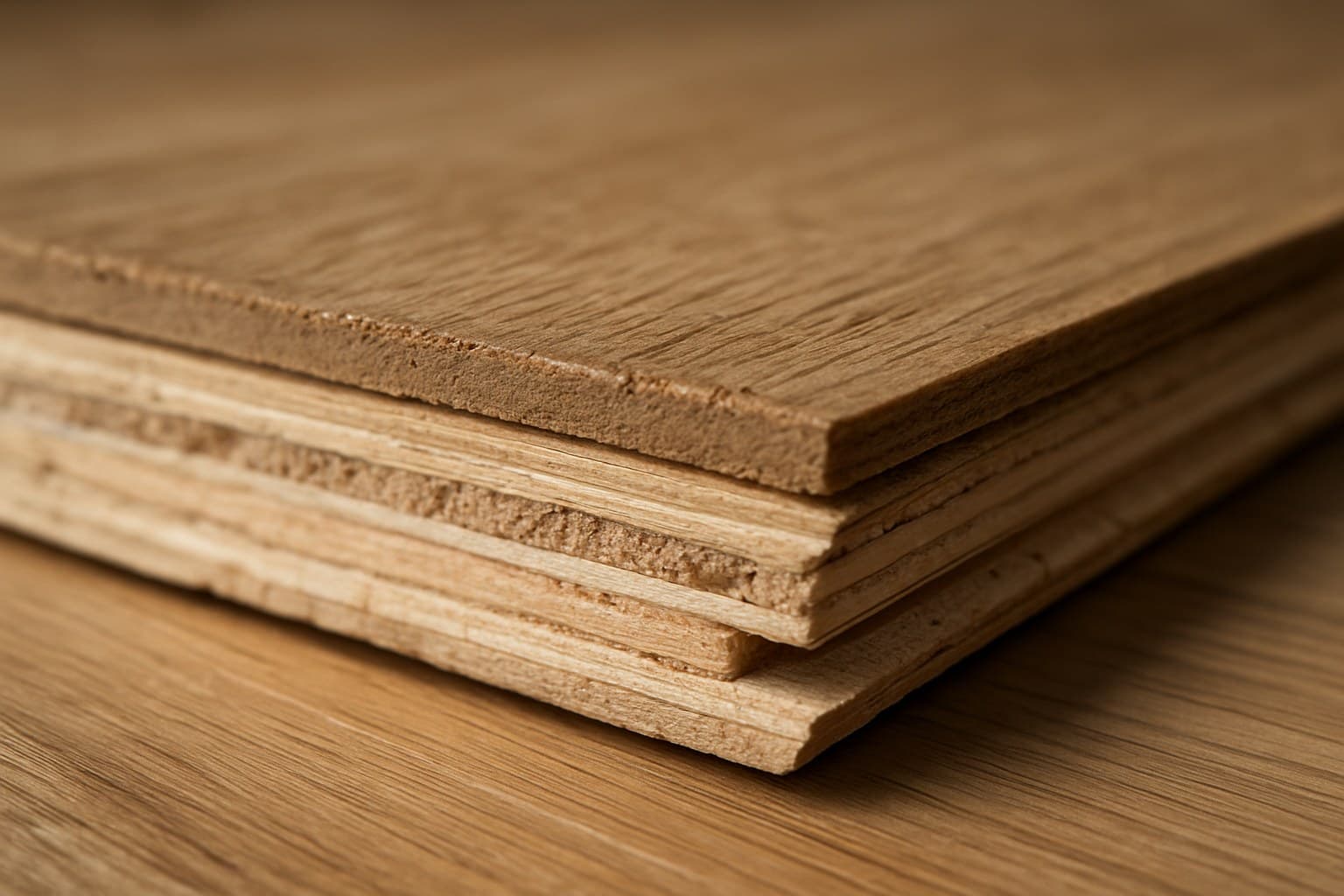
Look at the plank's cut edge. You can usually see the line where the real-wood grain of the veneer stops and the layered core begins. That grain band is your wear layer, and it's the honest way to judge a floor at the sample rack.
Watch the spec sheet, too. Some blur total board thickness and wear layer together, or list only the overall millimeters. Measure the veneer band on the edge, not the whole plank, or you'll pay for stability you can't ever sand.
Cut Methods: Sawn, Sliced, and Rotary-Peel
How the veneer is cut ties straight to its thickness, look, and price. Sawn means the veneer is dry-sawn off the log like a thin solid board, which allows the thickest layers. Sliced means the log is shaved into sheets, giving a mid-range, even grain. Rotary-peel means the log is spun and peeled like unrolling a paper towel, which makes the thinnest, cheapest veneer with a wilder, plywood-like figure.
| Cut method | Typical wear layer | Grain look | Best for |
|---|---|---|---|
| Sawn (dry-sawn), DuChateau Longboards | 6mm | Most like solid wood | High-traffic, keep-for-decades floors |
| Sliced, Mullican Wexford | 4mm | Clean, consistent grain | Everyday living areas, most homes |
| Rotary-peel, Mohawk UltraWood Elements | Under 2mm | Wilder, plywood-like figure | Budget or light-traffic rooms |
Source: how these cut types and thicknesses have held up across the kid-and-dog houses I've floored
These pairings of cut method, brand, and thickness are commonly cited examples, not verified against each brand's current published spec sheet, always confirm cut method and wear-layer thickness on the specific product you're buying.
Cut method matched to the wear-layer thickness on DuChateau Longboards, Mullican Wexford, and Mohawk UltraWood Elements, plus the rooms each one suits.
Put it together at the rack: match cut and thickness to your traffic. A busy household you'll keep for years wants sawn 3-6mm. A normal living room does fine on sliced 3-4mm. A guest room on a budget can live with a thinner rotary-peel plank.
Sources
- NWFA Refinishable Program, Certification Criteria (2022)
- NWFA Refinishable Program, Program Overview (Updated August 2023)
- NWFA Engineered Wood Flooring Environmental Product Declaration (EPD, June 2025)
- NWFA Life-Cycle Cost Analysis (LCCA) Sales Sheet, TISE 2024
- NWFA Hardwood Floors Magazine, Refinishable Flooring Feature (Aug/Sept 2022)