
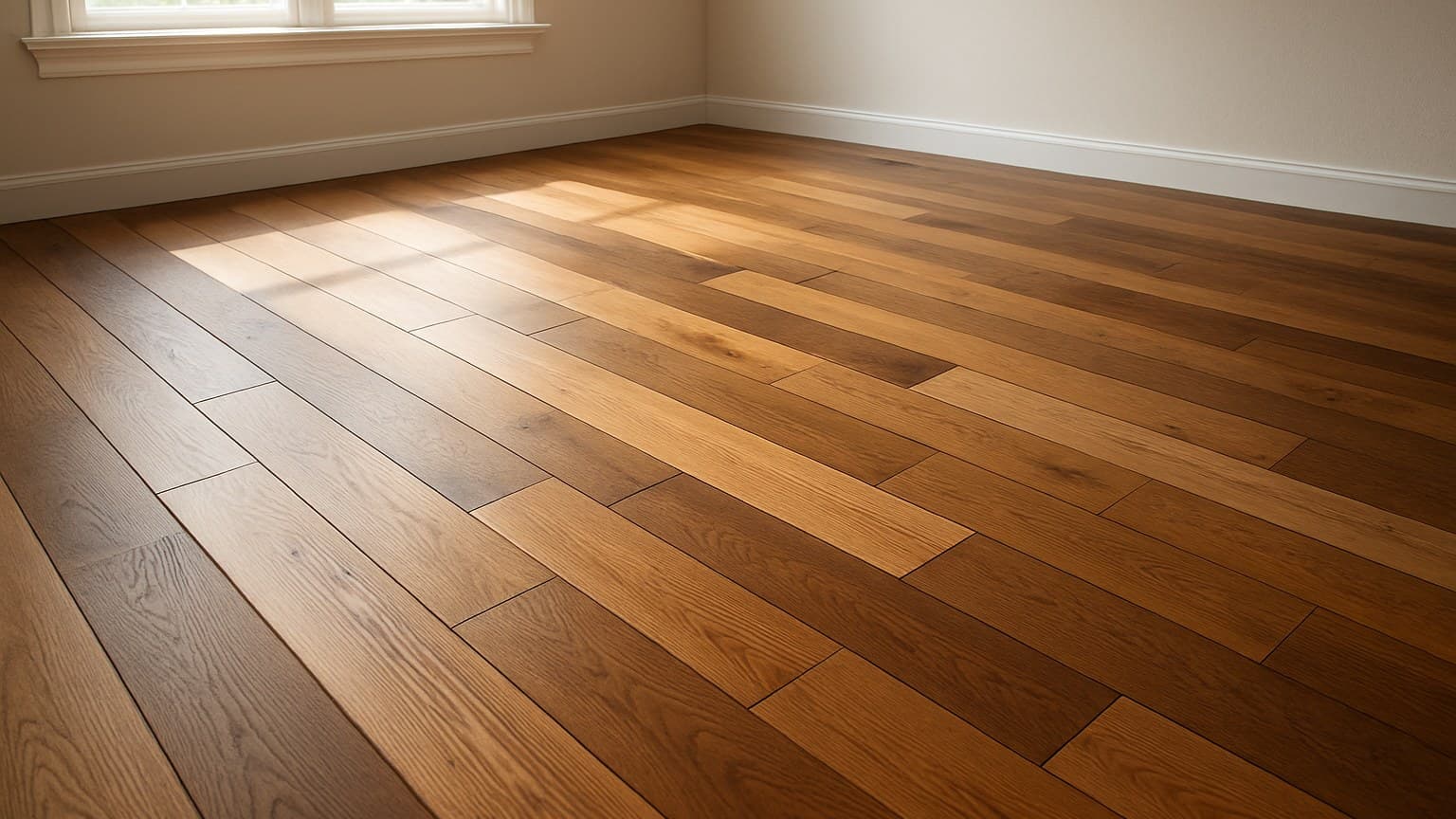
On a 1920s bungalow remodel in Waxahachie, Texas, my client Denise wanted a floor that looked like it had always been there, not one laid last month. I've installed hardwood professionally for better than a decade, and this was the job I refer back to most, because it's the clearest case I've seen of a floor going right or wrong on two decisions made before a single board was nailed down. Random width hardwood flooring goes wrong in two quiet places, and neither is the wood itself: the width mix you order, and the end seams you let fall into a pattern. Both get decided before you ever pick up a nailer, at the order desk and during dry layout. Get those two right and the floor reads custom instead of accidental.
Key takeaways
- Random width means mixing plank widths (say 3", 5", and 7") in one floor; wide plank is one wide size repeated over and over.
- On a concrete slab or in a basement, engineered handles moisture better; solid is fine on a wood subfloor above grade.
- Order 10-15% extra for random width, more than the 5-10% you'd add for uniform strip, because you cull and sort more boards.
- Keep end joints staggered at least 6 inches apart and dodge H-joints and stair-steps, or 'random' just looks sloppy.
- NWFA/NOFMA width tolerance: boards under 3" hold to about plus or minus 0.005", boards over 3" to about plus or minus 0.008".
Random Width Hardwood, in One Answer
Random width means one floor built from two or more plank widths mixed together, a common combo being 3-inch, 5-inch, and 7-inch boards. Wide plank, by contrast, is a single wide size repeated across the whole room. If you're weighing whether to go with solid wood at all, it's worth stepping back to compare bamboo flooring versus hardwood before you settle on a width strategy.
People reach for it because it reads as older, hand-laid, and custom. That's honest history, not marketing: floors were milled in mixed widths for a long time before uniform strip took over, so the mix looks like an old house because it basically is one. That same hand-laid impression is exactly what buyers are chasing when they ask how to spot genuine hand scraped hardwood flooring instead of a machine-distressed imitation.
Done wrong, it looks chaotic instead of characterful. The difference comes down to the width mix and the end-joint stagger, and both are things you control. So this article settles three decisions first, then hands you the ordering and racking math to act on. Before you get that deep into layout, though, it's worth weighing the broader pros and cons of hardwood flooring against other materials entirely.
Random Width vs. Wide Plank vs. Standard Uniform
Pick random width for character and old-house feel, wide plank for a clean statement, and standard strip for the lowest cost and easiest resale. That's the short version. Here's the reasoning. Whatever mix you land on, it's worth learning how to tell a genuine hardwood flooring sale discount from a markup-then-markdown trick before you order.
Standard strip is tidy and modern, and it's the cheapest to buy and install. Wide plank is bold and clean, but it's also the least forgiving: a single wide size repeated shows every gap, cup, and subfloor high spot, because your eye reads it as a grid and hunts for anything off. Random width hides small subfloor flaws better, since the eye stops looking for that grid once the widths change.
| Layout | Widths | Look | Hides subfloor flaws | Relative cost |
|---|---|---|---|---|
| Standard strip | 2.25"-3.25", one size | Tidy, uniform, modern | Some | Lowest |
| Wide plank | 5"+, one size | Bold, clean, statement | Least (shows gaps and cupping) | Higher |
| Random width | Two or more mixed (e.g. 3"/5"/7") | Custom, old-house, farmhouse | Most | Higher, plus more waste |
Source: how these three layouts have actually installed and held up across the floors I've laid
I based this comparison on how these three layouts have actually installed and held up across the floors I've laid.
How the three layouts compare on look, how well they hide subfloor flaws, and relative cost.
Solid vs. Engineered for a Random-Width Install
The decision driver here is where the floor goes, not how it looks. Wider boards move more with moisture than narrow strips, so a concrete slab or a basement pushes you toward engineered. If you want the fuller breakdown of solid versus engineered by room and species, this guide to picking solid vs. engineered hardwood floors walks through it in more detail.
Solid random width is fine on a wood subfloor above grade, and it can be sanded and refinished several times down the road. Engineered's plywood-style core stays more stable across wide boards over concrete and below grade, which is exactly where a wide random plank would otherwise cup or gap on you. Pergo is one of the more recognizable names building engineered-style planks for exactly these tougher subfloors, so it's worth reading whether Pergo hardwood flooring actually holds up like real wood before you commit.
Radiant heat is the other driver I get asked about as often as slabs and basements, and it deserves the same up-front answer: solid wood and radiant heat don't mix well, especially at wider random widths. Solid boards move as a single piece of wood, and the repeated heating and cooling cycle under them drives more expansion and contraction than a wide board can absorb without cupping or gapping at the seams. Engineered's cross-layered core is built to stay flatter under that cycling, which is why it's the construction manufacturers and installers reach for over radiant systems. If your subfloor has radiant heat in it, treat that as settled in favor of engineered before you even get to the slab-or-basement question, and confirm the specific product is rated for radiant use on its own spec sheet.
One refinishing caveat, and it's a spec question, not a rule of thumb: an engineered board's veneer (the real wood layer on top) has a thickness the maker publishes, and that thickness caps how many times, if ever, you can sand it. Check that board's own sheet before you assume you can refinish it later. If you're leaning engineered, it's worth reading up on click-lock engineered floors before you commit, since the install method changes what you can DIY.
Either way, run the maker's required moisture retarder or underlayment, the NWFA's installation guidelines call this out as standard prep for both solid and engineered jobs, and check subfloor moisture with a meter, a handheld tool that reads how wet the wood or slab is, before a single board goes down. On floating and nailed floors alike, the warranty hinges on that prep as much as on the plank you picked.
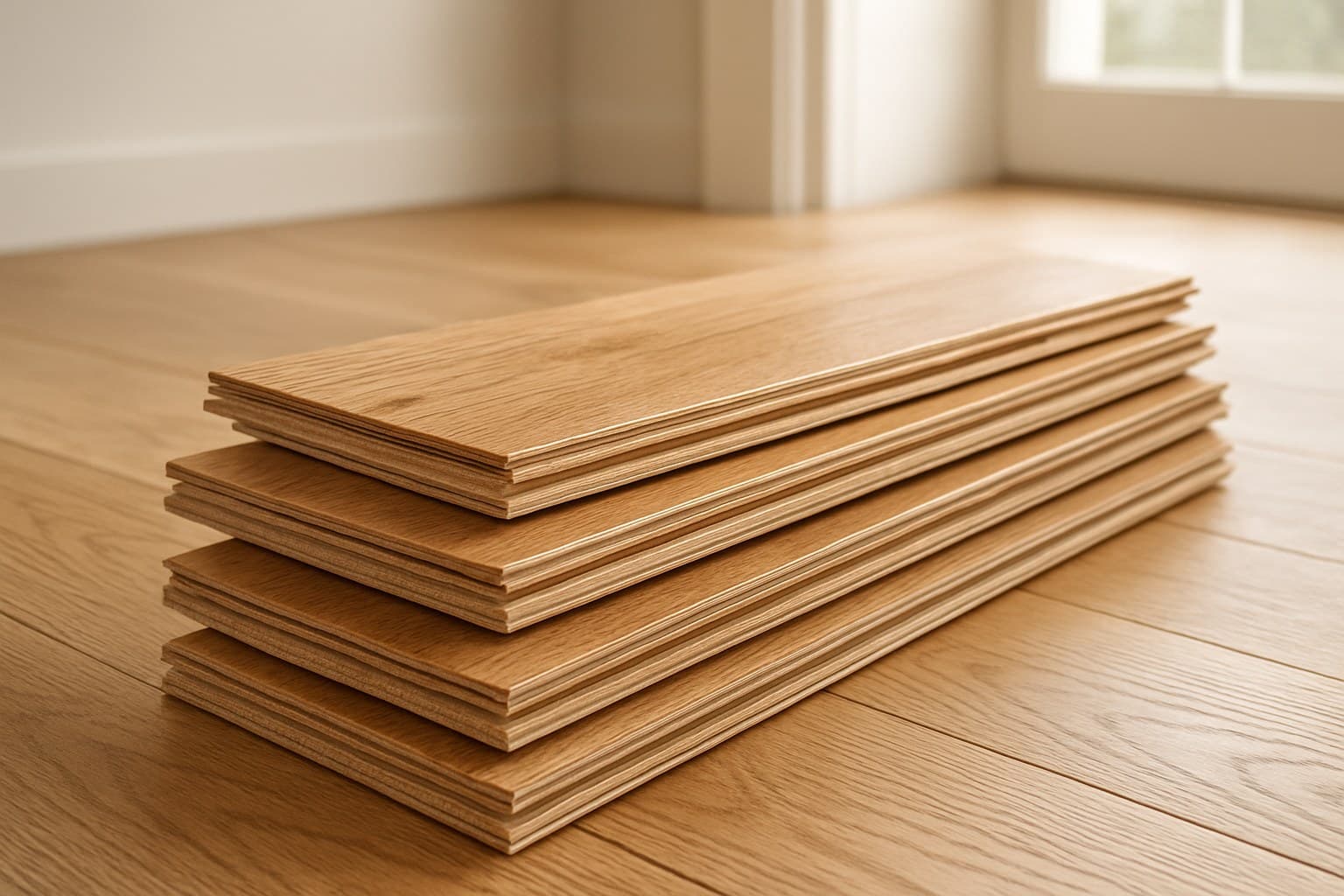
Order It Right: Width Mix, NWFA (National Wood Flooring Association) Tolerances, and Waste Math
There is no standard mix ratio, and that's the honest answer most pages dodge. The NWFA (National Wood Flooring Association) Homeowner's Handbook to Real Wood Floors documents a real 2"/3"/5" example, and a common starting split I use is roughly equal footage of each width, then I adjust by eye once boards are on the floor.
The order math is simple. Order amount equals room square footage times (1 plus your waste factor). Random width needs a bigger waste factor than uniform strip because you sort and cull more boards to get the mix and color right.
Worked example: a 500 square foot room at a 15% waste factor is 500 times 1.15, which is 575 square feet to order. I add 10-15% for random width versus the 5-10% I'd add for standard strip. And I count cut-heavy areas, closets, doorways, a bay window, separately, because the open middle of a room is never where the footage disappears.
| Room size | Add 10% | Add 15% |
|---|---|---|
| 200 sq ft | 220 sq ft | 230 sq ft |
| 500 sq ft | 550 sq ft | 575 sq ft |
| 1,000 sq ft | 1,100 sq ft | 1,150 sq ft |
| 1,500 sq ft | 1,650 sq ft | 1,725 sq ft |
Source: the extra footage I've had to eat sorting random-width boxes on jobs full of closets
These waste-factor numbers come from the extra footage I've had to eat sorting random-width boxes on jobs full of closets.
Rough footage to order for a random-width floor at a 10% and 15% waste factor.
One spec worth flagging: according to the NWFA/NOFMA factory-finished flooring standards, width tolerance runs about plus or minus 0.005 inch for boards under 3 inches, and about plus or minus 0.008 inch for boards over 3 inches. So slightly wider seams between your wide boards are normal and within spec, not a defect to send back.
Racking Patterns That Don't Look Random-Bad
"Racking" just means laying out several rows dry, without fastening, so you can see the pattern and fix it before it's permanent. It's the step that decides whether "random" looks intentional or sloppy.
Two failures to hunt for as you rack. An H-joint is two end seams nearly lining up with only one row between them, which draws an "H" your eye catches instantly. A stair-step is seams marching in a repeating diagonal, and once you see it you can't unsee it.
The rule that keeps random looking on purpose: per NWFA installation guidelines, stagger end joints at least 6 inches from the seams in the rows beside them, and don't repeat the same width in the same spot row after row. Mix widths within each row too, not just between rows, and pull boards from several boxes at once so color and width scatter evenly instead of clumping.
Install method follows construction. Solid goes down with staples or nails into wood. Engineered can glue, float, or staple depending on the maker's guide. All of it goes over a subfloor you've already checked flat and dry.
Drawing is not to scale; it shows seam placement, not real plank sizes.
Cost vs. Standard Width, and Who Should Buy It
Random width costs more than standard strip on both lines of the bill, and there's no honest flat national number, so treat these as ranges to confirm with local quotes. Materials run higher per square foot because you're buying wider, often nicer boards. Labor runs a bit higher too, because sorting and racking the mix takes longer than knocking down uniform strip.
| Line item | Standard strip | Random width |
|---|---|---|
| Materials (oak, per sq ft) | roughly $4-$8 | roughly $6-$12 |
| Labor (per sq ft) | roughly $3-$6 | roughly $4-$7 |
| Extra waste to buy | 5-10% | 10-15% |
Cost ranges for oak; they swing by region, species, and how much prep the old subfloor needs.
Two premiums to plan for. Basements and stairs cost more than an open room, because both mean more cutting, fitting, and slower going. And that extra 5%-or-so waste on random width is a real line item, not a rounding error, so put it in the budget. For a fuller picture of species-driven pricing, see what walnut hardwood actually costs before you settle on a wood.
Who should buy it: random width suits character-forward and older homes, and anyone who wants a custom look and will accept the extra waste. On species, white oak and plain oak are the safe, hard, widely stocked picks. Hickory reads more rustic and busy, which can be great in a farmhouse look or too loud in a small room, so sample it in the actual space first. Go standard strip for a tight budget and simplest resale, and wide plank when you want bold and clean and your subfloor is dead flat.