
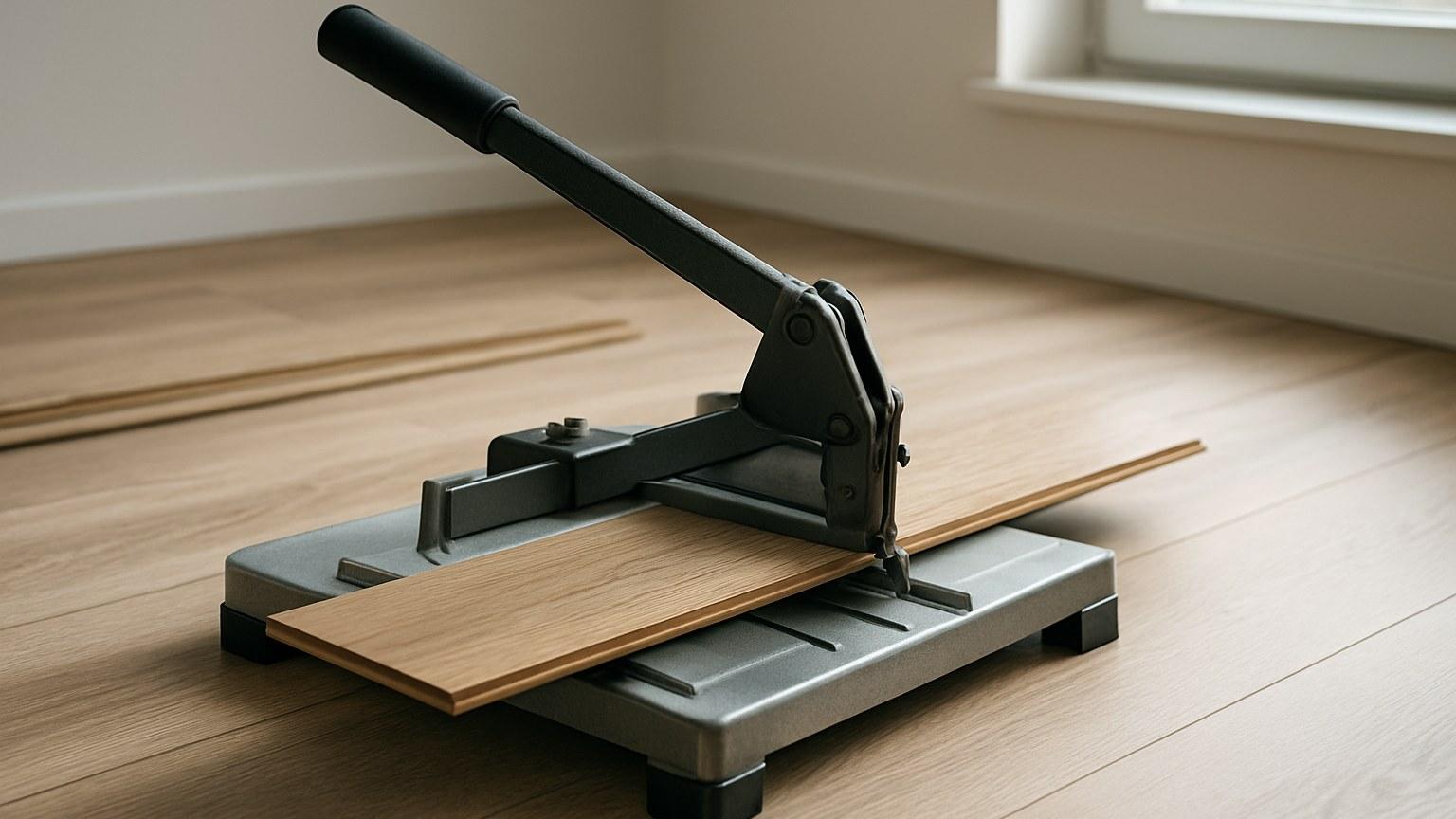
A laminate flooring cutter is a guillotine: a blade on a lever presses straight down, scores the plank, and snaps it clean with no dust, no cord, and no motor noise. That's the trick, and it's a good one, but it does exactly one cut, a straight crosscut across the plank's width. Every notch, rip, and curve in your room needs a different tool, which is where a lot of first-time installers get caught short.
Key takeaways
- A laminate flooring cutter is a guillotine: a blade presses down to score and snap planks with no dust, no motor noise, and no cord, so you can cut in the room you're flooring.
- It makes exactly one cut well, a straight crosscut across the plank's width. It can't rip a plank lengthwise, notch around a jamb, or cut a curve.
- Plan on a second tool: a jigsaw or oscillating multi-tool for notches, and a circular or miter saw with a fine-tooth blade for lengthwise rips.
- Vinyl plank cuts cleaner in the same guillotine than laminate does, because vinyl bends instead of chipping.
- Rent for a one-room weekend job; buy only if you'll reuse it. The cutter handles crosscuts, not the whole install.
What a Laminate Flooring Cutter Actually Is
Picture a heavy paper trimmer built for flooring. A blade mounted on a long lever presses straight down onto the plank, and the plank breaks along that line. There's no spinning blade and no sawing motion involved, just a straight press.
You won't deal with a dust cloud, a loud motor, or a cord to plug in. You set it up right in the room you're flooring and cut each piece where you stand, instead of walking a plank out to the garage every time you need a few inches off the end.
The cut works because the sharp blade presses through the printed wear layer on top and into the dense fiber core underneath. That core is HDF (high-density fiberboard), the pressed wood-fiber board most laminate is built on. The blade scores a line, the core gives, and the plank snaps.
So that's what it is: a fast, quiet tool for one specific cut. Not the whole kit. The rest of this breaks down what it nails and where you'll still need a saw.
Do Laminate Floor Cutters Work, and Are They Any Good?
Yes, for a straight crosscut across a plank's width they work great. Fast, silent, and dust-free. The catch is that a straight crosscut is the only cut they do.
Where the cutter earns its spot is the finished edge. With a sharp blade and a plank it's rated for, you get a square, splinter-free edge that tucks tight under baseboard or hides at a seam. You skip hauling planks outside to cut and skip vacuuming up afterward.
The downside shows up when the blade goes dull, or when you feed it a plank thicker and denser than the cutter is built for. Then you get a chipped wear layer or a fuzzy, torn edge, and those chips show at the seams where two planks meet.
Cut quality rides on three things: how sharp the blade is, how thick the plank is, and how hard the core is. So "are they any good" really means "does this cutter match your plank." Get that match right and the edge is clean every time.
The Cuts a Laminate Cutter Can't Make (So You Still Need a Second Tool)
The guillotine only crosscuts straight across the plank. It can't rip a plank lengthwise, notch around a door jamb or a pipe, or follow a curve. Every one of those shows up in a normal room. Getting each of those cuts right, and knowing which side of the plank to cut from, is worth walking through in detail in a dedicated guide to cutting laminate flooring.
The lengthwise rip is the big one. The last row almost never lands at a full plank width, so you have to slice a plank down its length. That's a job for a table, track, or circular saw fitted with the right circular saw blade for laminate so the top layer doesn't chip as the blade exits.
Notches are next. Door casing, radiator pipes, and closet corners all need a piece cut out of the plank, and that's where a jigsaw or an oscillating multi-tool comes in.
Door jamb undercuts are their own thing. Instead of notching the plank to fit the jamb, you trim the bottom of the jamb so the plank slides under it. An oscillating multi-tool or a jamb saw does that flat against the floor. Curves and odd shapes go to the jigsaw.
Most rooms need at least one of these alongside the cutter. A plain rectangular room with no pipes and a doorway or two is about the only time you'd get away with the guillotine and nothing else.
Hand Cutter vs Jigsaw and Circular Saw: Which to Reach For
Quick verdict: reach for the hand guillotine when you want quiet, clean crosscuts; a jigsaw for notches and curves; a circular or miter saw for fast rips and high-volume cutting, trading quiet for dust and noise.
A "laminate cutter hand tool" is the lever-and-blade guillotine: no power, no dust, one cut type. That's the whole category, whatever the listing calls it.
On the "best," "heavy duty," and "professional" labels, don't read too much into them. The bigger cutters just handle thicker, wider planks and harder cores. Someone cutting all day still keeps a saw on the truck for the cuts the guillotine skips, because there's no model that notches or rips.
| Tool | What it cuts | Dust | Noise | Best for |
|---|---|---|---|---|
| Guillotine hand cutter | Straight crosscuts only | None | Silent | Fast, clean width cuts indoors |
| Jigsaw | Notches, curves, irregular shapes | Moderate | Loud | Door casing, pipes, closets |
| Circular / track saw | Lengthwise rips, long straight cuts | Heavy | Loud | Last-row rips, bulk cutting |
| Miter saw | Repeated square crosscuts | Heavy | Loud | High-volume crosscutting at a station |
| Oscillating multi-tool | Jamb undercuts, tight notches | Light | Moderate | Undercutting door jambs in place |
What each tool cuts, plus the dust and noise tradeoff for a typical laminate install.
Cutting is only one piece of the job. You'll also want the rest of the laminate flooring tools, including a tapping block, spacers, and a pull bar to draw the last row tight against the wall where you can't swing a mallet. If you're buying everything at once, it's worth looking at a full laminate flooring installation kit instead of piecing it together.
The Best Tool to Cut Vinyl Plank Flooring (Does It Work on LVP?)
For cutting vinyl plank, a guillotine-style cutter or a simple score-and-snap with a sharp utility knife works well, because vinyl is soft enough to cut clean with no chipping and no dust.
Vinyl actually cuts cleaner in a guillotine than laminate does. It bends and shears instead of shattering, so you get a smooth edge without the chip risk you fight on dense HDF. The same tool often sells as a vinyl flooring cutter, so you can use one guillotine for both materials.
How you cut depends on the plank. Thin, flexible LVP (luxury vinyl plank) scores easily: run a utility knife along a straightedge, bend the plank, and it snaps. Thick rigid-core plank is stiffer, so a guillotine cutter or a fine-tooth saw does a better job than a knife.
One thing holds true across both materials: notches and curves in vinyl still want a jigsaw, or a knife and straightedge for straight interior cuts. One tool won't do every cut, same as laminate.
Buy or Rent? Where to Get a Laminate Cutter
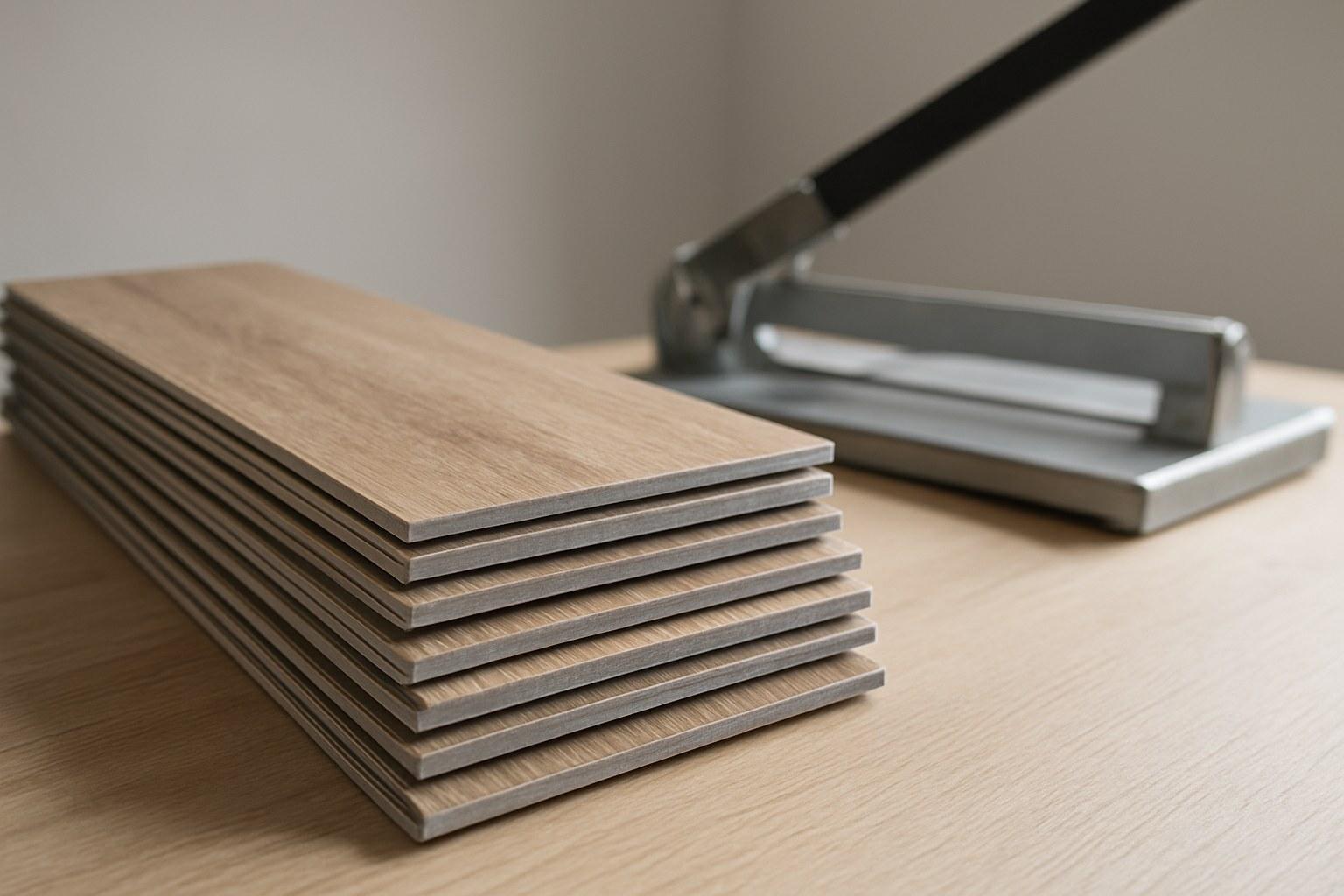
Rent if it's a one-room weekend job. Buy if you'll reuse it across several rooms or expect more flooring down the road. That's the whole decision.
Where you get one depends on which version you need. Home-center tool-rental counters rent guillotine cutters by the day, which is the cheapest path for a single room. Discount tool chains sell cheap entry-level cutters built for thinner planks. Flooring suppliers carry the heavy-duty ones that take wide, dense boards, and that's where you go if your plank is thick enough to chip in a bargain cutter.
Price swings with the cutter's size, its cutting width, and whether you rent or buy, so there's no one number. Check the daily rental rate against the price of a cheap buy before you commit. On a small job the rental often wins; on a big one the tool pays for itself.
I've rented a guillotine cutter plenty of times for a single-room job, and it almost always beats buying one that just sits in the garage afterward. If you're doing more than a room or two a year, though, the math flips, a cutter you own pays for itself after a couple of jobs instead of racking up rental fees each time. For a single hallway or closet, renting for the day beats buying a tool that then lives in the garage.
Before you cut a single plank, check the subfloor is flat and dry, because the durability of a floating laminate floor depends on the prep under it, and most makers tie their warranty to that, not to your cuts. If you want the full rundown of what to have on hand, the tools needed to install laminate flooring guide walks through the whole kit so you're not making a second hardware run mid-install. That same moisture sensitivity is also why laminate suits some rooms far better than others, a distinction covered in this guide to where laminate flooring works best.