
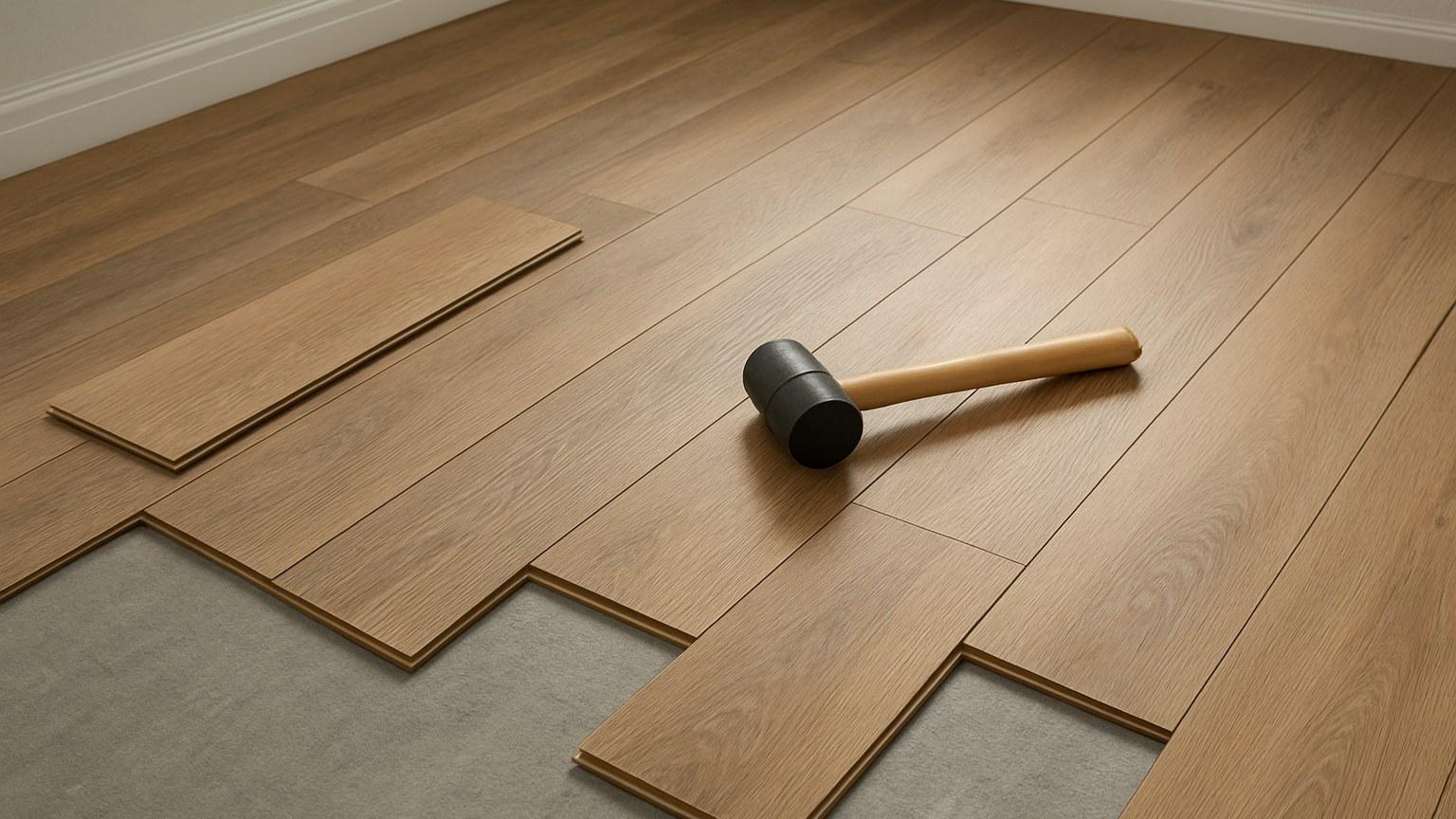
On a NuCore floor, the plank itself rarely fails. The core is waterproof and the wear layer takes everyday abuse. What gives out is the seams and the perimeter, where water sneaks under the floor and sits on the subfloor long after you've mopped it up. That's a meaningfully better failure pattern than some of the names that show up again and again in rankings of the worst vinyl plank flooring brands, where the plank material itself is often the first thing to go.
That gap between the box word and the real room is where NuCore trips people up. Below, I break down what holds up, what doesn't, and what it actually costs you installed.
Key takeaways
- NuCore is Floor & Decor's own rigid-core waterproof vinyl plank brand, not the Northwestern NUcore billing system or the NuCore AI building platform.
- The plank core is waterproof, but seams and the perimeter are where water actually reaches the subfloor, so the box word doesn't cover the whole room.
- Most NuCore lines run about $1.50-$4 a square foot for materials before labor, according to dgfloors.com.
- NuCore planks ship with attached cork or foam backing, so a second underlayment usually isn't needed and can void the warranty.
What NuCore Is, and Who Makes It
NuCore flooring is Floor & Decor's own rigid-core waterproof vinyl plank. If a search sent you somewhere strange, note that the same name lands on Northwestern's NUcore billing system and NuCore AI Foundation, a smart-building platform group. Neither of those has anything to do with flooring.
Floor & Decor sells NuCore as a house brand, which means you buy it through them and nobody else. That matters down the road: because it's a house brand, a color or line can get retired, and matching a plank later is harder than with a national brand. If you ever hit that wall, our guide on finding and matching discontinued vinyl flooring walks through it. If buying from a brand carried by multiple retailers instead matters more to you than price, Mannington's flooring lineup is one of the bigger national names worth cross-shopping.
A NuCore plank is built in four layers, top to bottom. A clear vinyl wear layer takes the scratches and scuffs. Under it sits a printed design layer, the photo that gives the plank its wood or stone look. Below that is the rigid waterproof core that keeps the plank flat and stable. At the bottom is an attached cork or foam backing that softens the step and quiets the floor.
Thickness varies by line. According to inmyownstyle.com, the NuCore planks it measured came in at 6.5mm, but thickness and wear layer both shift from one line to the next, so read the sheet on the exact product you're buying.
Is NuCore Good? Where It Fails and Where It Holds Up
The plank face and core hold up well. My work has shown that the plank is almost never the real trouble. It's the seams and the perimeter, where water finds its way down to the subfloor and does the damage you don't see until the planks start to lift.
The wear layer shrugs off daily traffic, pets, and furniture as long as you put felt pads under chair and table legs. According to inmyownstyle.com, the same 6.5mm NuCore planks it tested carry a 15-year residential warranty, and the site got about 6 years of real use out of them across 4 rooms. That tracks with what I see: the surface is tough enough for a busy household.
What "Waterproof" Does and Doesn't Cover
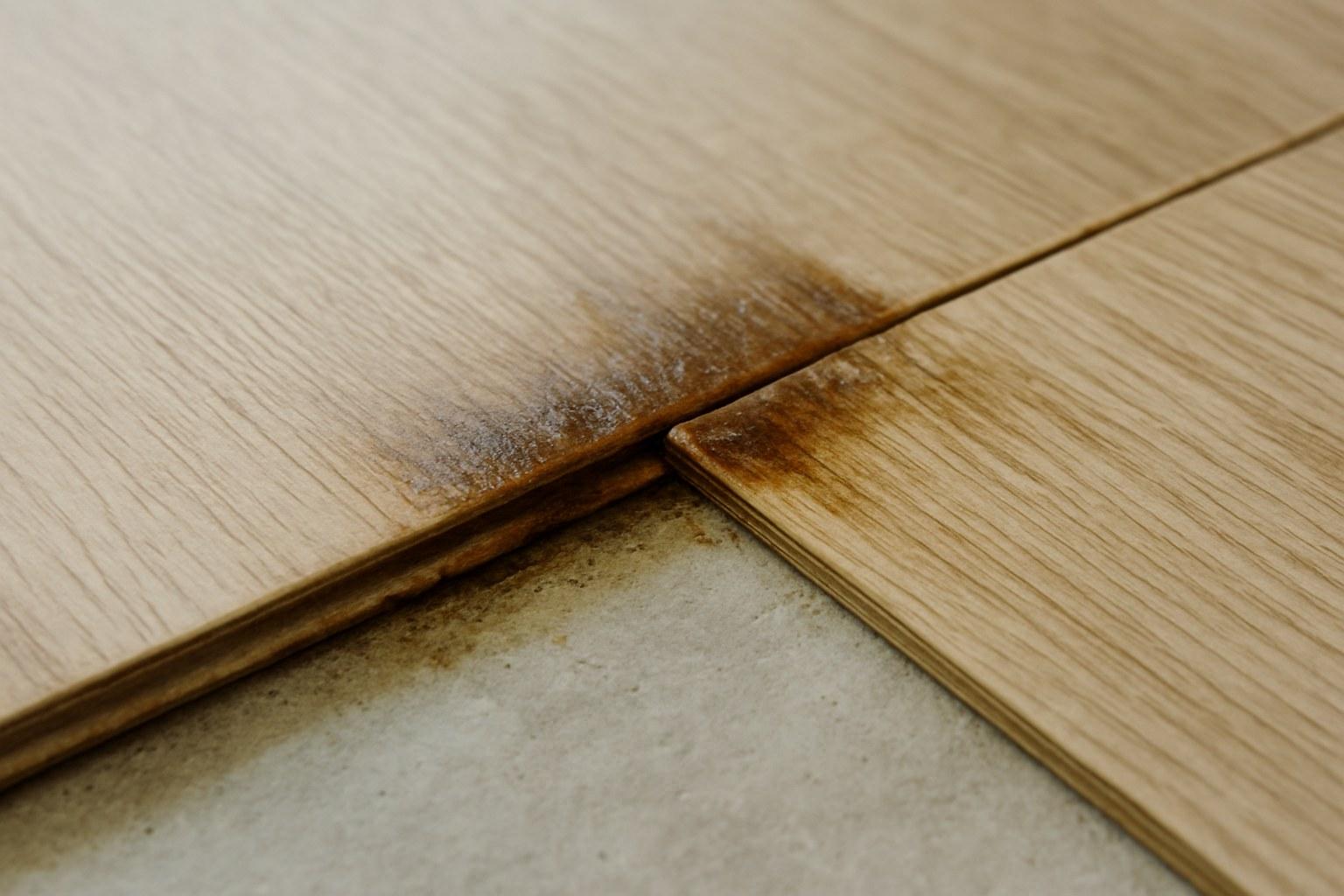
On a NuCore box, "Waterproof" describes only the plank material, it doesn't apply to the joints or the room. The core won't swell when water touches it. But a floating floor isn't sealed to the subfloor, so water can run through a seam or slip under the baseboard at the perimeter, pool below, and ruin the subfloor while the planks sit there looking fine.
I pulled up a kitchen floor near Columbus where a dishwasher had been seeping for weeks. The NuCore planks themselves were in good shape. The particleboard under them had swelled and gone soft right along the cabinet run, because the water sat in the perimeter gap under the toe-kick, the recessed strip at the floor along the bottom of the cabinets, with nowhere to go. The floor wasn't the problem. The water it trapped was.
So think of NuCore's waterproof claim as a property of the plank, not a promise about the room. Seal your seams where the install guide calls for it, caulk wet-area perimeters, and wipe spills before they travel.
Installing NuCore: Underlayment, Expansion Gaps, and Transitions
Before a single plank goes down, check that the subfloor is flat and run a moisture check. That holds whether you're over concrete, wood, or existing tile. The lifespan of a floating floor is controlled by the prep under it, and the manufacturer's warranty quietly hinges on that flatness and moisture control, not on the plank you picked.
Do You Need Underlayment Under NuCore?
Usually no. NuCore ships with cork or foam already attached to the bottom, so a second pad underneath is normally unnecessary and can actually void the warranty. Over concrete, the product sheet may still call for a vapor barrier, which does a different job than cushion, so read that sheet before you add anything.
Leave room to move. According to inmyownstyle.com, plan on a 1/4-inch expansion gap around the perimeter during install. The planks click together tongue-and-groove with no glue, so a clean, square room goes fast.
Plan your transitions door to door before you start. T-molding bridges two floors of the same height. A reducer steps down from the NuCore to a lower floor like tile or an entry slab. An endcap finishes the run at a doorway or a hearth. Running the subfloor flat and clean, skipping that second underlayment, holding the 1/4-inch gap, and mapping transitions ahead of time is the whole checklist that keeps a NuCore job from coming back on you.
Click-lock NuCore is realistic for most DIYers in a straightforward square room. Stairs, big open-plan runs, and spots where the floor meets a wet or uneven transition are where hiring a pro pays for itself.
What NuCore Costs and Where to Buy
Materials run roughly $1.50 to $4 a square foot depending on the line. The table below shows the per-product split that dgfloors.com publishes.
| NuCore line | Materials per sq ft |
|---|---|
| NuCore DryBack | $1.50-$2.50 |
| NuCore Performance | $2-$3 |
| NuCore with Attached Pad | $2.50-$3.50 |
| NuCore XL | $3-$4 |
Source: dgfloors.com
Labor costs are separate. According to dgfloors.com, professional install runs about $1.50 to $3 a square foot, while engineerhardwoodflooring.com puts it at $2 to $5. Basements and stairs cost more than an open room. If you're weighing vinyl specifically for a basement or bedroom, our breakdown of what decides vinyl flooring's lifespan covers the factors that push a floor toward 5 years or 20.
A Worked Cost Example for 1,000 Square Feet
Say you're doing 1,000 square feet of NuCore Performance. Materials at $2 to $3 a square foot come to $2,000 to $3,000. Labor at $1.50 to $3 adds $1,500 to $3,000. All in, that's roughly $3,500 to $6,000 before transition strips, since you won't need extra underlayment with this product. Do the install yourself and you drop the whole labor line.
NuCore sells one place: Floor & Decor, in-store and online. If you're pricing bulk, watch for wholesale LVP (luxury vinyl plank) deals and compare against its sibling lines like DuraLux Performance, Optimax Performance, and everENDURE, which often sit at similar price points. Our guide to telling a real wholesale vinyl plank deal from a marked-up sticker is worth a read before you commit to a pallet, since the per-foot math is where most "deals" quietly fall apart. If you're weighing that single-retailer setup against other options, our best places to buy vinyl flooring breakdown looks at what you actually get beyond the price tag.
Sources
- Dgfloors.com