
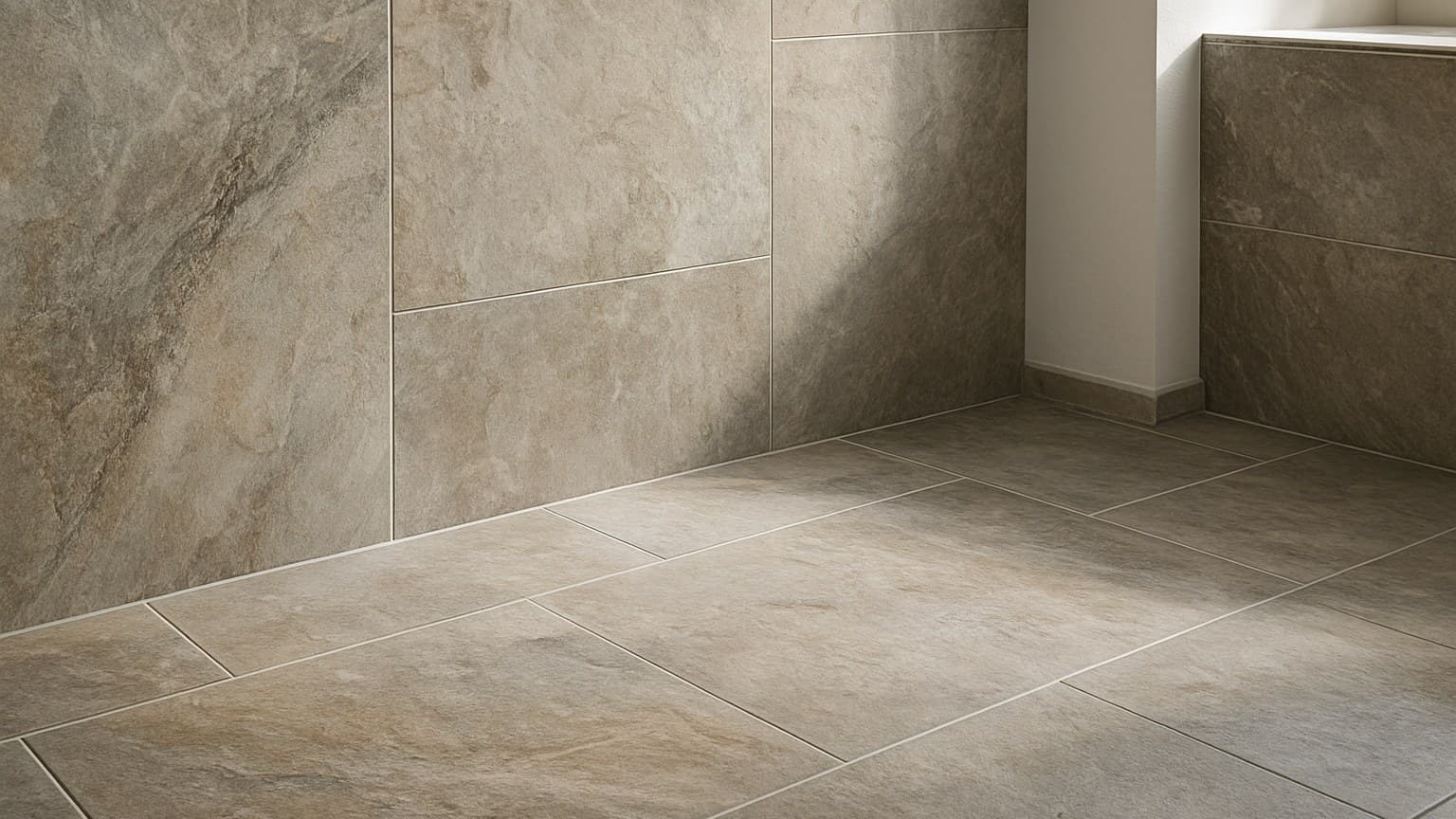
A customer in Austin once spread six tile samples across her kitchen table and dared me to pick out the real marble. I got it wrong, twice. That mix-up is exactly why buying stone look tile blind is so easy to get wrong: porcelain printed with a photo of real stone can look nearly identical to the real thing, or it can look like a placemat, and telling them apart before you buy is where a whole-floor mistake gets made.
Key takeaways
- Convincing stone-look porcelain uses many different face patterns (good lines run 10 or more), while cheap ones repeat the same 2-3 faces every few feet, which is the fastest way to spot a fake.
- For wet floors and showers, look for a DCOF slip rating of 0.42 or higher (ANSI A326.3); PEI 3 covers most home floors and PEI 4 handles kitchens and entries.
- Materials run roughly $2-15 per sq ft depending on tier, and labor adds about $5-15 per sq ft, with showers, bathrooms, and large-format slabs costing more than open floors.
- Unlike natural stone, porcelain never needs sealing; only the grout lines do.
- Large-format tile turns small subfloor dips into lippage, so a flatness and moisture check comes before the first tile, not after.
What Stone Look Tile Actually Is, and How the Look Gets Made
Stone look tile is mostly porcelain (sometimes ceramic) with a high-resolution photo of real stone printed onto it, then fired hard. You get the look of travertine, marble, or slate without the sealing and staining that real stone hands you.
Here's how the print happens in plain terms. A factory scans real slabs, then an inkjet printer lays that image onto the raw tile body. A clear glaze goes over the top and the whole thing gets fired in a kiln, so the pattern sits under a hard surface that takes foot traffic. It's the same idea as a photo printed on a mug, just built to be walked on.
The porcelain-versus-ceramic split matters more than the racks let on. Porcelain is denser and, by the industry definition, absorbs about 0.5% water or less, which is why it holds up on floors, in showers, and outdoors. Ceramic is more porous and softer, so it's fine on a low-traffic wall but not where water and weight pile up.
That leaves one thing that decides everything else: how good the print is, and how many different stone faces they bothered to print. That's what separates a tile that reads like real stone from one that looks like a cartoon of it, and it's what the rest of this breaks down.
The Stone Styles You'll See, and How Convincing Each One Is
Some stones fake far better than others, and it comes down to how varied and matte the real version already is. The busier and more random the real stone, the easier it is to hide a print.
Slate and concrete-effect are the easiest wins. Real slate is already all over the place in color and texture, and real concrete is matte and plain, so a printed version doesn't have much to give itself away. On the floors I've laid, a good matte slate-look porcelain in a shower reads as the real thing even up close.
Travertine and limestone land in the middle. They read well when the tile is embossed, meaning the surface has real dips and pitting pressed into it that line up with the printed holes and grain. Skip that texture and travertine especially starts to look like a sticker.
Marble is the hard one. Your eye knows real marble veining flows across a whole slab and never repeats, so the second you see the same vein pattern show up on the next tile over, the illusion breaks. Cheap marble-look tile is where you catch the repeat fastest. Vinyl sidesteps that repeat problem differently, staggering veining across long printed runs of sheet or plank instead of tile to tile, which is why comparing marble vinyl flooring formats by room and budget is worth doing before you rule out a synthetic floor entirely.
| Style | How convincing | Watch for | Best use |
|---|---|---|---|
| Slate | Very good | Flat, un-textured surface | Showers, entries, floors |
| Concrete-effect | Very good | Too-uniform color | Open living floors, modern spaces |
| Travertine | Good | No embossed pitting to match print | Bathrooms, patios, walls |
| Limestone | Good | Repeated soft mottling | Living areas, walls |
| Marble | Hardest to fake well | Same vein pattern repeating | Feature walls, fireplaces, low-traffic floors |
| Source: my own install jobs |
Spotting a Convincing Stone Look From a Cheap Fake
The single biggest tell is the number of different faces. Quality lines often print 10 or more unique patterns, so you can walk a whole room before you see the same "stone" twice. Budget lines may cycle through as few as 2-3 faces, and once your eye catches that repeat, you can't unsee it across the floor.
Next, run your hand over it. On good tile the texture you feel lines up with the grain you see: press into a printed crack and there's a real dip there. Cheap tile is a flat, glossy photo with no relief under your palm, the same thing that gives away a laminate countertop.
Finish and edges matter too. A matte or honed (softly polished, low-shine) finish reads like real stone; high gloss reads plastic almost every time. Rectified tiles, meaning machine-cut to an exact size, let you run a tight grout line so the floor looks like joined slabs instead of a grid of squares.
Do one thing in the store that almost nobody does. Ask to lay out several boxes' worth on the floor and look at them in light coming across the surface at a low angle, not straight down. That raking light, light skimming sideways over the tile, exaggerates any fake sheen and makes a repeating pattern jump out before your money's gone.
The correct signs are on the left; the giveaways of a cheap tile are on the right.
What Stone Look Tile Costs: Materials vs. Labor
Materials typically run roughly $2-4 per square foot for budget lines, $4-8 for mid-range, and $8-15 or more for premium and large-format slab looks, though exact pricing varies by region, retailer, and time of year. That's tile only, before anyone sets it.
Labor is the part brand pages skip. Figure roughly $5-10 per square foot for standard tile and $8-15 for large-format in many markets, though local labor rates vary, because big slabs need two people, a leveling system to stop edges from sitting proud, and more prep to get the floor dead flat first.
The premiums are real and worth planning for. A shower, a bathroom full of cuts around the toilet and vanity, and basement or stair jobs all cost more per square foot than one open room. I stopped quoting flat rate by the square foot after a small bathroom with a bay-window nook and three doorways ate an extra day; the open middle of a room is never where the hours go, the cut-heavy edges are.
On the cost comparison brand pages tend to dodge: stone-look porcelain often costs less than natural stone in total cost of ownership, since you never seal it and it doesn't stain, though exact savings vary by project. The exception is a premium large-format slab look, which can land right in real-stone material territory once you add the harder install.
| Tier | Cost ($/sq ft) |
|---|---|
| Budget porcelain (materials) | 2-4 |
| Mid-range (materials) | 4-8 |
| Standard install (labor) | 5-10 |
| Premium / large-format (materials) | 8-15 |
| Large-format install (labor) | 8-15 |
Cost ranges per square foot, split into tile materials and install labor, before room premiums.
Sizes and Formats: From 12x12 to Large-Format Slabs
Pick the size around the space and the look you want. Mosaics and 12x12 tiles suit shower floors and niches because the extra grout lines give grip and bend around drains. 12x24 and 24x24 are the everyday floor sizes, and large-format slabs (24x48 and bigger) give that seamless stone-slab look on floors and feature walls. Matching size to location is really just the first step, so once you've narrowed the format, this breakdown of choosing stone look tile room by room walks through finish and grip needs for kitchens, baths, and entries specifically.
Rectified versus non-rectified is the detail that changes the look most. Rectified tiles are machine-cut to an exact size, so you can run a tight grout joint around 1/8 inch. Non-rectified tiles vary slightly in size, so they need a wider joint, around 3/16 inch or more, to hide the difference.
Wider grout lines read less like real stone. If a slab look is the goal, rectified edges plus a grout color matched to the tile do the heavy lifting. Contrast grout turns even a great tile back into an obvious grid.
Large-format has one string attached: the bigger the tile, the flatter your floor has to be. A small dip that a 12x12 tile would ride over becomes lippage under a 24x48, where one edge sits higher than its neighbor and you feel the ridge with a bare foot. Check flatness and moisture before the first tile goes down, not after. One thicker option natural-stone hunters miss: tiles around 3/4 inch and up, sold for outdoors, can be dry-laid on gravel or sand for a patio, no mortar needed.
Where to Put It, Room by Room (and the Slip Rating That Matters)
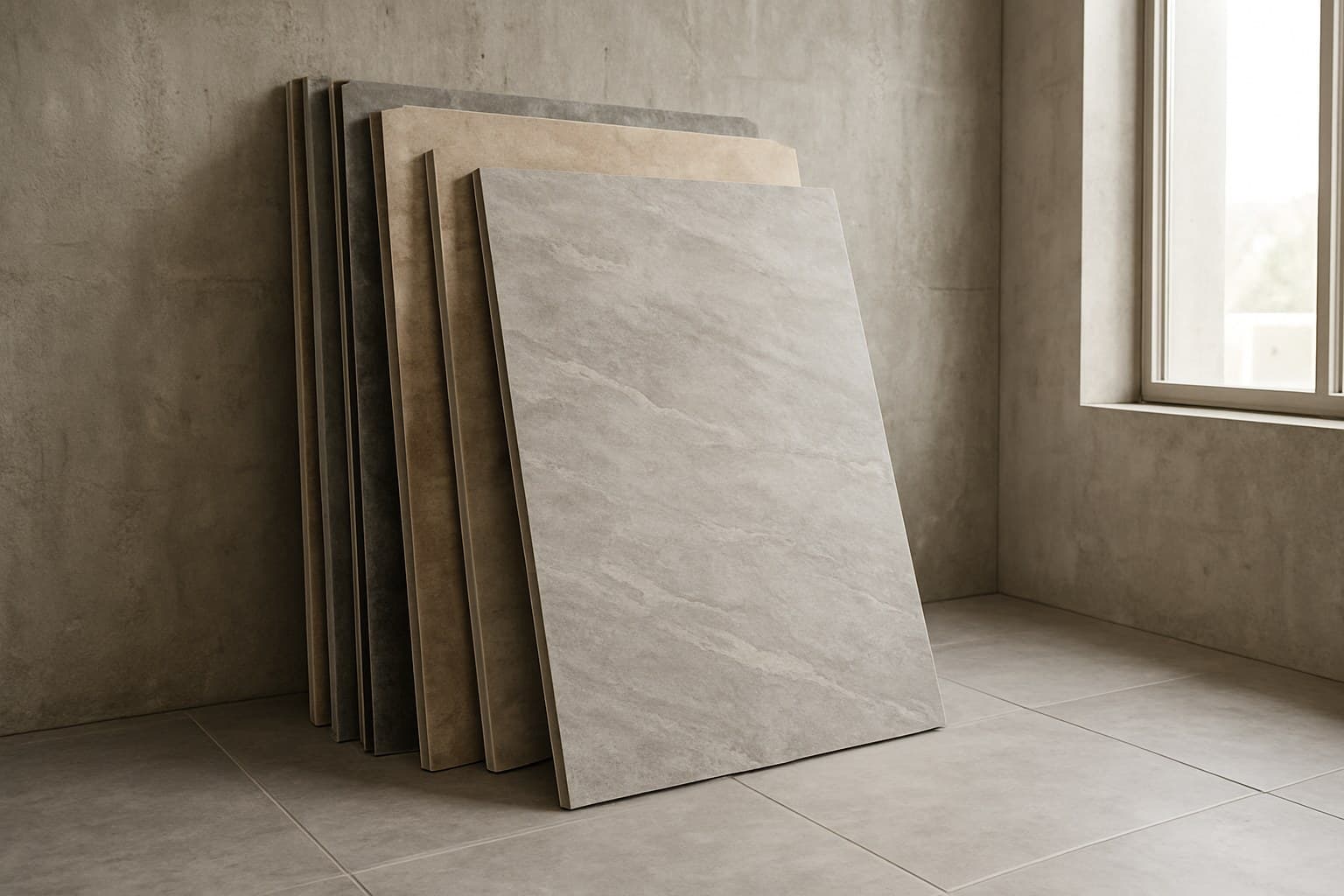
Two ratings decide where a tile belongs, and neither shows up on most brand pages. PEI is the surface wear scale from 0 to 5, where higher takes more traffic. DCOF is the wet-grip number, meaning how much friction the surface gives when it's wet. These two numbers are just the start; for the fuller picture of what decides whether your stone tile floor lasts, from substrate prep to sealing schedule, it helps to walk through all the factors that separate a floor that holds up from one that turns into a callback.
For the wear side, PEI 3 covers most household floors, and PEI 4 handles the busy, gritty rooms like kitchens and entries. Walls can use anything, since nothing walks on them.
For grip, the number to remember is DCOF 0.42 or higher for any floor that gets wet, which is the threshold set by the American National Standards Institute, or ANSI, in its tile industry standard ANSI A326.3. Below that, a wet bathroom or entry floor gets slick. A polished marble-look tile might be gorgeous, but if its DCOF sits under 0.42, keep it off the shower floor and put it on the wall instead.
Room by room, it sorts out like this:
- Bathrooms and showers: matte or textured slate-look, DCOF 0.42 or higher on the floor. A glossy tile is fine on the shower wall.
- Kitchens and entries: PEI 4, matte finish, since these take grit, dropped pans, and wet shoes.
- Living areas and bedrooms: almost anything works; concrete-effect large-format gives the calmest, most seamless floor.
- Feature walls and fireplaces: the place to spend on marble-look, because low-traffic vertical surfaces hide the one weakness (repeat veining) and never need slip grip.
- Patios and outdoors: frost-resistant porcelain rated for outdoor use, with a textured surface for wet grip.
One more honest call on doing it yourself. Setting standard 12x24 tile on a flat floor is within reach for a patient DIYer. Large-format slabs, shower pans, and anything needing a leveling system are where hiring a pro pays for itself, because a flat-looking floor is rarely flat enough for a 4-foot tile.