
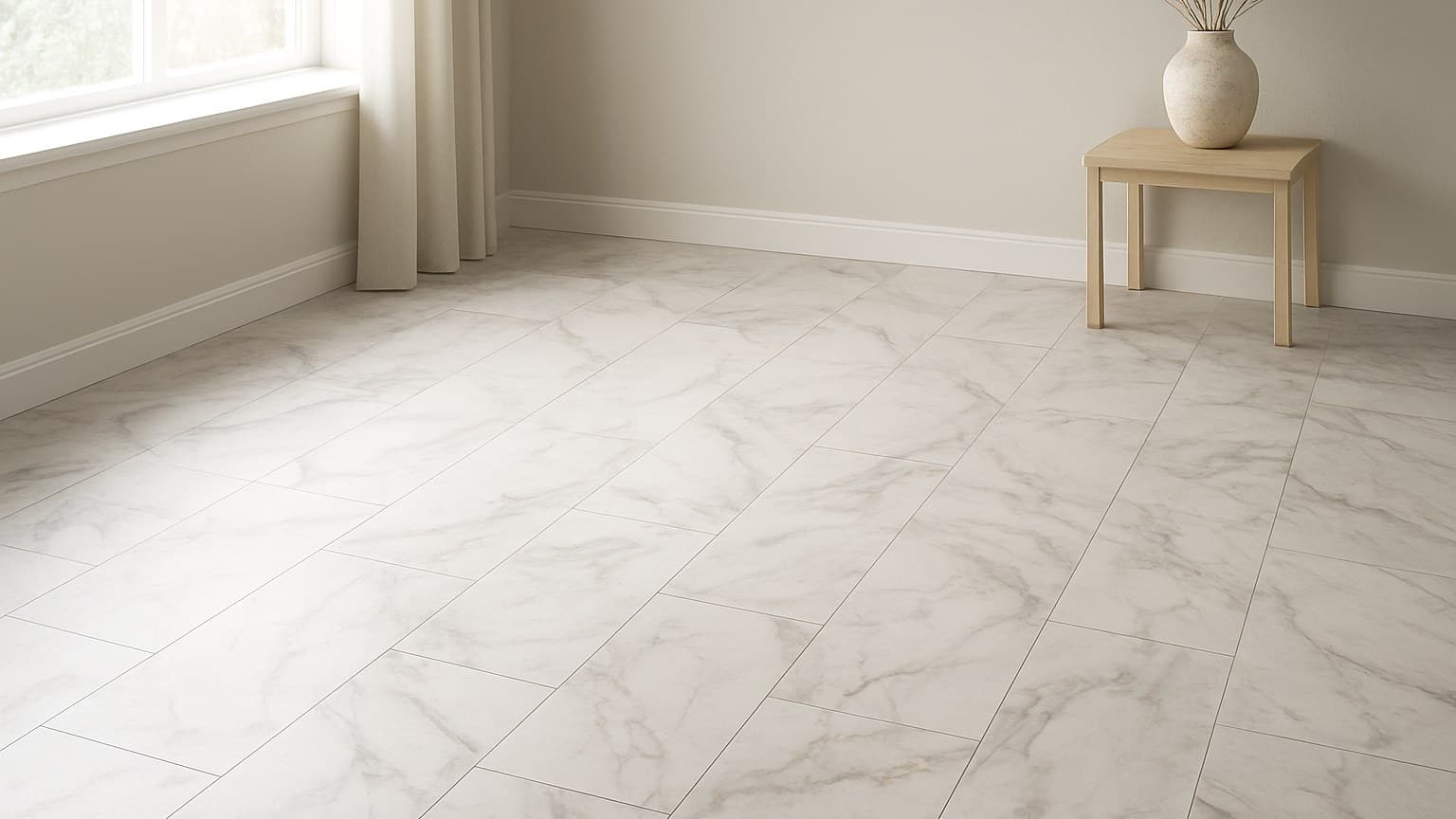
Walk down any flooring aisle and "marble vinyl flooring" means five different products, each with its own price, water tolerance, and DIY difficulty. Pick the wrong one for a wet bathroom and you'll be pulling up curled edges inside a year. Here's the short version: sheet vinyl or click-lock rigid-core planks handle a wet bath best, peel-and-stick and groutable tile fit a dry powder room or rental, and glue-down LVT is the pick for a big open kitchen or busy bathroom where the floor needs to stay flat under heavy traffic.
Key takeaways
- Sheet vinyl and plain peel-and-stick are the cheapest to buy (materials roughly $1-3 per sq ft) but read as fake fastest; groutable peel-and-stick and click-lock rigid planks look the most convincing.
- Click-lock SPC/rigid-core is the easiest waterproof format for a DIYer; glue-down LVT, stairs, and big open-plan wet-room transitions are usually worth hiring out.
- Rigid planks are sold with waterproof cores, but that rating is set per named product and covers the core, not the seams, so most water trouble in a bathroom starts at the edges.
- Real marble needs periodic sealing and can etch; marble vinyl skips the sealing and over 10 years costs a fraction, though it can dent and cannot be refinished.
How I Size Up a Marble-Vinyl Format Before I Buy Anything
My rule on every job is the same, in this order: match the format to how much water hits the floor, then to the budget, then to whether you're laying it yourself. Get that order wrong and you end up with a pretty floor that fails where it gets wet.
There are five families you'll actually see on shelves and online: sheet (roll) vinyl, peel-and-stick tile, groutable peel-and-stick, glue-down LVT (luxury vinyl tile, meaning separate pieces), and click-lock SPC (stone plastic composite, a dense plastic core) or rigid-core planks that float over the subfloor. Each one wears the marble look differently and holds up differently.
Here's the seam truth up front, because it decides your bathroom pick: a plank's core can be waterproof on a specific named product while the seams between pieces are only water-resistant. Water almost never comes up through the middle of a plank. It creeps in at the edges. That gap between "waterproof core" and "water-resistant seam" matters in a wet room.
The table below compares all five on best room, whether a DIYer can handle it, how they really behave around water, and cost split into materials versus labor.
| Format | Best room | DIY? | Water behavior | Materials/sq ft | Labor/sq ft |
|---|---|---|---|---|---|
| Sheet (roll) vinyl | Small bath, laundry | Doable in a plain square room | Few seams, most water-tolerant surface | $1-4 | $1-3 |
| Peel-and-stick tile | Rental, powder room | Yes, easiest of all | Seams and edges vulnerable | $0.70-3 | $1-2 if hired |
| Groutable peel-and-stick | Powder room, entry | Yes, slower | Water-resistant, not a wet-room floor | $2-5 plus grout | $2-3 if hired |
| Glue-down LVT | Big kitchen, busy bath | Hard, hire it out | Strong when glued to a flat, dry base | $2-5 | $2-4 |
| Click-lock SPC/rigid-core | Most rooms, whole floors | Yes, best all-round | Waterproof core per product, seams still water-resistant | $2.50-6 | $2-4 |
Materials-only price ranges for each marble-vinyl format, in dollars per square foot. Labor and the room itself move the total on top of this, and basements or stairs run higher than an open room.
1. Marble Sheet Vinyl: The Cheapest Waterproof Surface for a Small Bath
Sheet vinyl is a cheap waterproof surface for a small bathroom or laundry, because one continuous roll means almost no seams for water to find. In a tight, square room, that unbroken surface is hard to beat on a budget.
Materials run about $1-4 per square foot. A pro adds roughly $1-3 on top. DIY is realistic in a plain rectangle, but it turns fiddly fast around a toilet flange or a curved wall, where one bad cut wastes a big piece of goods.
The marble vinyl flooring roll look leans on large printed veining, and it does read as stone from across the room. The catch is that sheet shows its pattern repeat sooner than plank formats, so the same veins reappear more often once you're standing on it.
Say the downsides plainly: sheet dents under heavy furniture legs, it's hard to patch a single spot without a visible seam, and its photo-realism is the weakest of the five formats here. For a rental laundry or a kid's bathroom, none of that may matter. For a floor you want to admire, it will. That's exactly the gap a poured, seamless surface closes, so it's worth checking a liquid marble flooring cost guide before ruling out anything pricier than vinyl.
2. Peel-and-Stick Marble Tile: The Renter's Fast Fix
Peel-and-stick marble tile is the format I point renters and weekend refreshers to, because it goes down over a flat, clean subfloor and pulls back up later without wrecking anything underneath. It's a fast, forgiving way to change a floor you don't own.
Materials are about $0.70-3 per square foot, with near-zero labor if you do it yourself. The weakness is the adhesive: it lets go on damp, dusty, or textured subfloors, and once one corner lifts, the rest follows.
Realism is weakest here too. The tiles are small, so the printed marble pattern repeats quickly, and the edges can curl and let water sneak underneath. That's exactly where a bathroom floor starts to smell.
So where does it earn its keep? Rentals, powder rooms, and quick refreshes over a clean, flat surface. Where it fails is a full bathroom with standing water, or any damp or textured subfloor. Keep it to low-traffic spots or a bedroom accent and it does its job.
3. Groutable Peel-and-Stick: The Most Convincing Budget Look
Groutable peel-and-stick is a cheap way to a marble look that actually fools people, because real grout between the tiles kills the plastic seam that gives cheap vinyl away. That thin line of true grout is a real realism upgrade in the budget tier.
Materials run about $2-5 per square foot plus the grout, and it takes more patience than plain peel-and-stick. You're setting tiles with spacers, then grouting, so plan on a slower weekend.
Here's why it looks better: the tile spacing plus the grout lines break up the printed pattern loop. Your eye follows the grid instead of hunting for repeating veins, so the printed repeat stops jumping out at you.
It's still only water-resistant at the seams. Treat it as a dry-to-damp floor, an entry or a powder room, not a true wet room with a shower splashing on it. Push it into a wet bathroom and the grout won't save the edges.
4. Glue-Down Marble LVT: Flat, Quiet, and Built for Big Wet Rooms
Glue-down marble LVT is my pick for big open kitchens and busy bathrooms, because bonding every piece to the subfloor keeps the floor flat, quiet underfoot, and stable across large moisture transitions where a floating floor can shift. In a wide room, that glued bond is what stops movement over time. If you want the deeper walkthrough on choosing a glue-down marble LVT that reads as real stone instead of plastic, see marble LVT that doesn't look fake.
Materials are about $2-5 per square foot, and labor runs about $2-4. This is the format where hiring out earns its money.
It comes as planks or large tiles, and that vinyl marble flooring look beats sheet on realism because the pieces carry deeper texture and less obvious repeat. If you want stone across a whole open floor, this is the vinyl that carries it.
DIY is genuinely hard here. Troweled adhesive has an open-time window, meaning you get a limited number of minutes to set the tile before the glue skins over, and the subfloor has to be dead flat first. That's why I steer most homeowners to a pro for this one. If you're also weighing the real thing for a showpiece kitchen, marble floor tile is a different budget and upkeep story, and porcelain that mimics stone, like stone-look porcelain tile, is another wet-room option worth pricing against LVT.
5. Click-Lock SPC/Rigid-Core: The Easiest DIY Waterproof Plank
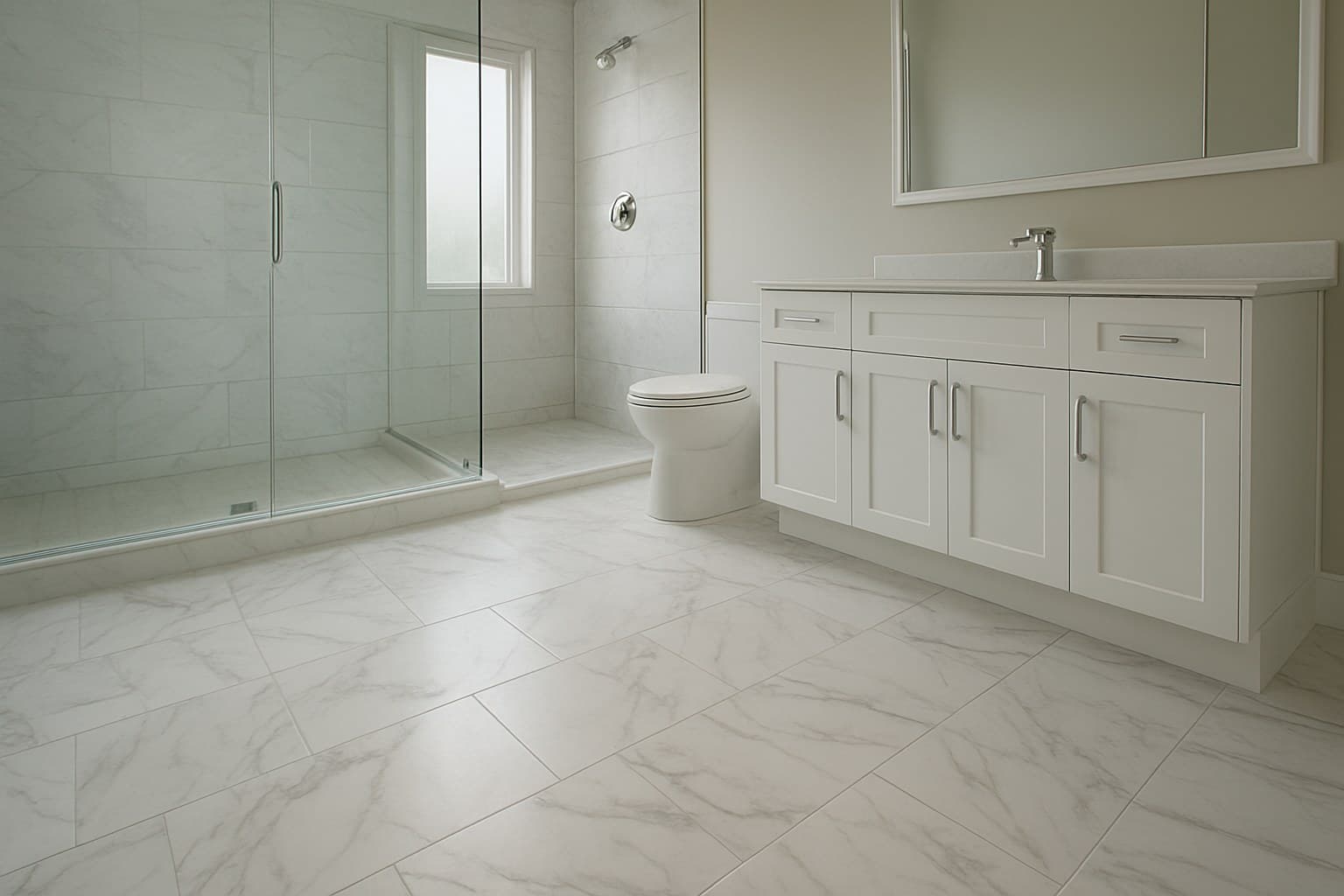
Click-lock SPC or rigid-core is a strong all-round DIY choice: floating planks that snap together with no glue and forgive minor subfloor flaws better than any other format here. For most whole-floor projects, this is what I'd hand a confident homeowner.
It's sold as marble vinyl plank flooring and marble look vinyl plank flooring, in large tiles or planks with printed veining, and many lines come with a pad already attached to the back. SPC stands for stone plastic composite, a dense core that gives the plank its rigid, stone-like feel.
Materials run about $2.50-6 per square foot, and labor about $2-4 if you hire it, though click-lock is realistic for most DIYers to lay themselves. Before you buy, it pays to understand the wider vinyl category and what actually makes it last, since the same core specs decide a marble plank's life as any other.
SPC cores are sold as waterproof on specific named products, not as a blanket category promise. You still have to leave the maker's required expansion gap around the room, and the seams between planks stay only water-resistant. So in a bathroom, seal the perimeter and don't assume "waterproof core" means the whole floor shrugs off standing water.
How to Keep Marble Vinyl From Looking Fake
The fastest way to spot a floor that will look cheap is to check the pattern repeat before you buy: ask or count how many unique planks or tiles print before the veining starts over, and favor the products with more. Fewer unique pieces means you'll see the same vein again and again once it's down.
Pick a larger format and a matte, or low-sheen, finish. High gloss catches light and reads as plastic across a whole floor, while matte hides the printed surface. I judge a full-size sample in the actual room's daylight, never a phone photo, the same way I check any stone-look tile or plank for the fake tell.
Color changes the odds too. A white marble vinyl look hides repeats better because light veining is subtle, while a bolder black marble look shows dramatic veins that repeat more obviously. If you want the printed-stone look on a different core entirely, marble laminate flooring is worth comparing, though it trades some water tolerance for its own strengths.
The left floor sells the marble look because no two planks share the same veins and the seams don't line up. The right one gives itself away with the same vein every few pieces and a shiny surface. If you're weighing real stone instead of the printed look, stone flooring ranked by cost and upkeep breaks down where each natural material lands on those same trade-offs.
Before You Lay Any of Them: Subfloor and Moisture
No marble vinyl format survives a bad subfloor, so this step comes before you open a single box. On most floating and glue-down jobs, the finished floor only lasts as long as the prep beneath it, and the manufacturer's warranty depends directly on flatness and moisture at install, not on which plank you picked.
Check flatness first. Lay a long straightedge across the floor and look for gaps or high spots. Click-lock forgives small dips better than glue-down, but a real hump will telegraph through any of these and stress the seams.
Then check moisture, especially over concrete or in a basement. Use a moisture meter, a small tool that reads how wet the slab or subfloor is, rather than a hand test, which tells you nothing reliable. A slab that reads high needs to be dealt with before flooring goes down, or you'll trap moisture under a waterproof-core plank and grow problems you can't see.
One more universal rule: nearly every floating floor needs an expansion gap around the edges, and every product sets its own gap size and its own acclimation rule on the box. Look those up per product instead of trusting a number you read online. If your project is a basement or a set of stairs, budget more than an open room, since both take more cutting, more transitions, and more labor time.