
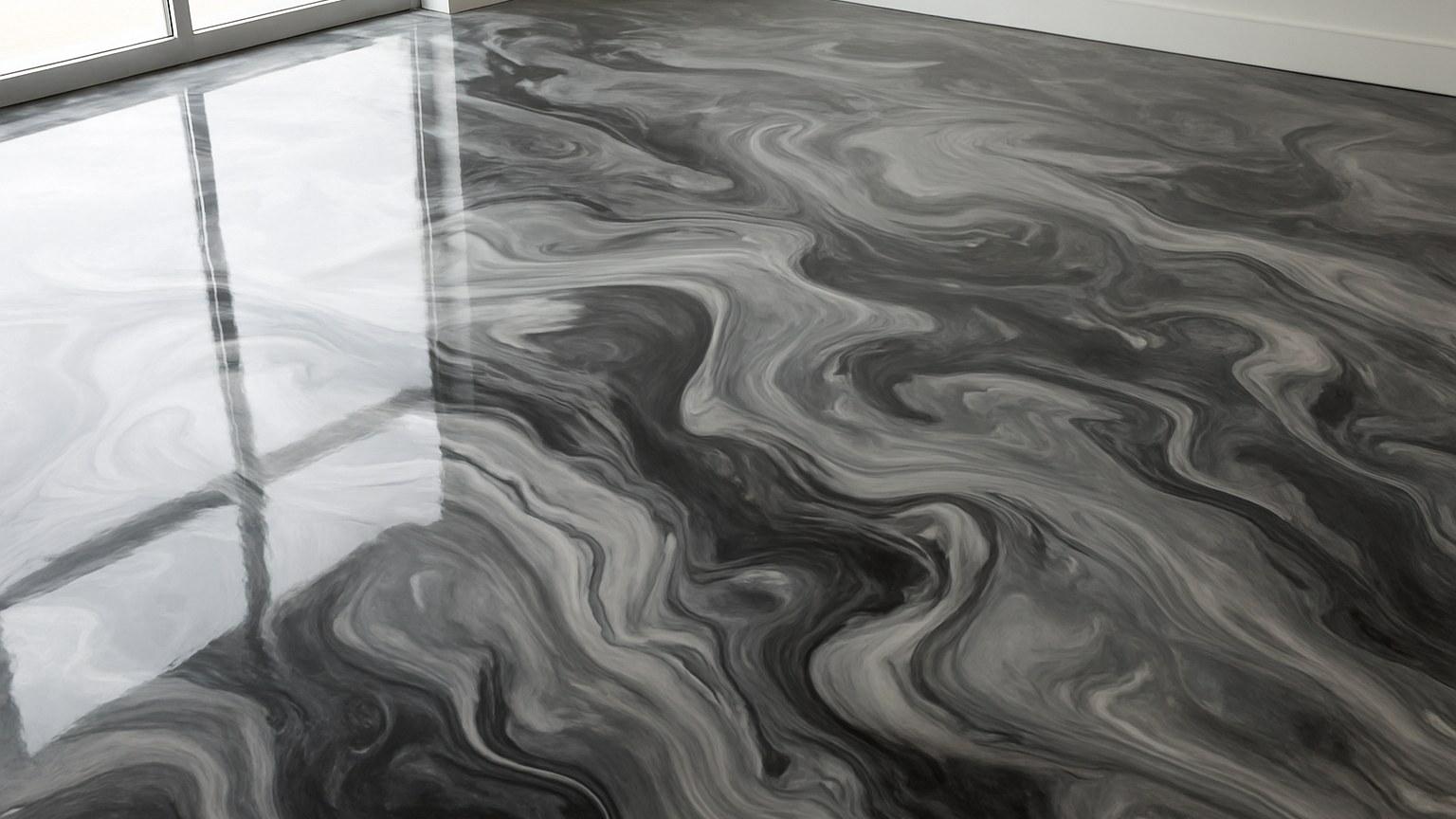
According to HomeGuide's flooring cost data, a basic epoxy coat for liquid marble flooring runs about $3-7 per square foot installed, while a decorative metallic veined floor typically costs more, often in the $8-15 per square foot range. Those two numbers look like they fight each other because they're two different floors, not one price gone haywire. Once you know which tier you want, you can build your own number before a contractor hands you one.
Key takeaways
- A basic epoxy marble coat runs about $3-7 per square foot installed; a custom metallic veined floor runs about $8-15 per square foot installed. That gap is the whole reason online prices look like they disagree.
- A 300 sq ft room lands around $900-2,100 as a basic coat or $2,400-4,500 as a decorative metallic floor, with material and labor bundled into one poured price.
- Build your own quote: tier price per sq ft times your square footage, then add prep and extras (sealant $1-2/sq ft, trim $3-12 per linear foot, radiant heat $7-17/sq ft).
- A marble epoxy floor is rated to last 15-25 years; real marble lasts 25-100+ years but costs $10-40 per square foot installed.
- A basic single-color epoxy coat is a realistic garage DIY. The metallic marble veining is a skilled pro job where the money goes into labor, not just resin.
How Much Does Liquid Marble Flooring Cost?
A basic epoxy marble coat runs about $3-7 per square foot installed. A decorative metallic veined floor, the kind that actually reads as marble, runs about $8-15 per square foot installed. On both tiers, labor is the bigger slice of that number, not the resin, the raw material itself is the smaller piece, while the skilled pouring, tinting, and veining work makes up most of what you're paying for. That's why a contractor prices it as one poured job instead of handing you a separate material line and labor line.
Put that against a real room. A 300 square foot space lands around $900-2,100 as a basic coat, or $2,400-4,500 as a decorative metallic floor.
That spread is why online prices seem to disagree. One site is quoting a plain epoxy coat with a light swirl. Another is quoting hand-worked metallic veining with a longer warranty. They're pricing two different floors and calling both "liquid marble."
The rest of this guide walks you through building your own quote: pick your tier, multiply by your square footage, then fold in prep and extras.
Step 1: Figure Out Which Price Tier You're Actually Buying
Lock this in first, because every number after it multiplies off this one choice.
There are two tiers. A basic epoxy marble coat is a solid base color with a light marble swirl worked in, and it runs about $3-7 per square foot installed. A decorative metallic marble epoxy is pigmented resin that an installer works by hand into veins and depth, and it runs about $8-15 per square foot installed.
The basic coat looks like a nice coated floor when you stand over it. The decorative one is what fools people into thinking it's stone. The difference is almost entirely in the labor, not the resin. Pouring, tinting, and dragging metallic pigment into believable veins takes skill and time, and that's where the money goes on the high tier.
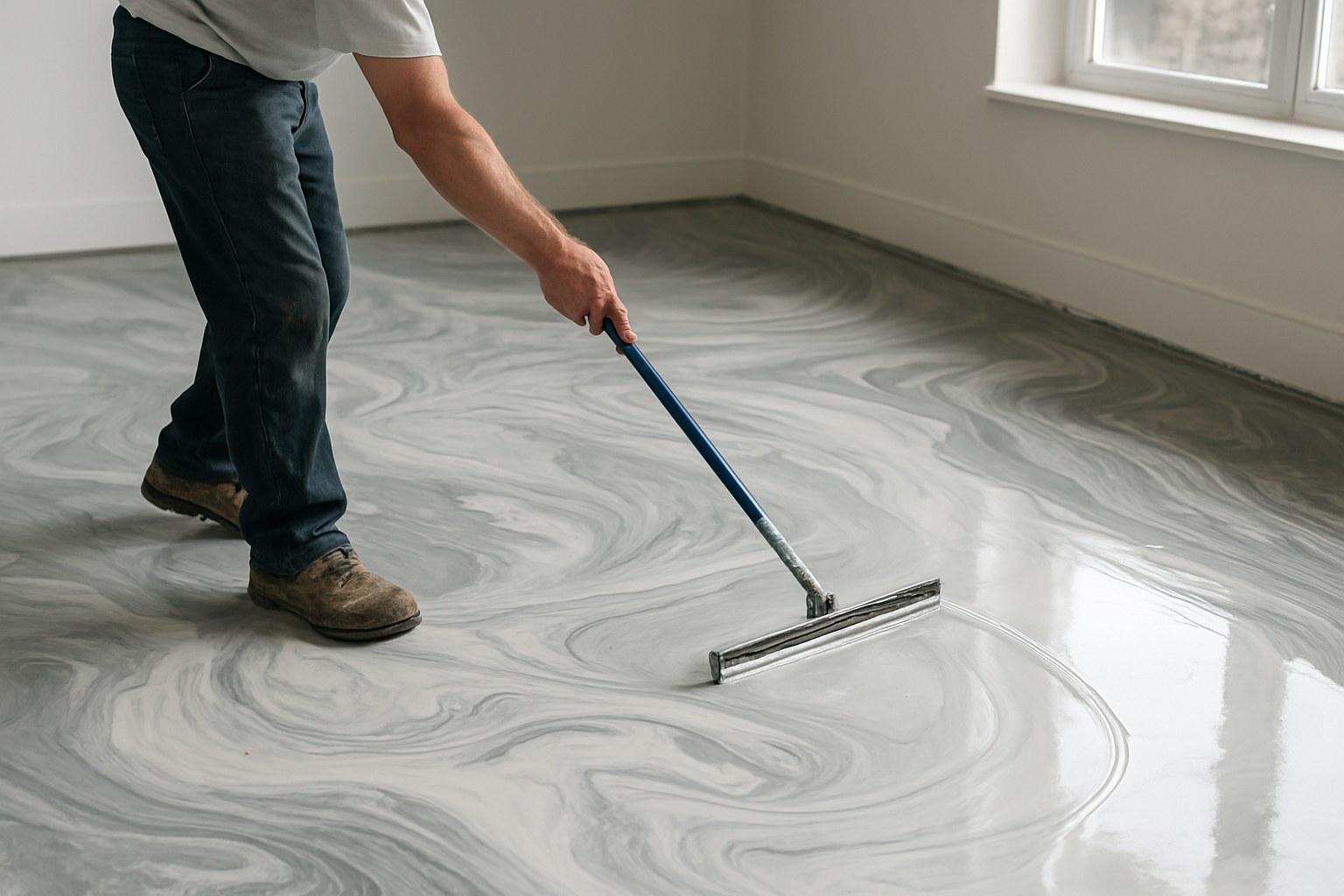
That also sorts out who should pour it. A basic single-color coat with a light swirl is a realistic garage DIY if you follow the kit. The metallic veining is a skilled pro job. Timing the coats and working the metal while it's still open is what decides whether the floor looks like real stone or like a muddy puddle. I've seen the muddy version, and there's no fixing it once it cures.
If you want the floor that reads as marble, hire it out and budget the decorative tier. If you just want a tough coated slab in a solid color, the basic tier is in reach for a patient DIYer.
Step 2: Multiply Your Square Footage by the Tier Price
The formula is plain: total installed cost = your square footage x the tier price per square foot, then add prep and extras from Step 3.
Work one case all the way through. A 300 square foot room at the decorative $8-15 band is 300 x $8 on the low end and 300 x $15 on the high end. That's about $2,400-4,500 before any extras.
Here's what that looks like across the three room sizes people ask about most, at both tiers. Keep in mind a basement slab usually costs more to prep than an open main-floor room, since it needs extra moisture testing and sometimes a vapor barrier before any resin goes down. Stairs aren't a realistic fit for a poured epoxy system like this, so budget those as a separate project if you need them covered.
| Room size | Tier | Total installed |
|---|---|---|
| 200 sq ft | Basic epoxy coat ($3-7/sq ft) | $600-1,400 |
| 200 sq ft | Decorative metallic ($8-15/sq ft) | $1,600-3,000 |
| 300 sq ft | Basic epoxy coat ($3-7/sq ft) | $900-2,100 |
| 300 sq ft | Decorative metallic ($8-15/sq ft) | $2,400-4,500 |
| 500 sq ft | Basic epoxy coat ($3-7/sq ft) | $1,500-3,500 |
| 500 sq ft | Decorative metallic ($8-15/sq ft) | $4,000-7,500 |
Installed cost (material plus labor) by room size and tier.
Blue bars are the basic coat; red bars are the decorative metallic tier.
Remember what that per-square-foot price already includes: resin, pigment, topcoat, and the prep labor, all poured as one job. On a poured system like this, the skilled labor and the prep are a bigger slice than the material in the bucket.
Step 3: Add Prep, Removal, and the Extras
Prep comes first because it decides whether the floor holds at all. Two checks have to happen before any resin goes down. The slab gets diamond-ground flat and profiled so the epoxy can grab it. And it gets a moisture test, because a damp slab pushes vapor up through the concrete, and that vapor can lift a fresh epoxy coat right off the floor.
I've pulled up plenty of floating floors that failed for one reason: nobody checked what the slab was doing underneath. Epoxy is less forgiving than a floating plank, because it bonds straight to the concrete. If the slab is damp or dusty, the bond is where it lets go.
Here are the add-ons that get folded into a quote, with figures from HomeGuide's flooring cost data.
| Add-on | Typical cost |
|---|---|
| Old floor removal (carpet/tile tear-out) | Quoted per job |
| Diamond grinding / slab flattening | Usually bundled; extra on rough slabs |
| Moisture barrier / primer on damp slabs | Part of the system when the slab tests wet |
| Extra sealant or topcoat | $1-2/sq ft |
| Radiant heat under the slab | $7-17/sq ft |
| Trim or cove base | $3-12 per linear ft |
Source: HomeGuide's flooring cost data
Prep and add-on line items to fold into a liquid marble quote.
Note which ones are quoted per job instead of per square foot. Tearing out old carpet or tile and heavy slab repair don't scale neatly with room size, so some installers bundle them and some bill them separately. Ask which.
One rule on the math: these extras get added to your Step 2 subtotal, not multiplied into it. So a 300 square foot decorative floor at $3,500 plus 40 linear feet of cove base at $6 per foot is $3,500 + $240, not a new per-square-foot rate.
How a Liquid Marble Floor Goes Down and How Long It Takes
A metallic marble epoxy floor is built in layers, and seeing the stack tells you what you're paying for.
At the bottom is the concrete slab, which has to be ground flat and tested dry. On top of that goes an epoxy primer that bonds the whole system to the slab. Then comes the base color coat, the solid background. The metallic marble coat is next, where pigmented resin gets worked by hand into the veins. The clear topcoat sits on top as the wear and stain surface you actually walk on.
These floors typically go down in about a day. Walkable and traffic-ready times vary by product, but many systems allow foot traffic in roughly 8 hours and light furniture or vehicle traffic within about 24 hours. Full cure takes longer than that, so check the specific manufacturer's spec sheet before you roll anything heavy across it.
The slab must be ground flat and tested dry before any resin goes down, or the whole buildup can fail at the bond. No topcoat saves a bad base.
Who should pour it? The basic single-color coat is DIY-friendly. The metallic veining and the topcoat timing are why most people hire this one out. You get one shot at the veins before the resin starts to set.
Durability, Finish, and Keeping It Clean
A marble epoxy floor is generally rated to last about 15-25 years, though actual lifespan varies by product and installation quality. Some decorative systems advertise a transferable warranty up to 25 years, but that term belongs to the specific product you're quoted, not to the category, so get it in writing on the brand you're buying.
Compare that to the real thing. According to HomeGuide's flooring cost data, Natural stone marble lasts anywhere from 25 to well over 100 years, but it costs about $10-40 per square foot installed, and it comes with upkeep the epoxy floor doesn't. For a sense of the long-run economics, the National Wood Flooring Association's life-cycle cost research puts natural stone-look flooring like travertine and limestone at roughly $24.30 per square foot in material cost and about $101.68 in total life-cycle cost over a 75-year lifespan, working out to around $1.36 per square foot per year, a useful yardstick against epoxy's 15-25-year lifespan.
Marble is only one entry in that stone flooring lineup, and the stone flooring cost and upkeep comparison ranks the other types by cost, upkeep, and slip risk.
That upkeep is the real catch with stone. I tell anyone eyeing marble in a bathroom that it etches and stains from everyday stuff like toothpaste and shampoo, and most of them switch to a stone-look porcelain tile once they hear it. An epoxy floor doesn't etch like that, and because it's poured in one piece, it has no seams, which is where water usually sneaks in on plank floors.
Cleaning is simple: dust mop, then a damp mop with a mild cleaner. Skip harsh or gritty cleaners that can dull the topcoat over time.
One honest caveat on the look. The realism of a metallic epoxy floor varies a lot by the installer's hand, the same way telling a convincing stone look from a fake one comes down to the product and the eye behind it. Ask to see a large finished sample or a past job in person before you commit, not a phone photo.
Sources
- NWFA 2023 Life-Cycle Cost Analysis of Flooring
- NWFA Life-Cycle Cost Analysis Summary, TISE 2024
- EPA Flooring Life-Cycle Cost Report
- HomeGuide's flooring cost data