
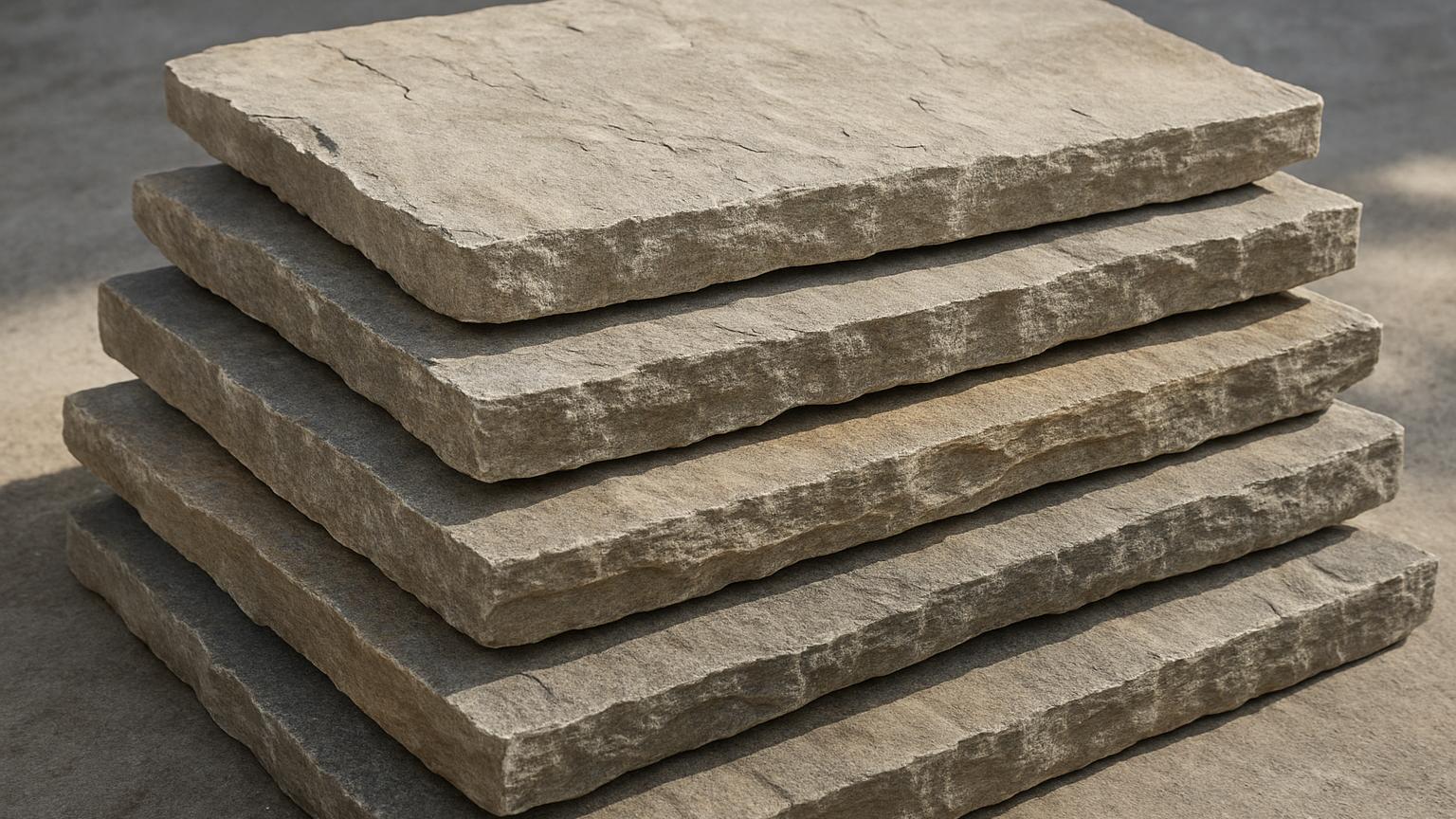
Natural stone is solid rock quarried from the earth and cut into slabs or tile. Granite, marble, slate, travertine and limestone all count, but each one seals, wears, and prices out differently, which is exactly where buyers get tripped up.
Key takeaways
- Natural stone is rock quarried from the earth and cut to use. Granite, marble, limestone, travertine, slate, quartzite and more all count. Its veining is natural, not a defect.
- Most natural stone is porous and needs periodic sealing. Marble, limestone and travertine etch from acids, so skip bleach and vinegar and use a pH-neutral cleaner.
- Quartzite and granite are the densest and lowest-upkeep stones; limestone, travertine and marble ask for the most care.
- Cost splits into materials (roughly $5-50+ per sq ft depending on the stone) and labor (a separate charge, often $8-20 per sq ft). Basements and stairs run higher.
- ASTM C1528 is the selection guide; C503 (marble), C568 (limestone), C615 (granite) and C629 (slate) are the material specs you can ask a supplier to meet.
What Is Natural Stone?
Natural stone is rock pulled from the earth and cut into slabs or tile. It is not a man-made surface like quartz or porcelain, which are built in a factory.
The common types all live under that one umbrella: granite, marble, quartzite, sandstone, travertine, limestone, onyx, soapstone, and slate.
Every piece is one of a kind. It formed from minerals over a very long time, so the color swings and veining you see are natural, not a flaw to send back. The flip side is that no two slabs match exactly. You buy and approve the actual slab in front of you, not a small sample chip.
Is Granite a Natural Stone?
Yes. Granite is natural stone, formed when molten rock cooled and hardened deep underground. It's one of the hardest, least porous stones you can buy, which is why it's been the long-running default for kitchen counters.
How Natural Stone Is Formed and Quarried
How a stone formed tells you how it will behave on your floor or counter. There are three groups.
Igneous stone, like granite, cooled from molten rock, so it ends up dense and hard.
Sedimentary stone, like limestone, sandstone and travertine, built up in layers, so it tends to be soft and thirsty.
Metamorphic stone, like marble, quartzite and slate, started as something else and got changed by heat and pressure.
At the quarry, stone comes out of the ground in huge blocks. Marbleandgranite.com puts a single block at roughly 50,000 pounds before it's ever sliced.
Those blocks get sawn into slabs. Arcsurfaces.com lists the two standard slab thicknesses as 2cm and 3cm. The surface finish goes on last, after the slab is cut and before it ships.
Types of Natural Stone, Compared Side by Side
The headline split is hardness and porosity. Quartzite and granite are dense and hard. Limestone, travertine, marble and onyx are soft and thirsty. That one fact decides where each stone belongs.
Match the stone to the traffic and the moisture, not to the photo. A soft, porous stone in a busy wet room is the kind of job that gets ripped out and redone a year later. A full breakdown of stone types ranked by slip risk and upkeep makes it easier to match the right stone to that wet room from the start.
| Type | Forms | Hardness & porosity | Best use | Usual finish |
|---|---|---|---|---|
| Granite | Igneous | Very hard, low porosity | Counters, floors, outdoor | Polished or honed |
| Quartzite | Metamorphic | Very hard, low porosity | Counters, busy floors | Polished or honed |
| Marble | Metamorphic | Soft, porous, etches | Low-use counters, vanities, walls | Polished or honed |
| Slate | Metamorphic | Medium-hard, low-to-moderate porosity | Floors, wet rooms, roofing | Natural cleft or honed |
| Soapstone | Metamorphic | Soft but dense, non-porous | Counters, sinks | Honed or oiled |
| Travertine | Sedimentary | Soft, porous, has holes | Floors, patios, showers | Honed or tumbled |
| Limestone | Sedimentary | Soft, porous | Low-traffic floors, walls | Honed |
| Sandstone | Sedimentary | Medium-soft, thirsty | Patios, feature walls | Natural or honed |
| Onyx | Sedimentary (calcite) | Soft, porous, translucent | Backlit panels, accent vanities | Polished |
How nine common natural stones form, how hard and porous each is, and where each belongs.
Polished, Honed, and Tumbled Finishes
The finish changes how a stone looks, how much it hides, and how it grips. Three come up most.
Polished is ground to a glossy, reflective shine. It looks the richest, but it shows every scratch and etch mark, and it gets slick when wet.
A honed finish is ground flat and smooth but stopped short of gloss, so it reads matte. It hides etching far better than polished and gives more grip underfoot.
Tumbled is roughed up and aged on purpose, with soft edges and the most texture, so it has the best traction of the three.
Simple rule for slip: anywhere water lands, showers, entries, pool decks, lean honed or tumbled, not polished.
Is Natural Stone Porous? Sealing and Everyday Care
Yes, most natural stone is porous to some degree. It soaks up liquids, so it needs periodic sealing to resist stains.
Keep two problems straight, because sealing only fixes one. Staining is a liquid soaking in. Etching is a chemical burn: marble, limestone and travertine are calcium-based, so acids like lemon, wine and vinegar leave dull spots. Sealing slows stains, but it doesn't stop etching.
How often to seal is set by the stone and the sealer maker, not a fixed calendar. Read the product sheet, then test it yourself. Drip a few drops of water on the stone, and if it stops beading and starts darkening, it's due.
Clean with a pH-neutral stone cleaner. Keep bleach, vinegar and generic bathroom sprays off it, the harsh ones eat the finish over time.
Natural Stone vs. Engineered Stone
Engineered stone is man-made. Quartz, ground-up stone bound with resin, is the big one; marbleandgranite.com also names Neolith and concrete surfaces as options.
The real tradeoff is upkeep against character. Engineered quartz is nonporous, never needs sealing, and matches slab to slab, but the resin can scorch under a hot pan. Natural stone gives you one-of-a-kind veining and a higher-end look, but most types need sealing and some etch.
There's a third path that sidesteps the upkeep. Stone-look porcelain and vinyl copy the look without the sealing, though the realism swings a lot by product, so judge a big sample. If you go that route, it pays to know how to tell a convincing stone look from a cheap fake and how to pick stone-look porcelain tile for each room. If vinyl plank fits the budget better, ask specifically for marble LVT (luxury vinyl tile) flooring options since the printed grain depth varies a lot between brands.
When a customer wants the stone look but a warmer, more forgiving floor, I bring stone-look vinyl samples to the house and lay them down in the real daylight. These prints can look dead fake under the wrong bulb, and I'd rather find that out on the floor than after the install. The same daylight test matters when comparing marble vinyl flooring choices, since photo-realistic prints can shift tone dramatically between warm and cool bulbs.
What Natural Stone Costs: Materials vs. Labor
Natural stone swings in price more than almost any other surface, because a budget travertine and a premium marble are nowhere near the same material. Keep the two numbers separate so the quote makes sense.
On the jobs I quote, materials alone run roughly $5 per square foot for cheap stone up to $50 and beyond for high-end marble or onyx, it swings that much because a budget travertine and a premium slab aren't close to the same material. Labor to cut and set it is billed separately, and I usually see it land somewhere in the $8 to $20 per square foot range depending on the stone and the cuts involved.
Here's the arithmetic on a 200 square foot kitchen floor. Say the stone runs $12 per square foot: that's $2,400 in material. Add labor at $12 per square foot, another $2,400, and you're at about $4,800 installed before trim and sealer. Swap in a $40 marble and the material alone jumps to $8,000.
Basements and stairs run higher than an open room. Stairs are slow, fiddly cuts, and a basement adds moisture control and often extra prep, so expect a premium on both. Setting a small stone tile job yourself is doable if you're comfortable with tile work, but full slab counters, large stone floors, and stair treads are heavy, unforgiving of mistakes, and need a dead-level mortar bed, that's where I tell homeowners to hire it out. Getting that installation right is one of the handful of factors that decide whether a stone tile floor lasts or turns into a callback.
How to Judge Quality: The ASTM Specs
You can judge stone quality by asking your supplier to meet the right ASTM (American Society for Testing and Materials) spec. ASTM is a standards organization that publishes material-testing standards, and dimension stone has its own set, as ASTM's dimension stone standards overview describes.
ASTM C1528 is the selection guide, the document that helps you pick the right stone for the job. Then each stone type has its own material spec you can hold a supplier to: C503 for marble, C568 for limestone, C615 for granite, and C629 for slate.
Those specs cover things like how much water the stone absorbs and how strong it is, and companion ASTM standards such as C1799 for specimen preparation and C1721 for petrographic examination back up how a slab gets tested before it ships. Real stone is also heavy, so the spot it goes needs a subfloor rated to carry it plus the right setting materials. On a floor, the prep under the tile matters as much as the stone on top, which is why a flat, dry, properly reinforced base is step one, not an afterthought.