
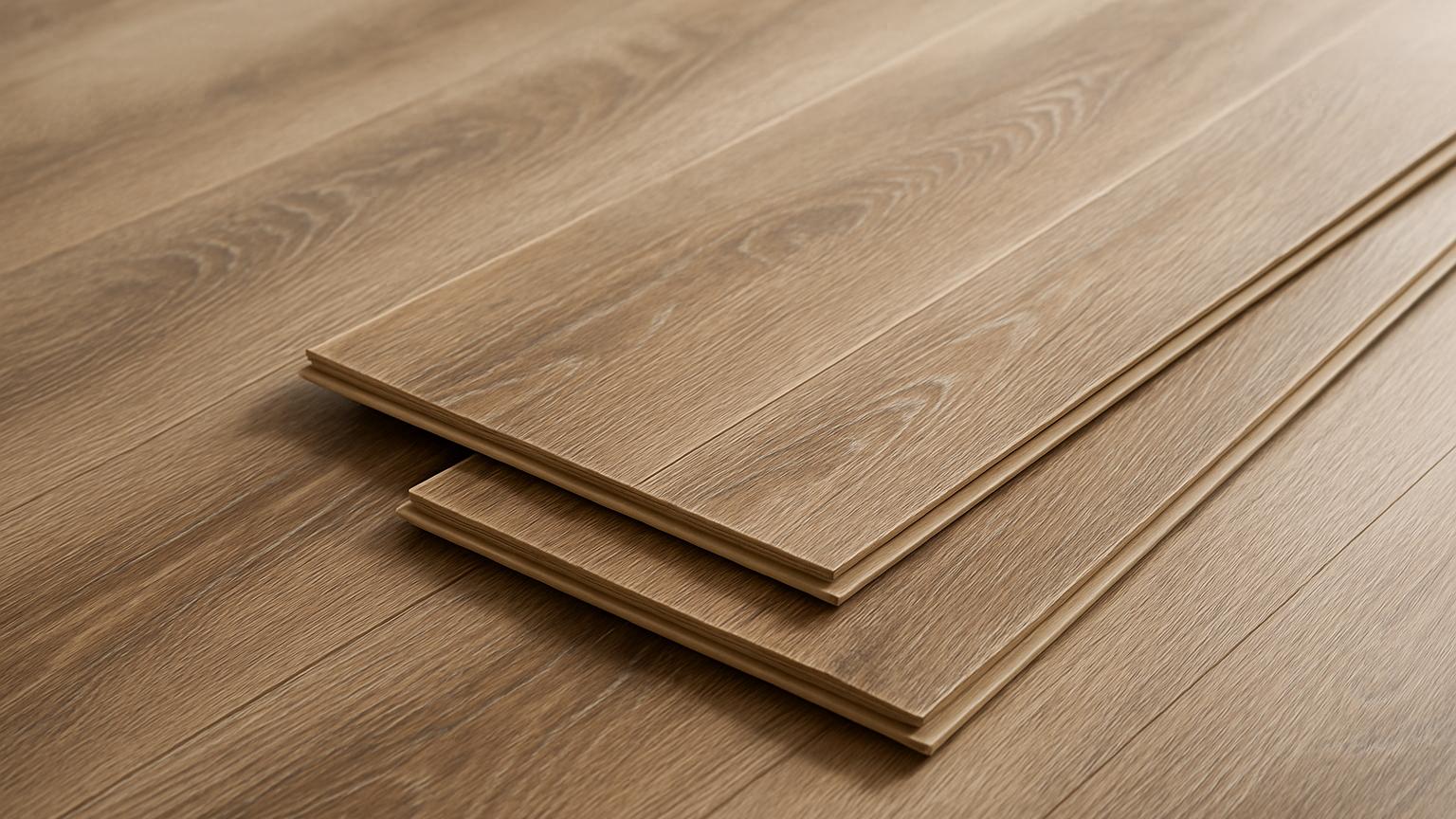
AquaGuard flooring is Floor & Decor's own house-brand laminate, sold only at their stores, and it ships in three lines people constantly mix up. That mix-up is why reviews contradict each other and why one shopper's price looks nothing like the next. Pin each claim to the right line and the floor starts making sense. That's one reason it helps to understand the three kinds of laminate flooring stores and what each is actually best for before you compare an exclusive house brand against anything else.
A quick note on sourcing: the job numbers, the DIY buckling lesson, and the stair labor costs later in this guide are from work I've done or priced myself. The water, scratch, and air-quality testing come from two homeowners who installed AquaGuard themselves and published their results, mychemicalfreehouse.net and projectsandporchswings.home.blog. I name each one every time I use their numbers, so you can always tell my firsthand calls apart from theirs.
Key takeaways
- AquaGuard is Floor & Decor's own house-brand laminate, with an HDF (high-density fiberboard) fiberboard core and a melamine top layer, sold only through Floor & Decor rather than by a separate manufacturer.
- It comes in three different lines, Performance, Wood, and Bamboo, so any AquaGuard review that doesn't name the line is telling you almost nothing useful.
- The core shrugs off spills, wet mopping, even steam mopping, but seams and edges are the weak spot, so a waterproof core is not the same as a waterproof floor.
- Scratch resistance is the real gamble: owners report conflicting results depending on pets, grit, and furniture feet, so your household decides more than the marketing does.
- Budget both sides. One owner's job ran $3,803 in materials and $3,250 in labor for 750 sq ft plus stairs, according to mychemicalfreehouse.net.
What Is AquaGuard Flooring?
AquaGuard is Floor & Decor's exclusive house-brand laminate. You will not find it at Lowe's, Home Depot, or a flooring wholesaler, and no separate consumer brand makes it. If you're searching "who makes AquaGuard flooring," that's the answer: it's Floor & Decor's own label, built for their shelves. Sam's Club runs a similar exclusive model with its own house brand, Select Surfaces laminate flooring.
Under the hood it's a laminate plank like any other. The body is an HDF core, which stands for high-density fiberboard, basically tightly packed wood fibers. On top of that sits a printed decor-paper layer, a photo of wood grain that gives the plank its look. Over that is a clear melamine wear layer, the hard top coat that takes your daily scuffing, grit, and foot traffic. A backing layer on the bottom keeps the plank flat. Armstrong's laminate flooring uses a similar HDF-core sandwich, though the decor and finish differ by line.
On the air-quality side, AquaGuard carries GreenGuard Gold, a low-emissions certification. One owner's testing, reported by mychemicalfreehouse.net, measured formaldehyde off-gassing at or below 0.0073 ppm. US laminate also has to clear two federal formaldehyde rules: TSCA Title VI, the national limit on how much formaldehyde composite wood can give off, and CARB2, California's matching Phase 2 standard.
One thing to lock in before you read a single review: "AquaGuard" is a line name, not one single plank.
AquaGuard Performance vs Wood vs Bamboo
AquaGuard splits into three separate lines, and they are not interchangeable in look, feel, or price. No other guide tells you this, which is why "AquaGuard reviews" online read like people are talking about different floors. They are.
Performance and Wood are both laminate. Performance is the standard laminate, HDF core with the melamine top. Wood uses different plank styling and a different surface finish aimed at a more varied, realistic grain. Bamboo is the odd one out: it's a bamboo-based product, a different material from the two laminate lines, for buyers set on that specific grain and feel.
Colors like Renaissance Oak, Gogh, and Cocoa live inside these lines. They are styles, not quality tiers. A rating or a price with no line attached is telling you almost nothing.
| Line | What it is | Best fit |
|---|---|---|
| Performance | Standard laminate with HDF core and melamine top | Everyday rooms where budget and wood look both matter |
| Wood | Laminate with different plank styling and surface finish | Buyers wanting a more varied, realistic wood appearance |
| Bamboo | Bamboo-based product, a different material from the laminate lines | Shoppers set on a bamboo grain and feel |
The three AquaGuard product lines and the kind of buyer each one suits.
So when you read "AquaGuard laminate flooring reviews," find the line name first. Without it, the rating is noise.
One gap worth flagging: Floor & Decor does not publish an AC rating, the industry wear-class number like AC3 or AC4 that tells you how a laminate holds up to traffic, for Performance, Wood, or Bamboo on its own spec pages, and neither review tested for it. The same goes for warranty terms: length, and what's covered for fade, stain, wear, or structural issues, aren't spelled out for any of the three lines in what's published. If either number matters to your decision, ask a Floor & Decor associate for that line's current spec sheet before you buy, since both can change between production runs.
Is AquaGuard Really Waterproof? Core vs Seams
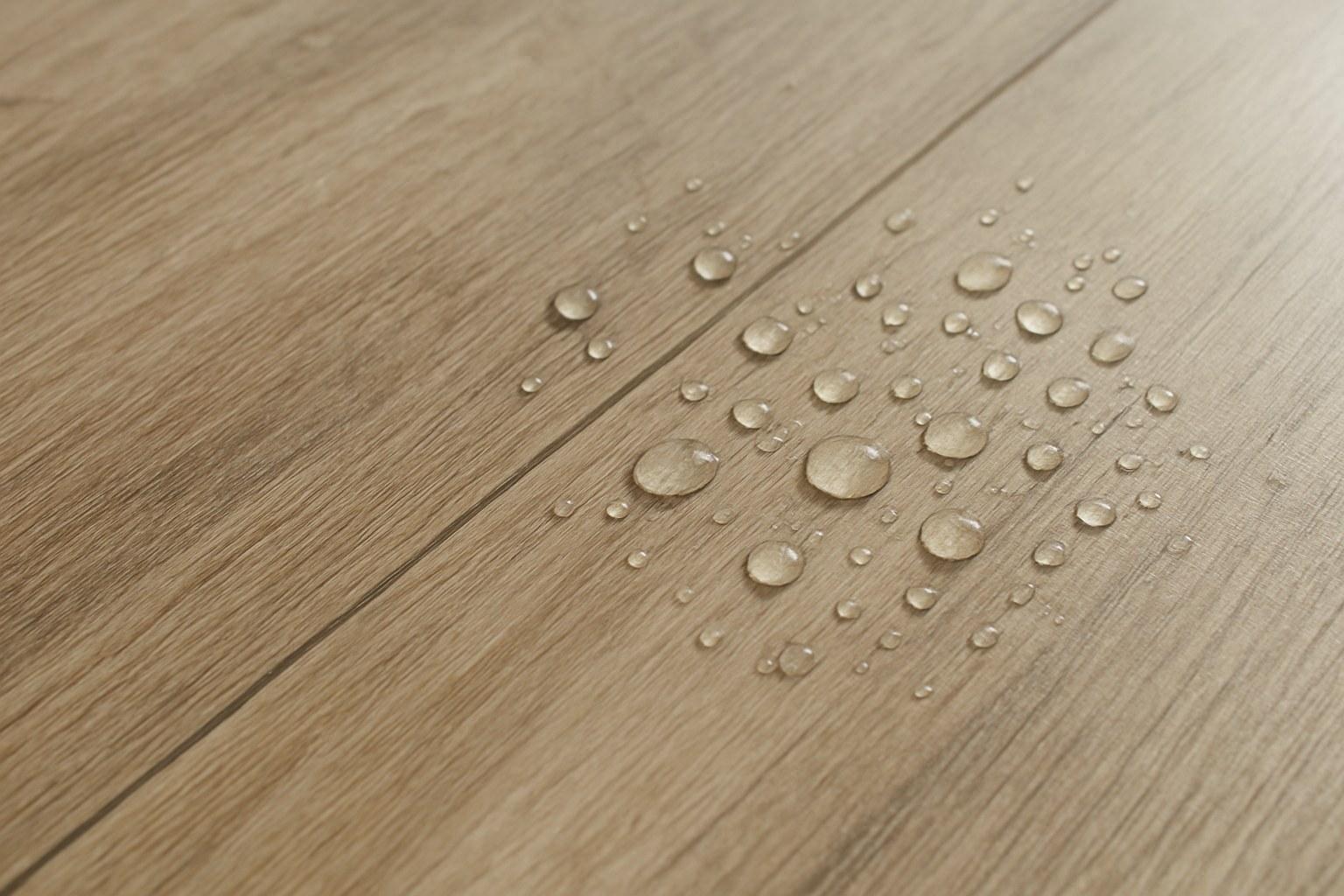
The core resists water. The seams and edges are where trouble starts. Keep "waterproof core" and "waterproof floor" as two different ideas in your head.
The core claim holds up in real homes. Both mychemicalfreehouse.net and projectsandporchswings.home.blog report spills, wet mopping, and even steam mopping with no swelling or damage on the plank surface.
Here's the catch with any fiberboard core. Standing water that sits in a seam or reaches a cut edge can wick into the HDF and swell it, no matter how tough the top coat is. The melamine wear layer is sealed; the joint between two planks is not. That's where laminate tends to fail first.
So the plain answer to "is AquaGuard laminate really waterproof": it's strong against everyday wet, and it is not a sealed surface you can flood and walk away from.
Can You Put AquaGuard in a Bathroom?
A powder room, yes. A full bath with a tub or shower, only if a pro seals the edges and the perimeter properly, because that room stays wet and water finds seams. If you want a floor you can truly flood in a kids' bathroom or a laundry, a glue-down or sheet product with sealed joints is the safer call than any floating laminate. That caution fits a larger pattern of which rooms laminate flooring actually works in across a house.
Scratch Resistance: The Claim vs Real Use
This is the real gamble with AquaGuard, and the reviews flatly disagree. mychemicalfreehouse.net reports noticeable scratches and chips despite the scratch-resistant label, while projectsandporchswings.home.blog reports no scratch problems at all. Both are honest accounts. The difference is the house, not the floor.
What actually scratches laminate is pet nails, grit tracked in from outside, furniture feet dragged without pads, and heavy debris underfoot. The marketing word doesn't decide it; your household does. A home with two big dogs and a sandy back door is a different test than a quiet house with soft-sole slippers at the door.
AquaGuard does have a scratch repair kit, but treat it as a patch, not a fix. It hides a mark; it doesn't rebuild the wear layer.
In a low-grit, soft-sole household it holds up fine. In a high-traffic home with pets and grit, expect visible wear and plan for it.
AquaGuard vs Pergo XP
Both are laminate, so the honest split here is price and where you can buy them, not one being wildly tougher than the other. Laminate-to-laminate, the durability is close.
projectsandporchswings.home.blog, in a 2018 post, puts Pergo XP around $2.59 per sq ft at 10mm thick, treat that number as dated and confirm current pricing before you budget. Pergo is carried widely, in the big boxes and online. AquaGuard you can only get through Floor & Decor, and its price varies by line. So your choice often comes down to availability and budget first, look and feel second. Pergo also sells a pricier, more water-resistant line called Pergo Outlast laminate flooring, which costs more than the XP series mentioned above.
| Spec | AquaGuard | Pergo XP |
|---|---|---|
| Material | Laminate, HDF core + melamine top | Laminate |
| Price | Varies by line (sold only at Floor & Decor) | ~$2.59 per sq ft |
| Thickness | Varies by line | 10mm |
| Where sold | Floor & Decor only | Widely available |
A side-by-side of AquaGuard and Pergo XP laminate on material, price, thickness, and where to buy.
If you're cross-shopping laminate anyway, it's worth pricing Mohawk's laminate lines against both. Mohawk's water-resistant laminate, sold as the RevWood family, is another realistic-wood option carried through its own dealer network.
What AquaGuard Costs: Materials and Labor
Budget AquaGuard as two separate numbers, materials and labor, and expect stairs and basements to cost more than a flat, open room. A single per-square-foot sticker hides half the bill. Costco's laminate flooring pricing hides a similar gap between the carton sticker and the full installed cost.
The one fully transparent job in the research comes from mychemicalfreehouse.net: $3,803 in materials, covering Renaissance Oak laminate, underlayment, stair nose, and quarter round, plus $3,250 in labor for 750 sq ft with stairs and risers.
| Cost component | Amount |
|---|---|
| Materials (Renaissance Oak laminate, underlayment, stair nose, quarter round) | $3,803 |
| Labor (install, stairs, and risers) | $3,250 |
| Total for 750 sq ft plus stairs | $7,053 |
One real AquaGuard job: materials and labor split out for 750 sq ft plus stairs and risers.
Notice the stairs. Those risers and stair noses are a big slice of why that labor number landed at $3,250 rather than something lower for a plain room. Stairs are slow, finicky work.
The extras pad the sticker fast. Stair nose runs $15-$45 per piece per dgfloors.com, with onflooring.com listing a 1-inch piece at $45.99. Quarter round installed runs $3-$7 per linear foot per homeguide.com. Tearing out the old floor runs $1-$4 per sq ft per dropcurb.com, and up to $7 for tile per apollotile.com.
On the DIY question: click-lock laminate in an open room is realistic for a careful homeowner, but check the subfloor before you touch a plank. Laminate needs a flat, dry base, so run a flatness check for humps and dips and a moisture check on the slab or subfloor first. Skip that step and no install method saves you. Stairs and risers are where hiring out makes sense. And don't run one continuous floating floor across a huge span, I did that once between two large rooms and the whole thing buckled into a ridge by summer. Now I break long runs with a transition at the doorway and let each room move on its own.
If you want a lower per-square-foot number, the math lives in volume buying. See what a pallet of laminate really costs per square foot before you assume store pricing is your only option.