
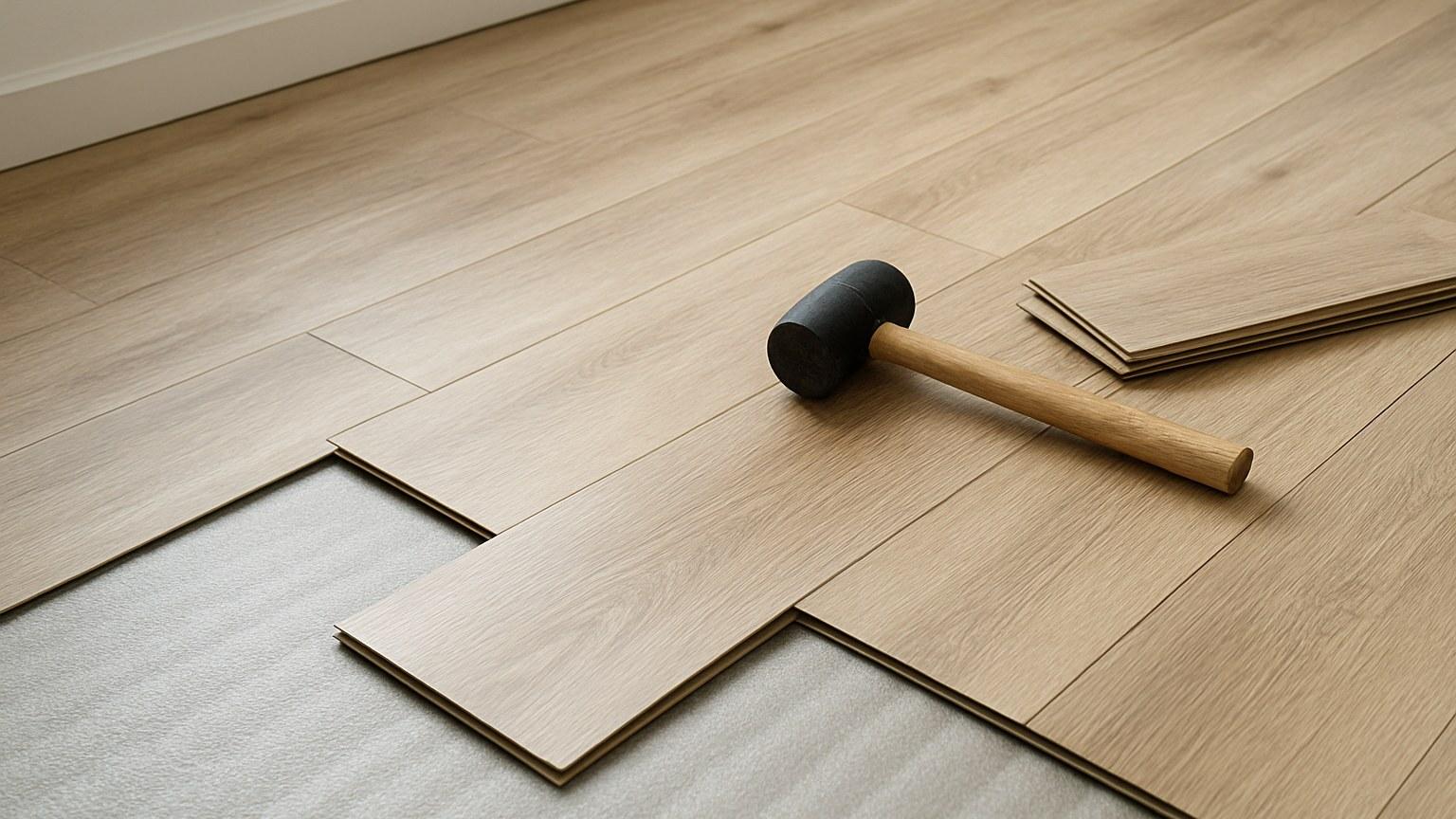
Click-lock vinyl flooring is really the snap joint, not the plank: machined edges that lock planks into a floating floor with no glue or nails. That joint, plus a flat subfloor, is what decides whether the floor holds. Get either wrong and the seams open, peak, or pop loose while the plank face still looks perfect.
Key takeaways
- You're really buying the locking joint, not the plank. Two families run the market: Unilin-style drop-lock, where the next plank presses straight down, and Valinge-style angle-tap, where you angle a plank in and fold it flat.
- A 'waterproof core' only means the plank itself won't swell. Water still gets under a floating floor at the seams and the perimeter gap and sits on the subfloor.
- A flat subfloor and the maker's expansion gap are what keep the clicks shut. Skip the flatness check and joints peak, gap, or pop apart.
- Installed cost runs about $4.50-$12 per square foot in 2026, per estimators.us, split roughly $2.50-$7 for materials and $2-$5 for labor.
- Click-lock floating floors are realistic DIY for most flat, open rooms. Stairs and big open-plan moisture transitions are where hiring out usually pays off.
What Click-Lock Vinyl Flooring Is
Click-lock vinyl is planks or tiles with shaped edges that snap into each other and form a floating floor, nothing holding it to the subfloor underneath. No glue, no nails. The floor rides loose and moves as one piece.
Think of old tongue-and-groove woodwork, except the pieces snap shut instead of getting glued. That snap is doing the whole job of holding the floor together.
The edge joint is the real product here. Two planks can have the exact same wood-look face and behave completely differently at the lock. One stays tight for years; the other starts gapping after a season. That's one more reason to look past the surface pattern and run through what to check before buying wood-look vinyl flooring before you commit to a box.
You'll see it sold under a pile of names that all mean the same method: click lock, click-and-lock, snap-together, interlocking, vinyl click, and luxury vinyl click flooring. They're describing the same snap joint.
It comes in two formats: plank, usually called LVP (luxury vinyl plank), and tile, usually called LVT (luxury vinyl tile). If you're trying to sort out what the "luxury" tag is even promising, I broke down what the "luxury" vinyl label actually buys you in a separate piece. For the tile side of that split, I go deeper on LVT versus VCT (vinyl composition tile) durability and cost in a dedicated breakdown.
Two Ways the Planks Lock: Angle-Tap vs Drop-Lock
Most click vinyl uses one of two locking styles, licensed from one of two joint families: Unilin or Valinge. Knowing which one you've got changes how the install goes.
Angle-tap, the Valinge-style joint, is sometimes called a fold-down or angle-angle lock. You angle the long edge into the row you've already laid, then fold the plank flat. As it drops, the end seam closes on its own.
Drop-lock, the Unilin-style joint, works a bit different. You angle the long edge in, then set the next plank's end straight down so it snaps without you sliding anything sideways.
Why care which you bought? Drop-lock is friendlier for a one-person job because you're not fighting a whole row at once. Angle-tap moves faster down a long wall, but the end seams are fussier and like to pop if you rush them.
The cheap, unlicensed locks are the ones that crack while you're still assembling the floor. When you read a review where somebody says their floor "stopped clicking" partway through, that's a damaged or low-grade lock giving out.
Why "Waterproof" Stops at the Plank, Not the Seam
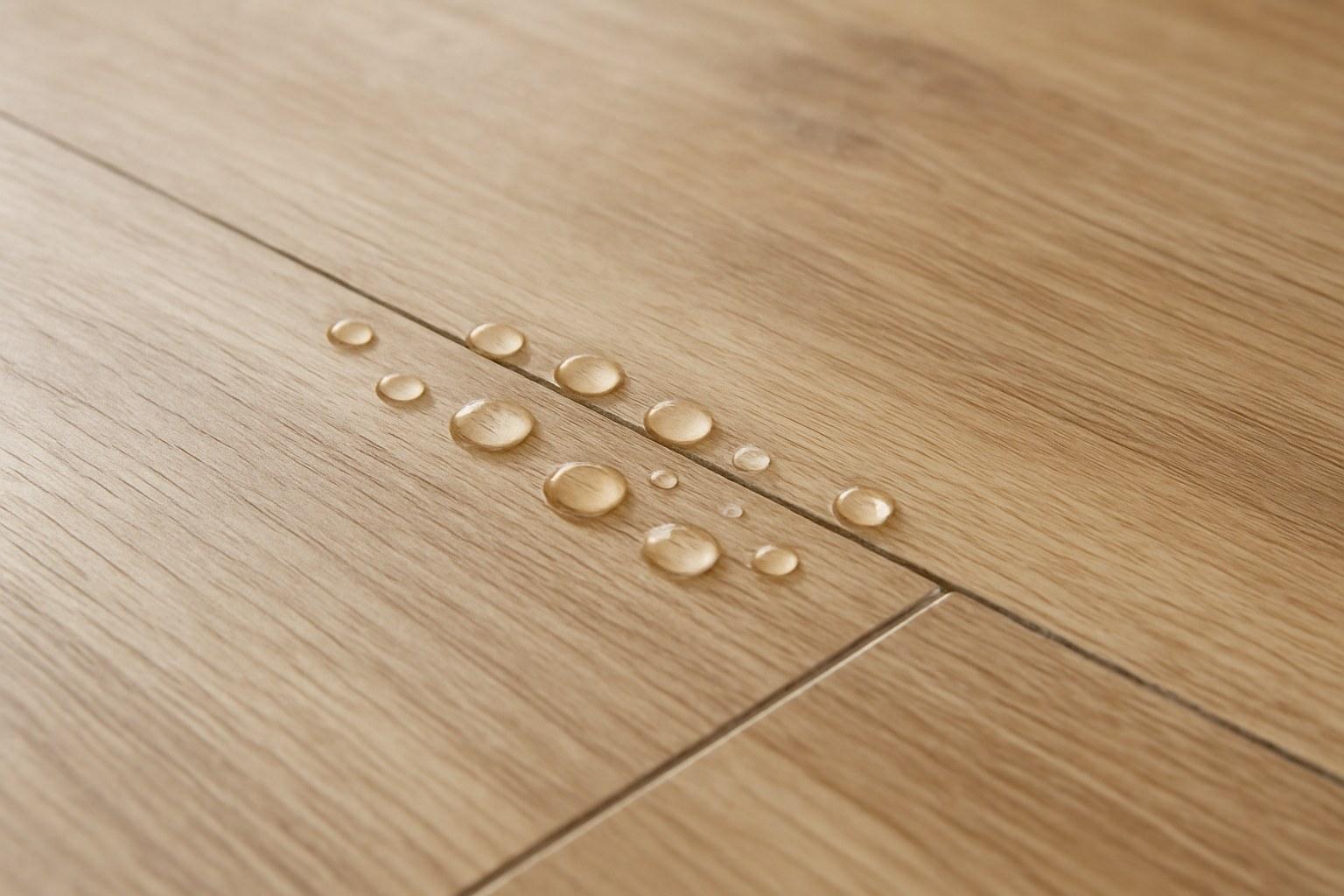
A waterproof core means the plank won't swell when it gets wet. It does not mean the floor is sealed. Those are two different claims, and the box blurs them on purpose.
The plank material can be genuinely waterproof while the seams and the perimeter gap are only water-resistant at best. Water doesn't care that the plank won't swell. It finds the way down.
Here's how the failures I get sent to fix actually play out. A spill or an overflow runs through the seams and the gap at the wall, slips under the floor, and sits on the subfloor. Up top the floor still looks fine. Down below, that trapped water is where the mold and the smell start.
As a surface, click vinyl is a solid pick for kitchens, baths, basements, and mudrooms. Just know that standing water still needs wiping and the perimeter still matters. Whether a floor like that lasts five years or twenty comes down to a handful of specific factors I cover in what decides vinyl flooring's lifespan.
This is also the real split between vinyl and laminate. Laminate usually gives a more convincing wood look for less money; vinyl tolerates water better. I laid that out room by room in vinyl vs laminate flooring if you're stuck between the two.
Flat Subfloor and Expansion Gaps Keep the Clicks Shut
The clicks only stay shut over a flat subfloor. Dips and humps lever the joints open, and that shows up as peaking, gapping, or planks popping loose a few months in.
Checking flatness is simple. Lay a long straightedge across the floor and look for daylight under it. Mark any low spots, then fill them with leveling compound before a single plank goes down. Grind down the high spots. Do this before you lay, not after you notice a wobble.
On concrete, check moisture too, because a floating floor traps whatever rises up at the perimeter. I had a basement job down in Dayton where the homeowner, Dana, wanted it done that morning. My meter read too high off the slab, so we didn't lay that day. We let it dry and came back. Floating a floor over a wet slab is how you build yourself a mold sandwich you can't see.
Every wall gets an expansion gap so the floating floor can move. The size depends on the product's own instructions, not some universal number you read online. Make "leave room to move" your guideline and consult the box for the exact figure.
Before you snap a single plank together, keep unopened boxes in the room for the time the manufacturer lists on the carton. That's there so the vinyl settles to the room's actual temperature and humidity before it locks tight. Skip it on a cold room or a delivery that just came off a truck, and you can get the same gapping or peaking a few weeks later even with a flat subfloor and the right expansion gap.
Budget for prep, because it's real work. Subfloor leveling adds cost per square foot on top of the floor itself, and the amount depends on how bad the slab is. A basement or a stairway runs you more than an open room.
Do You Need Anything Under Click-Lock Vinyl?
Often nothing extra. Many rigid-core click planks ship with a pad already bonded to the back, usually a layer of IXPE foam, a dense, cross-linked foam that cushions your feet a bit and knocks down some sound. Adding a second underlayment on top of that built-in layer can void the warranty. Double up and you've paid to break your own coverage.
When you might add something: over bare concrete, for a little sound deadening or underfoot comfort. But only if that specific product's instructions allow a pad and name which type.
A moisture barrier goes over concrete when the product calls for one. It's cheap per square foot against the cost of a floor that mildews underneath where you can't reach it.
If you're shopping "click lock vinyl flooring with pad," that just means the pad is built in. The floor is ready to float straight onto a prepped subfloor, so don't go buying more underlayment on top.
Let the instruction sheet in the box decide. What goes underneath depends on that product and the subfloor supporting it.
What It Costs, and Whether to Buy and Install It Yourself
What to Check Before You Buy
Judge the floor by three things, not the showroom lighting. The wear layer, measured in mils, which the maker publishes per product, a thin wear layer is a light-traffic floor dressed up to look tough. The locking family, since a licensed Unilin or Valinge joint is far less likely to be the one that cracks mid-install. And the warranty, and whether it covers the rooms you actually want it in.
If you want picks already sorted by room and traffic, I rounded up the best LVP floors matched to the room you're buying for.
Cost per Square Foot: Materials vs Labor
Installed, click-lock vinyl runs about $4.50 to $12 per square foot in 2026, according to estimators.us. That splits into roughly $2.50 to $7 for materials and $2 to $5 for labor. Basements and stairs push you toward the top of every one of those ranges.
| Cost piece | Per square foot (2026) | What moves it |
|---|---|---|
| Materials only | $2.50-$7 | Wear layer, core type, lock quality |
| Labor only | $2-$5 | Room shape, stairs, prep needed |
| Installed total | $4.50-$12 | Low end open rooms, high end basements and stairs |
Source: estimators.us's 2026 cost data
For a fuller breakdown by product tier and room, see my LVP flooring cost guide.
DIY or Hire It Out
Click-lock floating is realistic for most flat, open rooms. That's the whole appeal of a snap-together floor, and a confident DIYer can do a living room or bedroom over a weekend once the subfloor is flat.
Where I'd tell you to hire: stairs, transitions between big open-plan rooms that need large expansion breaks, and anywhere real moisture prep is involved. Those are where a redo costs more than the pro would have, so pay once.
Sources
- Estimators.us's 2026 cost data