
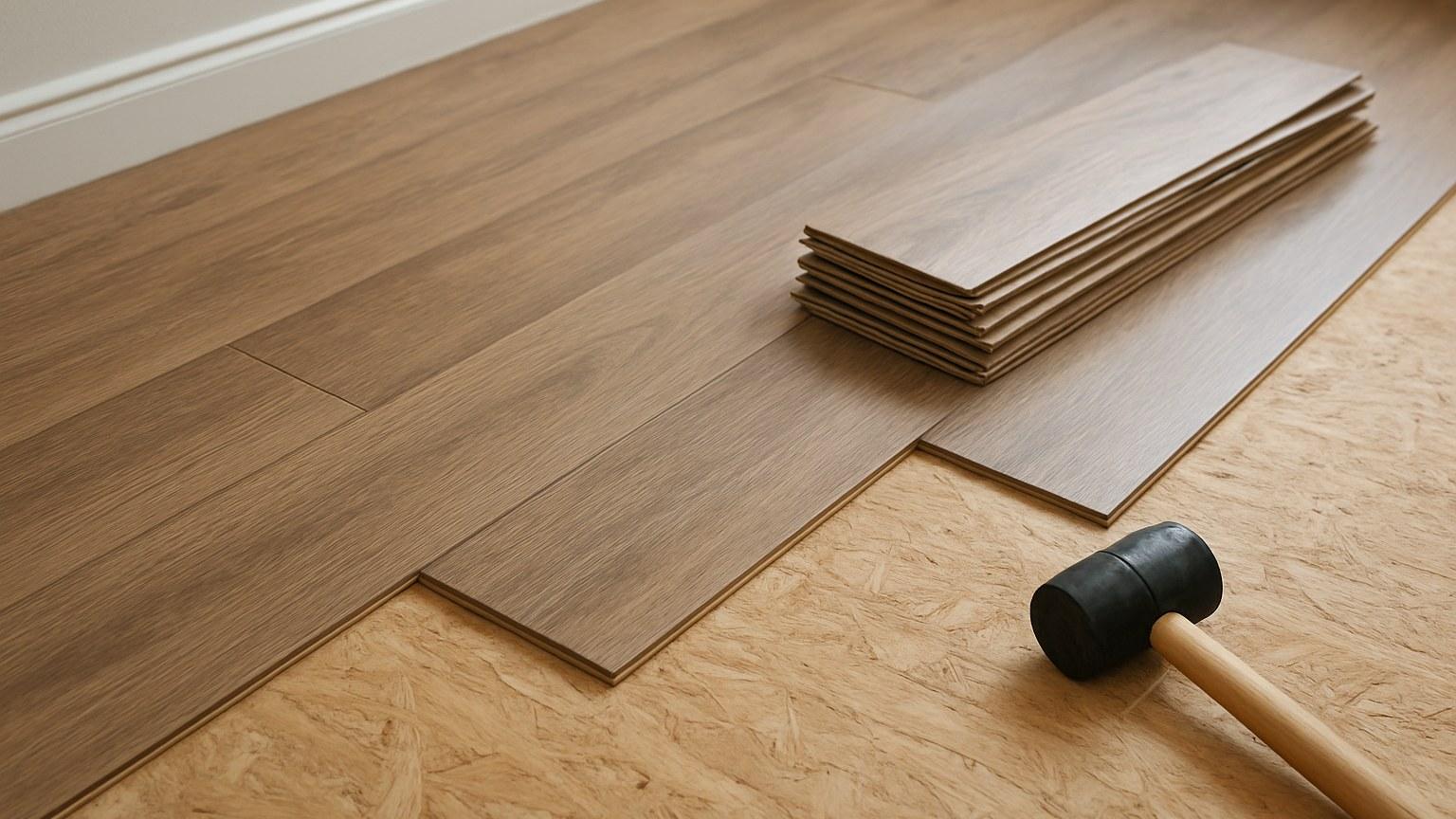
How long does LVP (luxury vinyl plank) off-gas? The chemical smell usually clears in a few days to a few weeks once you get air moving, but low-level VOCs (the gases that cause that new-floor smell) can hang on longer than your nose can tell. That gap between "smell gone" and "gases gone" is why the popular guides give you four different answers.
Key takeaways
- The chemical smell from new LVP (luxury vinyl plank) usually clears in a few days to a few weeks with good airflow, but measurable VOCs can stay elevated longer.
- Guides disagree because 'smell gone' (your nose) and 'VOCs near zero' (an instrument) are two different finish lines.
- Off-gassing is strongest right after install; cross-ventilation plus an activated-carbon purifier are the fastest ways to clear it.
- WPC (wood-plastic core) can off-gas more noticeably than SPC (stone-plastic core); FloorScore and GREENGUARD Gold labels mean the plank was tested to lower emission limits.
- A professional VOC air test runs roughly $200-$400 per test (angi.com) to $200-$500 (ibuyer.com).
How Long Does LVP Off-Gas? The Short Answer
The smell fades in a few days to a few weeks with good ventilation. The VOCs can stay elevated beyond that. Those are two separate finish lines, and most guides only track one of them.
Search this question and you'll get days from one site, weeks from another, and months from a third. They're not all right, and they're not all wrong, they're measuring different things, so this page lines each one up instead of handing you one fuzzy range.
Off-gassing is strongest right after install, and fresh air speeds up how fast the smell clears. The early days matter most.
A cleared smell only tells you what your nose thinks, it isn't proof the air is clean. Your nose stops noticing a steady smell long before an instrument stops reading gas. Don't treat "I can't smell it anymore" as "the floor is done."
Why the Guides Can't Agree on How Long
They disagree because some are timing the smell and some are timing the instrument readings. Once you know which one a guide is measuring, the "contradiction" disappears.
| Guide | What it says | What that's measuring |
|---|---|---|
| thebestlaminateflooring.com | Strongest 24-72 hours, tail of weeks | Smell plus general advice |
| creativecarpetinc.com | Fades within a week, rarely a month | Smell |
| 5starfloor.com | Weeks or months | Vague, no data |
| mychemicalfreehouse.net | Cites a study: VOC levels barely declined over 2-12 weeks | Instrument readings |
How four flooring guides describe LVP off-gas duration, and what each one is actually tracking.
The short-range guides are describing when the smell goes. The longer ones are describing when a meter stops reading VOCs. mychemicalfreehouse.net points to a study where VOC levels barely dropped over a 2-12 week window, which is a far cry from creativecarpetinc.com saying the smell fades within a week.
So the read you can act on: expect a few days to a couple of weeks for the smell, and weeks beyond that before VOC readings settle down. A wood-plastic core floor (more on that below) can run longer.
What Homeowners Report on Reddit
In the threads where people post about new LVP, the pattern lines up with the smell timeline, not the instrument one. People describe the smell easing off within a week or two once they run fans and open windows.
The outliers are almost always basements and sealed-up rooms with little airflow. That aligns with my observations during the work. Air movement is the biggest difference between a floor that smells for days and one that smells for a month.
Does LVP Off-Gas, and Why?
Yes, it does. LVP is built on PVC (polyvinyl chloride), a type of plastic, and makers mix in plasticizers, chemicals that keep the vinyl soft and bendable instead of stiff, to make it flexible. Those plasticizers give off VOCs, heaviest when the plank is brand new.
A lot of old advice doesn't hold up anymore. Older vinyl leaned on phthalate plasticizers, a family of softening chemicals once common in vinyl products that raised real health concerns. Much of today's LVP uses DOTP or DEHT instead, newer softening chemicals that aren't phthalates and are generally considered a safer swap. Lumping a new floor in with decades-old phthalate warnings is misleading, so read the product's own spec, not a generic scare. If you're weighing materials beyond LVP altogether, it helps to compare a wider range of non-toxic flooring options.
It's also not only the plank. The glue and the backing can release formaldehyde, which is why the whole assembly matters, not just the board. I watched a "low-VOC" plank get set in a Dayton basement with whatever adhesive was already on the truck, and the room smelled for weeks longer than it should have. If you care about this, the underlayment and the glue are worth checking along with the plank. For a fuller breakdown of which floors clear fastest, see what flooring has the least off-gassing.
LVP vs. Sheet Vinyl VOCs
LVP generally runs lower-VOC than sheet vinyl. Sheet vinyl is a big, continuous roll with more surface and more glue down at once. Don't carry old sheet-vinyl worries straight over to a rigid plank floor, they're not the same product.
What Changes How Long Yours Lasts
Four things decide whether your floor clears in days or drags on for weeks.
Core type. mychemicalfreehouse.net notes that WPC (wood plastic composite), a wood-plastic core, trends higher in noticeable VOCs than SPC (stone plastic composite), a stone-plastic core. A WPC floor can take longer to stop smelling.
Certifications. A FloorScore or GREENGUARD Gold label means the plank was tested against a lower emission limit before it shipped. A floor that passed one usually off-gasses less and for a shorter stretch. mychemicalfreehouse.net points to Proximity Mills as an example of a 0-VOC flooring brand built around this kind of low-emission standard, instead of just a generic 'low-VOC' label.
Ventilation and heat. A warm, well-aired room clears far faster than a cold, sealed one. A basement with weak airflow holds the smell the longest.
How it was stored. Planks sealed in a box since the factory start fresh. Unboxing and airing them before install gives the off-gassing a head start somewhere other than your living room.
How to Clear LVP Off-Gassing Faster
Move air, and move a lot of it. Open windows on two sides of the room and run a box fan to pull a cross-breeze through. This is the one step every guide agrees on, and it does more than anything else.
Pick the right filter. An activated-carbon purifier adsorbs VOC gases. A plain HEPA filter catches dust and particles, not the gases, so HEPA alone won't fix a chemical smell. If you buy a purifier for this, make sure it has a carbon stage.
Warm the room, then vent it. Heat drives off-gassing out faster, so bumping the temperature up and then airing the room out can shorten the tail. You're speeding the process up on purpose, not trapping it.
And if you can, pre-air the planks. Unbox them in a garage or spare room for a day or two before install, so the worst of the smell happens off the floor instead of under your feet.
Is New LVP Dangerous, and How Do You Check It?
For most healthy adults, a well-ventilated new LVP floor smells unpleasant rather than acutely hazardous. That said, if you or anyone in the house has symptoms or health concerns, that's a question for a doctor, not a flooring blog.
Who's Most at Risk
Some people should be more careful during the strong early days: infants, pregnant people, anyone with asthma or a breathing condition, people with chemical sensitivities, and pets that live down low on the floor.
The practical move is simple. Keep kids and pets off a fresh floor and keep the room aired out until the smell drops off. Levels are highest in the early days, so that's when the extra caution earns its keep.
Testing Your Air for VOCs
A cheap consumer VOC monitor shows you rough trends, which is enough to tell whether things are getting better week to week. A professional test gives you a real, defensible number.
A professional test costs more than a cheap monitor, but it gives you a real, defensible number instead of a rough trend. Below is the typical price range two sources quote:
| Test | Cost range (USD per test) |
|---|---|
| VOC test (angi.com) | $200 - $400 |
| VOC test (ibuyer.com) | $200 - $500 |
If you want the full checklist for buying a lower-emission plank in the first place, our guide on non-toxic LVP flooring walks through the exact labels to confirm before you commit.