
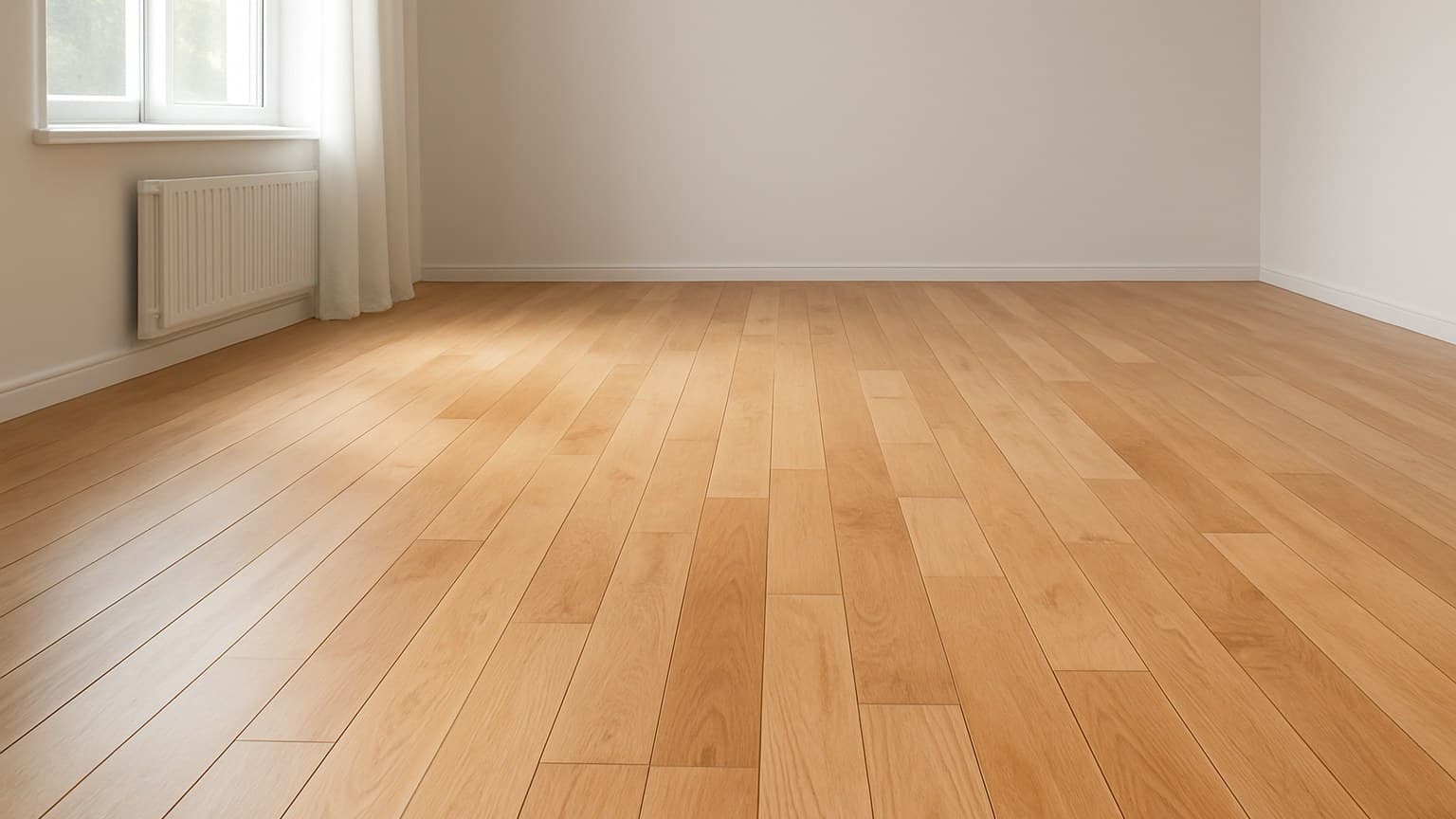
Beech hardwood flooring gets sold on one line: harder than oak. About three years ago, I pulled up a cupped beech floor in a customer's bathroom in Naperville, Illinois, 5-inch solid boards laid over a plywood subfloor, not even a year old and already gapping at the seams and cupping along the tub wall. That half-truth is exactly what left him with ruined boards in the wrong room. Here is where beech earns its keep, and where oak actually wins.
Key takeaways
- Beech lands around 1300 on the Janka hardness scale, between red oak (1290) and white oak (1360), so it is barely harder than oak, not dramatically tougher.
- Beech moves more with humidity than oak and takes stain blotchy, which makes it a poor pick for bathrooms, basements, or any room that sees standing water or big swings in moisture.
- Solid beech can be sanded and refinished several times over its life; engineered beech stays flatter over concrete and works better with underfloor heat.
- Expect beech materials to run roughly $4-9 per square foot and install labor $3-7 per square foot, with stairs and basements always costing more than open rooms.
- Oak is the safer all-round default; choose beech mainly when you want its pale, uniform, near-grainless look in a dry, climate-steady room.
Beech vs Oak: The Janka Hardness Numbers, Settled
Beech is only a hair harder than red oak, and it's actually a touch softer than white oak. "Much harder than oak" is a myth that sells floors.
Here's the plain version. The Janka number comes from a test where a steel ball is pressed into the wood, and you measure how much force it takes to leave a dent. Higher number, harder wood. American beech lands around 1300. Red oak is about 1290, and white oak is about 1360. A 60-point gap like that is nothing you'll ever feel underfoot. A 400-point gap is a different story, which is why black walnut at around 1010 dents and marks far more easily than any of these.
That also settles a contradiction you'll hit while shopping. BuildDirect calls beech "slightly harder than red oak," while Wood and Beyond says it "surpasses oak." Both are half right. Beech beats red oak by a whisker and loses to white oak and hard maple. It doesn't tower over oak.
One more thing to clear up: American and European beech sit at roughly the same hardness, so hardness isn't the reason to pick one over the other.
| Species | Janka rating | Note |
|---|---|---|
| Hard maple | 1450 | Hardest of this group; harder than beech |
| White oak | 1360 | Slightly harder than beech, more water-tolerant |
| American beech | 1300 | Sits just above red oak |
| Red oak | 1290 | Essentially a tie with beech |
| Black walnut | 1010 | Clearly softer; shown for scale |
Source: the Janka hardness figures the NWFA publishes for each species
Note: Janka hardness figures are widely cited industry averages for each species; exact lab results vary by test sample, so treat these as approximate rankings rather than fixed values.
Black walnut sits far below the rest here. It's softer, marks more easily, and is a different price bracket altogether if you were weighing it in the mix.
American vs European Beech: Not the Same Floor
They aren't interchangeable, and most buying guides skip this entirely. European beech, the kind makers like Junckers sell, tends to run a touch pinker and is often steamed to even out the color. American beech skews paler with more color streaking board to board.
That difference matters most when it comes to color, because beech is a stubborn wood to stain.
Why beech stains blotchy (and what to do instead)
Beech is dense and its grain closes up tight, so it drinks stain unevenly. You end up with dark patches and light patches across the same board, a mess most people don't expect from a smooth-looking wood.
The fix is to not fight it. Buy prefinished or factory-colored beech: per NWFA/NOFMA (National Wood Flooring Association) factory-finished flooring standards, factory finishes are applied and cured under controlled plant conditions specifically to produce consistent, even color and durability. Site-staining raw beech yourself is the hard road, and it's where a lot of DIY beech jobs go wrong.
Solid vs engineered beech: pick by where it's going
Solid beech is one piece of wood through and through. Engineered beech is a thin beech wear layer over a plywood-style core, and that core is the point. NWFA installation guidelines note engineered wood flooring as the more stable choice over concrete, below grade, and with radiant/underfloor heat, because it moves less than solid wood. If you're also weighing a laminate-style product marketed as hardwood, it's worth checking is Pergo actually real wood before you lump it in with true engineered options like this.
That stability is a trade, not a free upgrade. Because the wear layer on engineered beech is thin, it typically only tolerates about 1-2 light refinishing sandings over its life, compared to the several sandings a solid beech floor can take. Sand through that veneer and you hit the core, there's no bringing it back to bare wood after that. So if the basement, slab, or radiant-heat room is a floor you expect to refinish repeatedly over decades, go in knowing engineered buys you stability, not longevity of finish.
Solid beech moves more with the seasons, so I steer people toward engineered anytime the floor is going over a slab or on top of heat. If the click-lock question is where you're stuck, it's worth reading whether click hardwood flooring is worth it before you commit. And if the glue and core makeup matter to you for air quality, know that a "formaldehyde-free" label doesn't mean what you think.
Where Beech Beats Oak
Beech wins on one thing above all: the look. Its fine, straight grain gives a clean, near-grainless, uniform surface that oak can't match. Oak's grain runs bold and arched into what's called cathedral grain, the grain lines stack into pointed, arch shapes down the board, like a row of church windows, which reads busier than beech. If you want a floor that reads smooth and calm instead of busy, that's the real reason to choose beech.
It's also genuinely hard, a shade above red oak, so it takes daily foot traffic in a dry living room or bedroom without complaint.
Prefinished beech carries pale, cool, Scandinavian-style tones cleanly. If you like light modern rooms and find oak too orange, beech gets you there in a way oak fights.
And per the NWFA's Solid Wood Flooring Environmental Product Declaration, solid wood floors, beech included, are built to be sanded and refinished multiple times over a documented service life. A well-kept solid beech floor lasts decades. So the case for beech comes down to this: you want a smooth uniform low-grain look, in a dry climate-steady room, in pale cool color, and you're fine taking that color prefinished rather than custom-stained on site.
Where Beech Loses to Oak
Moisture is the big one, and you have to separate two things to understand it. The beech plank itself is dense. But the wood swells and shrinks more than oak with humidity swings, and that movement shows up at the seams, at the edges of the boards, not in the middle of the plank. Gaps in winter, cupping in summer, right along the joints.
It also has poor tolerance for standing water. A leak or a wet mop that white oak shrugs off can stain and warp beech. That alone takes bathrooms, powder rooms, mudrooms, and wet entryways off the table.
Then there's color. Beech's blotchy staining and limited custom options put it behind oak, and on dark-stained versions its paler base shows scratches and pet marks more.
Basements and other below-grade, humidity-prone spaces are a worse bet for beech than for oak. If you insist on beech down there, engineered is the only version worth considering, and even then I'd think hard about it. Keep beech out of bathrooms, mudrooms, wet entryways, uncontrolled basements, and any room with big seasonal humidity swings.
Beech vs Oak: Which One for Your Room
The honest verdict: oak, especially white oak, is the safer no-regret default for most homes and most rooms. Beech is a specialist pick, right for a specific look in a specific room.
Here's the head-to-head so you can find your own case.
| Factor | Beech | Oak |
|---|---|---|
| Hardness (Janka) | ~1300 | Red ~1290 / White ~1360 |
| Grain look | Fine, uniform, low grain | Bold, open cathedral grain |
| Staining | Blotchy; best factory-colored | Takes stain evenly, wide color range |
| Moisture tolerance | Low; avoid wet rooms | Better, especially white oak |
| Movement with humidity | Moves more | More stable |
| Refinishing | Solid sands several times | Solid sands several times |
| Best rooms | Dry living rooms, bedrooms | Almost anywhere, incl. kitchens/halls |
Source: comparing beech and red-oak floors in the homes I've installed and later pulled up
Note: Janka and moisture-tolerance figures are widely cited industry averages, checked against red oak and American beech floors I've installed and later pulled up for customers in the Chicago suburbs.
How beech and oak compare across the factors that decide a floor.
So which for whom. Choose beech for a dry, climate-steady living room or bedroom where you want that pale, uniform look and you're happy with prefinished color. Choose oak for kitchens, hallways, whole-home installs, and anywhere moisture or a resale-safe look matters. If you're nervous about the whole decision, oak is the lower-regret money. For a deeper dive into weighing solid against engineered construction and matching species to room beyond just beech and oak, this guide to picking solid vs engineered hardwood floors covers the broader decision framework.
What Beech Costs and What Install Adds
Beech materials run roughly $4-9 per square foot, and professional install labor runs roughly $3-7 per square foot for an open room. There's no single flat national number worth quoting, because species, region, and how much prep your old floor needs all move it. Treat these as starting ranges and confirm with two local quotes. If those ranges are still tight for your budget, it's worth figuring out whether clearance hardwood flooring is actually a deal or just leftover stock before you buy on price alone.
The room changes the labor line more than people expect. The open middle of a room is never where the time goes. Closets, doorways, and cut-heavy areas eat hours, so hallways cost more per foot than a big open living room, and stairs are their own price entirely, charged per step.
| Space | Beech materials | Install labor |
|---|---|---|
| Open living room / bedroom | $4-9 / sq ft | $3-7 / sq ft |
| Hallways (more cuts) | $4-9 / sq ft | $4-8 / sq ft |
| Stairs | $4-9 / sq ft of tread | $40-75 per step |
| Basement (engineered only) | $5-9 / sq ft | $5-9 / sq ft plus moisture prep |
Cost ranges for beech flooring split by materials and labor, by space. Confirm against local quotes.
Basements cost more than open rooms every time, because a slab needs a moisture check and often extra prep before anything goes down. Before you price the floor at all, that prep is the part that decides whether it lasts, so it's worth knowing what should go under hardwood flooring so you can budget for the layers you can't see once the planks are on.