
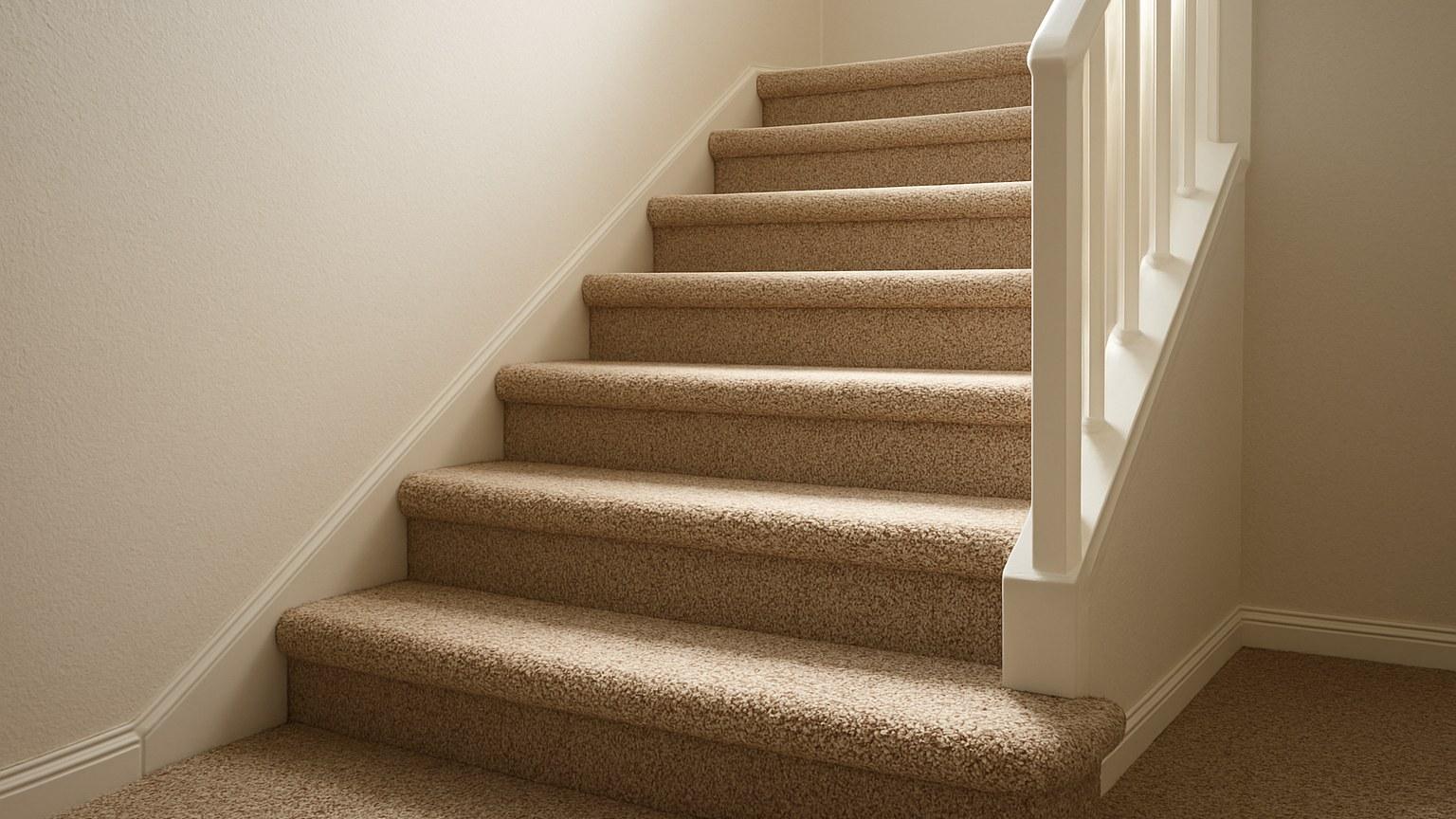
Carpeted stairs are worth it when you fit low, dense pile tight to every step; a loose runner is the one version that's more dangerous than bare wood. Safety, allergies, pets, upkeep, and cost all pull in different directions here.
Key takeaways
- Carpet makes stairs safer only when it's fitted tight with low, dense pile; a loose runner is more dangerous than bare wood.
- Judge stair carpet by construction density, not fibre name. The Carpet and Rug Institute says density, not fibre type, predicts wear.
- Before carpet goes down, the Carpet and Rug Institute's install standard says treads and risers must be clean, dry, and structurally sound, with the stair nose rounded 3/4 to 1 inch.
- Installed cost runs about $180-$880 for a straight flight, $400-$1,000 for U- or L-shaped, $500-$1,300 curved, and $800-$1,500 spiral (homeguide.com).
- Carpet is usually cheaper upfront than new hardwood stairs, but the gap swings with your stair shape and step count.
Are Carpeted Stairs Safer, or Just Slippery?
Carpet on stairs is safer than bare wood, but only when it's fitted tight and low. A loose, rippling runner is worse than bare treads, because now you've added something to trip on.
Bare wood stairs slip for a simple reason: socks on a finished surface have almost nothing to grab. A dense, low pile grips the step edge where feet land hardest, and it softens the blow if someone does go down.
Deep plush does the opposite. It rolls and compresses underfoot right on the nosing, the rounded front lip of each step, so your foot feels like it's shifting under you. Plush fails fast on stairs for that reason, and I won't put it there.
For the nuts and bolts of fitting it so it won't slide or wear through, see the guide to picking and installing carpet for stairs.
Noise, Warmth, and Comfort Underfoot
Carpet is the fastest fix for loud, cold, hard stairs. It still wins in houses where bedrooms sit over a living room, because nothing else quiets footsteps as cheaply.
It muffles footsteps and kills the bang that travels through a whole house when someone thumps down bare treads at night. In a home where people go up and down barefoot or in the dark, that softer, warmer landing matters more than the spec sheet lets on.
The flip side: carpet hides the look of a nice wood staircase. If you've got stained oak treads worth showing off, weigh the comfort against what you'd be covering up.
Allergens, Dust, and Moisture
If someone in the house has asthma or bad allergies, carpeted stairs hold more dust and dander than bare treads, and they only stay healthy if you actually vacuum them.
Carpet traps allergens instead of letting them blow around the house. That's good if you run a vacuum over it often, and bad if you don't, because then it's a reservoir. A weekly pass with a decent vacuum is the real cost of carpeted stairs in an allergy household.
Moisture is the other catch. Stairs heading down to a damp basement are the one spot I'd think twice about carpeting until the moisture is sorted out. Carpet over a wet substrate is how you end up with musty padding and mould you can't see.
Kids, Older Adults, and Mobility
When the stairs serve small kids or older adults, carpet is the easy call, because grip and cushion both matter the moment someone misses a step.
Firmer footing helps anyone unsteady on their feet or leaning on the handrail. And when a slip does happen, a cushioned step takes the worst out of the fall instead of a sharp wood edge.
One caution: keep the pile low and tight. A cane tip, a walker leg, or a toddler's foot can catch on a loose or shaggy edge, which turns a safety feature into a hazard.
Pets on the Stairs, Especially Dogs
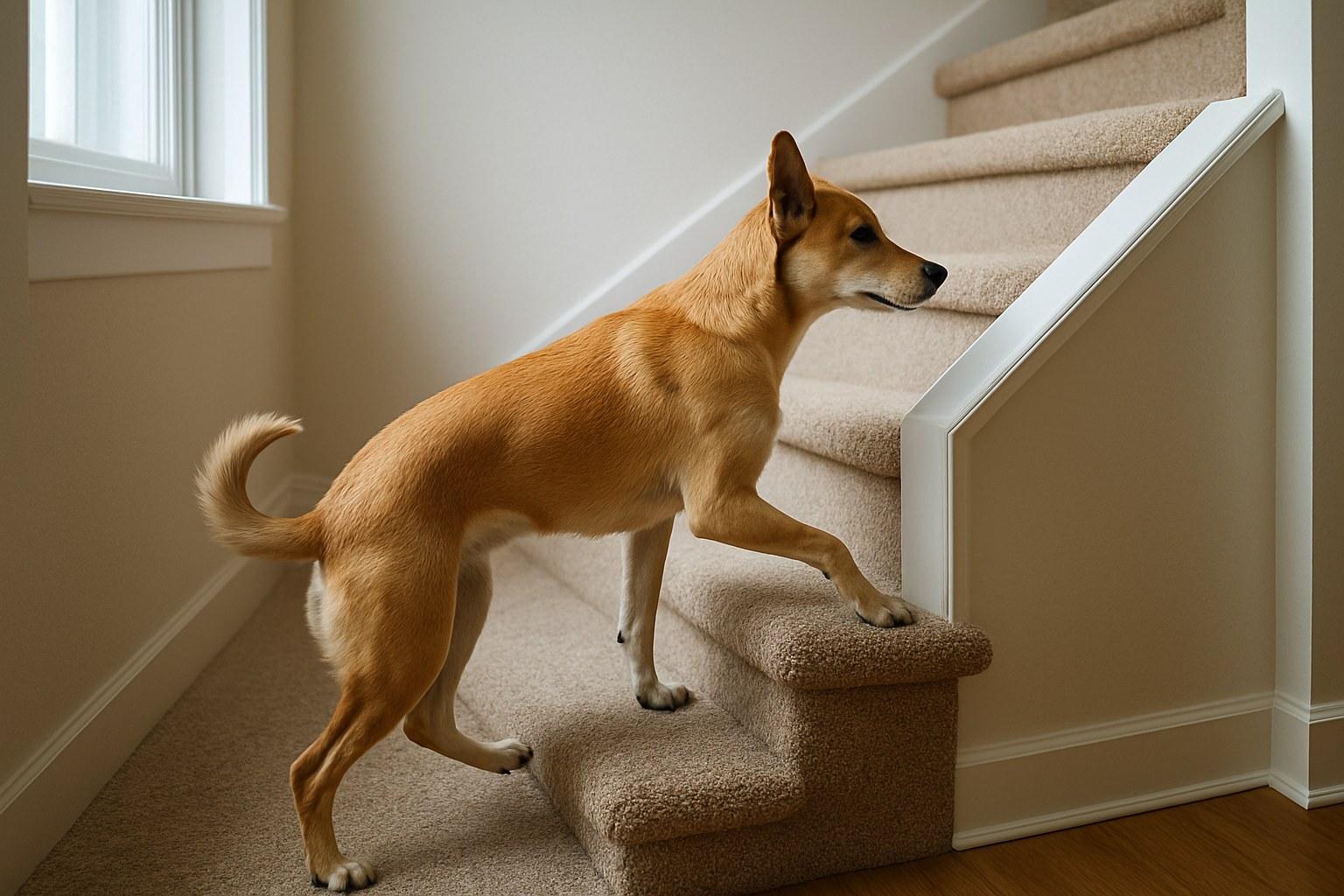
For dogs, carpet gives the traction they can't get on slick wood, so it's usually the right call in a dog household.
Older and large dogs are the ones who really suffer on bare stairs. They scramble, slide, and blow out joints trying to get grip. Carpet or a dense runner fixes that overnight.
The trade-off is claws. Berber-style carpet is woven with uncut loops of yarn instead of a cut pile, and claws snag those loops easily, so a dense cut pile holds up far better to pets than Berber-style loops do. For which fibres and cleanup routines handle pets best, read the guide to the best carpet for pets.
Are Carpeted Stairs Out of Style? And How to Modernize Them
Fully carpeted stairs aren't out of style, but wall-to-wall in a dated colour reads old fast. The current look is clean neutral low-pile, or a crisp runner down painted or stained treads with the wood edges showing.
You don't have to rip everything out to catch up. Swap a busy or beige-gold carpet for a neutral mid-tone, drop to a lower pile, or run a tight runner down the middle of refinished treads so the wood frames it. If you're picking carpet for the rest of the house too, the same logic of matching pile and color to the room applies, which the step-by-step carpet room guide walks through room by room.
The two looks are easy to picture. Fully carpeted means carpet across the whole tread and riser, wall to wall. A runner is a strip down the center with painted or stained wood showing on each side.
Either way, a tight, even fit is what makes it look current. Ripples, gaps, and loose edges are what make any carpet look cheap, no matter the colour.
The Upkeep You're Signing Up For
Stairs are the hardest-working carpet in the house, and the nosing wears first, so plan on cleaning them more often than a flat room.
Vacuuming each step and the front lip is fiddly, but it's non-negotiable if you want the carpet to last. Grit grinds the fibres at the edge, and that's exactly where failure starts. Spot-clean spills fast, and deep-clean the whole run a couple times a year.
I had a client over in a Dayton neighborhood who insisted on a light plush for a busy hallway. Within a few months it had matted into a visible worn path right where everyone walked, and no amount of cleaning brought it back. Stairs do the same thing, just faster, because every foot lands on the same nosing. That worn path is driven more by density and fit than by how often you clean it.
How to Choose and Fit Carpet So It Survives the Stairs
Density Over Fibre Name
Judge stair carpet by construction density, not the fibre on the label. The Carpet and Rug Institute, the industry's trade group, says density, how tightly the fibres are packed, predicts wear more than fibre type.
So favour a low, dense cut pile for high-traffic stairs. And use a thinner, firmer pad on stairs, not the thick, soft pad you'd put in a bedroom. Soft pad lets the carpet flex off the step edge and wear through at the lip. For how pad is priced and specced, see the carpet padding cost guide.
Prep: Treads, Risers, and the Stair Nose
Prep decides whether the carpet lasts. The Carpet and Rug Institute's residential install standard says treads and risers must be clean, dry, and structurally sound before anything goes down, and the stair nose return should be rounded to a radius of about 3/4 to 1 inch.
That rounded nose is the whole game. Carpet wraps a curve and wears evenly across it, but it tents over a sharp square edge and splits or frays there first.
As for doing it yourself: wrapping tight, even carpet around every nose with a knee kicker, a hand tool you bump with your knee to stretch the carpet tight before tucking it against the tread, is slow, exacting work. This is one job I'd usually hire out. A flat room is forgiving; stairs punish every loose wrap.
What It Costs, and Whether It Beats Hardwood
Carpet is usually cheaper upfront than new or refinished hardwood stairs, but the gap swings with your stair shape and step count.
The carpet and pad are the small part of a stair quote. Most of what you pay is per-step labor, and that per-step work is exactly why stairs cost far more per square foot than an open room. Curved and spiral stairs cost the most because every single step is cut and fitted by hand.
| Staircase shape | Installed cost per staircase | Why it moves |
|---|---|---|
| Straight | $180-$880 | simplest cuts, lowest labor |
| U- or L-shaped | $400-$1,000 | a landing and turns add cuts |
| Curved | $500-$1,300 | every step cut by hand |
| Spiral | $800-$1,500 | tightest hand-fitting, most labor |
Source: homeguide.com
Installed cost to carpet a staircase by shape, whole-staircase totals.
To price your exact step count and shape, the full stair carpet cost breakdown runs the per-step math so you can read your own staircase off it.