For most garage gyms the right home gym flooring is 3/4-inch rubber: horse stall mats where you drop weight, rolled rubber where you just need to cover a big floor cheaply. The confusing part is price, which can run from a few dollars a square foot to well over ten times that depending on material, so two floors that look alike can be a thousand dollars apart. Below are five materials ranked, each with real cost bands and the sizing math to price out your own space.
Key takeaways
- For most garage gyms the answer is 3/4-inch rubber: horse stall mats if you drop weight, rolled rubber if you're covering a big floor cheaply.
- Rubber rolls run $1-$5 per square foot material-only (HomeAdvisor); interlocking tiles run a much wider $7-$45 per square foot (Oasis Tile).
- A 3/4-inch 4x6 horse stall mat is $143-$149 (American Floor Mats); a 21x22 garage (462 sq ft) takes 20 of them, roughly $2,860-$2,980.
- Foam puzzle mats are the cheapest to buy but tear and dent under barbells and rack feet, so keep them to cardio and bodyweight work.
- Measure length times width, divide by one mat or roll's area, round up, and add 5-10% for waste before you order.
What a Home Gym Floor Actually Has to Do
A gym floor has three jobs. It protects your slab from dropped plates, it protects your bar and plates from the hard slab, and it cuts some of the thud and vibration that travels to rooms below.
It does not block sound through walls, though. Dampening a thud isn't the same as soundproofing a room. A rubber floor will soften the bang of a deadlift, but your neighbor in the next room still hears it. If quiet is the goal, that's a wall-and-ceiling problem, not a floor problem.
Thickness is what absorbs a drop. That's why a cardio corner and a deadlift corner have different needs. For jogging in place, stretching, or bodyweight work, thin is fine. For a loaded barbell coming down from the hip, you want dense rubber at least a half inch thick, and 3/4 inch if you drop heavy.
Over a concrete slab, and in a basement
The surface underneath changes the math. A concrete garage slab is usually dry and flat enough to loose-lay rubber right over it. A basement slab is a different animal, because below-grade concrete can pull moisture up from the ground no matter how parched it is.
In the work I've done, I plan for basement slabs to sweat even when they look dry, so I lean toward a floor you can lift and air out rather than gluing one down tight with urethane adhesive. That extra moisture prep is also why a basement gym floor runs higher than the same floor in a garage. If your gym is going in a finished basement, read how to install basement flooring that won't fail first, because moisture is what ruins those floors, not the workout.
The 5 Home Gym Flooring Options, Ranked at a Glance
Here are the five, ranked from best for heavy lifting down to cheapest stopgap, with cost bands credited to HomeAdvisor (rubber rolls), Oasis Tile (interlocking tiles), and American Floor Mats (stall mats). These are material costs for a DIY loose-lay job; gluing any of them down with urethane adhesive adds labor on top, and a basement gym costs more than a garage because of the extra moisture prep.
The two value winners are easy to name up front: 3/4-inch stall mats if you drop weight, and rubber rolls if you just need to cover a big floor without spending much.
| Material | Cost | Best for | Thickness | Heavy drops |
|---|---|---|---|---|
| Horse stall mats (3/4 in) | about $6/sq ft | Heavy lifting, deadlifts | 3/8-3/4 in | Excellent |
| Rubber rolls | $1-$5/sq ft | Covering a big floor on a budget | ~8 mm and up | Good |
| Interlocking rubber tiles | $7-$45/sq ft | Easy DIY, odd-shaped rooms | varies | Good to fair |
| Carpet tiles | Budget | Cardio, low-impact rooms | thin | Poor |
| Foam puzzle mats | Cheapest | Yoga, bodyweight, stopgap | thin | Poor |
Five home gym floors compared by cost, best use, thickness, and how they take dropped weight.
Horse Stall Mats: Best for Heavy Lifting and Deadlifts
Dense 3/4-inch stall mats are the best floor for dropped weights, and the best value for heavy lifting. They were built to take a horse standing and stamping on them, so a bumper plate coming off your hip is nothing.
Prices run by thickness. According to American Floor Mats, a 4x6-foot mat runs about $86-$89 at 3/8 inch, $123-$129 at 1/2 inch, and $143-$149 at 3/4 inch.
| Mat thickness (4x6 ft) | Price per mat |
|---|---|
| 3/8 in | $86-$89 |
| 1/2 in | $123-$129 |
| 3/4 in | $143-$149 |
A 4x6 mat is 24 square feet, so a 3/4-inch mat at $143-$149 works out to about $6 a square foot. That's cheaper real rubber than almost anything else you can buy. Price does swing by seller, though. Greatmats lists the same 3/4-inch 4x6 mat at $45-$75, so it pays to shop the exact thickness and size rather than trust one quote.
Two things to know before you order. Stall mats have the strongest rubber smell of any floor here, and it fades with air and time, so crack a window for the first week. And each mat is heavy and stiff, which makes a big single mat harder to muscle into place than smaller 2x2 tiles, but it also means fewer seams on the finished floor.
Do you need a deadlift platform?
Only if you drop from overhead or you lift truly heavy and often. For most garage lifters, two layers of 3/4-inch mat stacked under the bar, or a plywood-and-mat platform you build yourself, does the job for a fraction of a store-bought platform. If you only pull moderate weight and lower the bar with control, a single 3/4-inch mat across the floor is plenty.
Rubber Rolls: Best for Covering a Big Floor on a Budget
Rubber rolls are the cheapest way per square foot to cover a whole garage in real rubber, at $1-$5 a square foot for material only, per HomeAdvisor. If your goal is wall-to-wall rubber without paying tile prices, this is it.
The big advantage over tiles is seams. A roll gives you one long sheet instead of dozens of edges, so there's far less to curl up, shift, or catch a rolling rack wheel. Fewer seams means a flatter, quieter floor.
The downside is weight. A full roll is heavy and awkward, a genuine two-person job to carry in, unroll, and flatten out. It will also want to curl at the ends for a few days until it relaxes.
On the DIY question, loose-lay is right for most home gyms. You roll it out, let it settle, and trim the edges with a sharp utility knife. Gluing it down with urethane adhesive is for permanent or commercial installs where the floor has to stay put under constant dragging, and I'd rather have a professional tackle it, since the adhesive cost and the labor to spread it evenly both add to the price.
Interlocking Rubber Tiles: Best for Easy DIY and Odd-Shaped Rooms
Interlocking tiles are the easiest material here for a DIYer to lay and, just as important, to pull back up. The puzzle edges snap together without glue, so they fit an L-shaped room or tuck around a water heater far better than a stiff roll or a rigid mat.
Cost is the catch. Oasis Tile puts interlocking rubber tiles at $7-$45 a square foot, which is a huge spread. The high end is thick commercial-grade product built for a 24-hour fitness floor; home-grade tiles sit near the low end of that band, so don't let the top number scare you off.
Because they lock without adhesive, you can lift the whole floor and take it to a new house, or list it on Facebook Marketplace when you move. That resale value is real.
Their weak point is the seams. Under heavy dragging, or a car tire turning on them if the garage still parks a vehicle, the tiles can creep apart over time. Perimeter trim pieces or a tight wall-to-wall fit keep them from wandering.
Carpet Tiles: Best for Cardio and Low-Impact Rooms
Carpet tiles are cheap, warm, and quiet underfoot, which makes them right for a cardio or stretching room and wrong for barbells. If your gym is really a spare bedroom with a treadmill and a yoga mat, this is a comfortable, affordable floor.
Keep weights off them. Dropped plates and rack feet crush and tear the pile, and once it mats down or rips, it doesn't spring back. A loaded bar landing on carpet tile is a dead tile.
The upside for a DIYer is simple repairs. Peel-and-stick squares go down in an afternoon, and when one gets stained or worn you pull that single square and drop in a new one instead of redoing the room. For a finished-room gym, the same logic that drives how you choose living room flooring applies here, warmth and looks matter more than drop protection.
The combo I set up often: carpet tiles across the whole room for comfort, with a rubber pad or a couple of stall mats laid under the rack and lifting station. You get warmth where you walk and protection where the iron lands.
Foam Puzzle Mats: Cheapest to Buy, First to Fail Under Weights
Foam puzzle mats are the cheapest floor you can buy, and they're fine for yoga, stretching, and bodyweight work only. For a floor-based routine with no iron, they do everything you need for almost nothing.
Put weights on them and they fail fast. Rack feet dent the foam, and a loaded bar tears right through where it lands. Treat them as a stopgap, not a lifting floor.
New foam off-gasses a plastic smell, so air the room out before you train on it. Give it a few days with a window open and it settles down.
Where foam earns its keep is a first apartment or a first gym. Lay it now because it costs almost nothing, train on it while you figure out what you actually do, then sell it or hand it down when you upgrade to rubber.
Cost and Sizing Worksheet: How Much You'll Need for Your Garage
The math is simple, and you can do it on your phone. Here's the formula:
- Floor area = length x width (in feet).
- Pieces needed = area divided by one piece's area, always rounded up.
- Then add 5-10% for waste, cuts, and the tiles you ruin learning to cut them.
Worked example, a common 21x22 garage: 21 x 22 = 462 square feet. A 4x6 stall mat covers 24 square feet. So 462 / 24 = 19.25, which rounds up to 20 mats. At $143-$149 a mat, that's roughly $2,860-$2,980 in rubber, material only, since stall mats are a loose-lay job with no labor to add.
The table below runs that same math across common garage sizes for all three rubber floors, with prices credited to HomeAdvisor (rolls), American Floor Mats (stall mats), and Oasis Tile (interlocking tiles).
| Garage size | Area | Rubber rolls ($1-$5) | Stall mats (3/4 in) | Interlocking ($7-$45) |
|---|---|---|---|---|
| 10 x 20 (single bay) | 200 sq ft | $200-$1,000 | 9 mats, $1,287-$1,341 | $1,400-$9,000 |
| 20 x 20 (two-car) | 400 sq ft | $400-$2,000 | 17 mats, $2,431-$2,533 | $2,800-$18,000 |
| 21 x 22 | 462 sq ft | $462-$2,310 | 20 mats, $2,860-$2,980 | $3,234-$20,790 |
| 24 x 24 (large two-car) | 576 sq ft | $576-$2,880 | 24 mats, $3,432-$3,576 | $4,032-$25,920 |
Material-only cost by garage size for three rubber floors; hiring a pro to glue down rolls or tiles with urethane adhesive adds labor on top, and a basement install costs more than a garage due to extra moisture prep.
One thing jumps out of that table: the interlocking high end balloons fast. That's because the $7-$45 band runs all the way up to commercial-grade tile at $45 a square foot. Home-grade interlocking tiles land near the low end, so for a real home gym, read the interlocking column closer to its left number than its right.
Installation: What You Can DIY and What to Glue Down
Most home gym floors are a realistic DIY job. Loose-lay stall mats, loose-lay rubber rolls, and puzzle tiles all go down without glue, without special tools, and without a pro. You measure, you cut with a sharp utility knife and a straightedge, you lay it out, done.
Before you lay anything, two checks. First, flatness: run a long straightedge across the slab and look for dips or humps, because a floating rubber floor telegraphs every low spot and a rack that rocks is a rack on an uneven slab. Second, moisture, especially over a basement or below-grade slab, which can push vapor up into whatever sits on it.
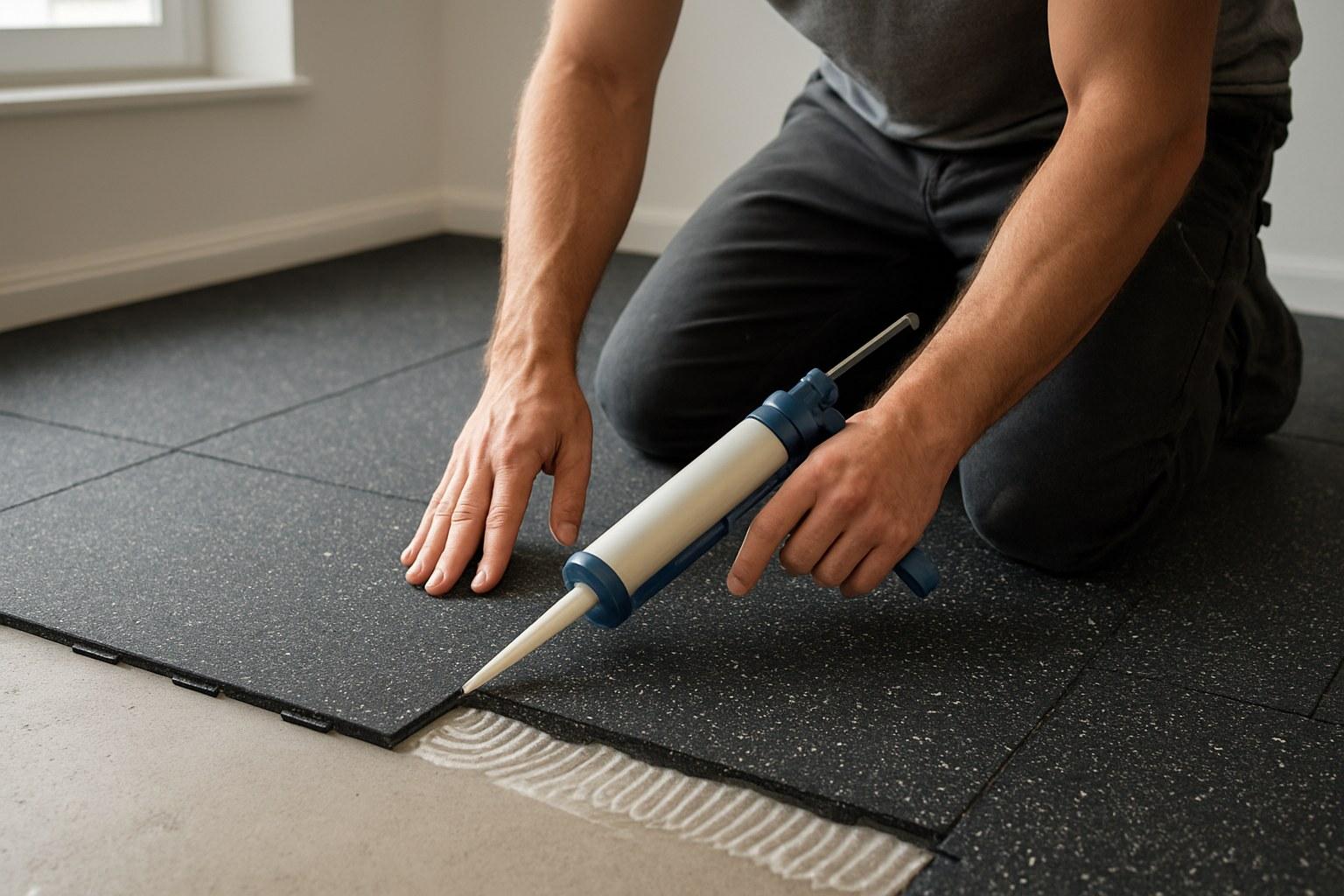
Gluing is the exception, and it's where I'd tell most people to hire out. Glue-down rolls or tiles, set with a urethane adhesive, are for permanent installs, heavy commercial dragging, or a floor that absolutely cannot shift. Spreading that adhesive flat and even across a big garage is messy, unforgiving work, so hiring it out adds labor cost on top of the material, how much depends on the installer and your area, since there's no flat rate everywhere. A bad glue job is a worse floor than a good loose-lay one, so for most home gyms, loose-lay isn't the budget compromise, it's the right answer.