
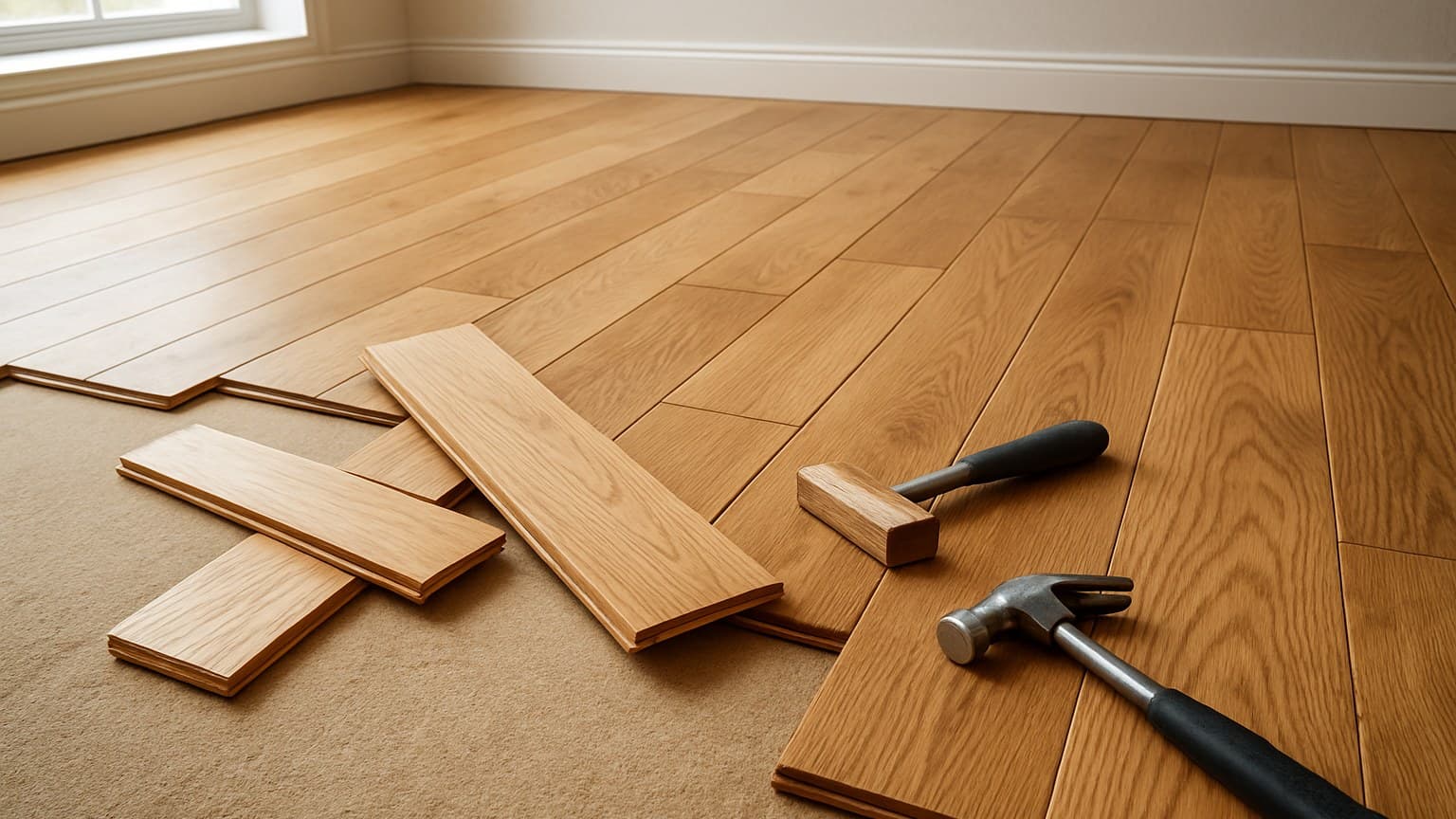
When I tore out the mudroom floor for the Delgado family in Lexington, all their old paperwork said was "a Somerset floor", no collection name, no SKU, nothing else. With Somerset hardwood flooring, the name is the easy part; the collection, the build, and the fine print are where the money and the regret hide. Check these eight things before you sign anything.
Key takeaways
- "Somerset" on a quote means nothing until you know the exact collection (Character, Classic Character, HandCrafted, Homestyle, or Color Plank) and whether it's solid or SolidPlus engineered.
- SolidPlus is engineered with a plywood-style core, so it handles concrete and below-grade rooms where solid hardwood usually shouldn't go.
- Expect material around $4-9 per square foot and labor around $3-6 in an open room; stairs and basements run higher.
- Somerset is made in Somerset, Kentucky, from Appalachian hardwood, and its parent company is the Bauwerk Group.
- Long finish warranties cover surface wear under strict conditions; water damage at seams and edges is usually excluded, so read past the headline number.
1. Nail Down Which Somerset Line You're Actually Being Quoted
A quote that just says "Somerset" tells you almost nothing. The company sells several collections that look and cost differently, so the first thing to pin down is the exact collection name and SKU in writing.
Two Somerset floors can be very different products. The biggest visual gap between them is grade, which is just how much knot, streak, and color change shows in the wood. A busy rustic board and a clean uniform one can both wear the same brand name and land far apart on price.
Get the collection and SKU on paper. That's the only way to compare one dealer's number against another's without guessing.
| Collection | Look | Typical grade |
|---|---|---|
| Character | Heavy knots, color streaks, rustic | Character / rustic grade |
| Classic Character | Some knots and variation, less busy | Mid grade |
| HandCrafted | Scraped or wire-brushed texture, worn feel | Textured surface |
| Homestyle | Cleaner, more uniform boards | Cleaner select-type grade |
| Color Plank | Stained color range, varied widths | Varies by color |
Source: I pulled these off Somerset's own collection pages to line them up side by side
Somerset's five main collections, lined up by look and grade so you can tell which one a quote is really for.
2. Decide Between Solid and SolidPlus Before You Pick a Room
Match the construction to the room first, then pick the look. Somerset makes both solid hardwood and SolidPlus, which is its engineered line built on a plywood-style core. If you're still weighing solid against engineered for your own space, this guide to picking solid vs. engineered hardwood floors walks through matching the construction and species to the room.
That core is why it matters where the floor goes. SolidPlus uses cross-layered plies under a real hardwood wear layer, with a factory finish on top and a backing veneer underneath to keep the plank flat. Those crossed layers make it more stable over concrete and in below-grade rooms, like a basement, where solid hardwood generally isn't recommended.
Refinishing is the trade-off. Solid can usually be sanded several times over its life. SolidPlus is capped by the thickness of its wear layer, which is a spec you look up on that exact product, not a number you assume. The National Wood Flooring Association has also recognized an industry-wide Engineered Refinishable Program, under which manufacturers with wear layers thick enough to be sanded like solid wood can have specific products certified as refinishable, but that certification applies product-by-product, so it's not something you should assume for every SolidPlus board without checking. If you want the click-together engineered style that a handy homeowner can install, read up on click hardwood flooring first, because not every engineered floor locks together the same way. And if the room is a damp slab you aren't sure about, look at LVP flooring instead, just check the waterproof-core rating on the specific product line you're buying, since that claim comes from the exact SKU, not the LVP category as a whole.
3. Learn What NWFA/NOFMA Grading Actually Means
Grade describes appearance, not strength. NWFA stands for the National Wood Flooring Association, and NOFMA was the older mill grading arm that set the published rules for how boards get sorted by looks. Per the NWFA-NOFMA Unfinished Wood Flooring grading standard, boards are sorted according to published appearance criteria, knots, streaks, and color variation, not according to structural strength.
Here's the part people get backward. A rustic "Character" grade isn't lower quality wood. It just shows more of the tree: visible knots, streaks, and color swings. A cleaner grade has fewer knots and more even color, but it isn't tougher underfoot.
When a mill says its boards are certified to a grading standard, that means they were graded to a written rulebook, not just eyeballed and sorted. Mills that appear on the NWFA's list of NOFMA-certified manufacturers have agreed to grade their product against that published rulebook rather than sorting it by eye, so the box matches the sample you fell for. Grade tells you what the floor will look like. It says nothing about how well it holds up, which comes down to the species, the finish, and the install.
4. Get Real Per-Square-Foot Numbers, Split Material vs Labor
Material for Somerset runs roughly $4 to $9 per square foot, depending on the collection and whether it's solid or SolidPlus. Install labor in an open room usually runs about $3 to $6 per square foot, with stairs and basements costing more because of the cutting, the tight work, and the moisture checks.
Work one example so you can sanity-check a quote. Say you have a 300 square foot room and pick a SolidPlus at $6 material. That's 300 x $6 = $1,800 in material. Add open-room labor at $4.50, so 300 x $4.50 = $1,350. Your rough total lands near $3,150 before delivery, trim, or subfloor prep. Change the room to a basement and both the material choice and the labor climb.
$ per sq ft         0    3    6    9   12
Labor, open room         |###|              3-6
SolidPlus material       |####|             4-8
Solid material           |#####|            4-9
Labor, stairs/basement        |######|      6-12
Cost ranges in dollars per square foot, split into material and labor; the chart is not drawn to scale.
These are starting ranges, not a fixed price. What you actually pay swings by region, by species, and by how much subfloor prep the job needs. For a species-by-species look at how the wood itself moves the number, see how much walnut hardwood flooring actually costs. And if the budget is tight, clearance hardwood flooring can be leftover stock rather than defective, which is worth understanding before you rule it out.
5. Read the Warranty for Seams and Edges, Not Just the Big Number
A long finish warranty covers surface wear-through, and only under strict conditions. It's not a promise against water, which is where real floor failures start.
Water damage at seams and edges is usually excluded. That gap matters because the plank surface almost never fails first; the edges and joints do, when moisture gets in from below or from a spill that sat. So separate the two in your head: finish wear is one thing, water and edge damage is another, and the headline number only speaks to the first.
Read the actual clauses. Solid and SolidPlus can carry different refinish and structural terms, so don't assume they match. Check what install and humidity conditions the coverage requires, how many refinishes it allows, and whether you're looking at residential or commercial limits. Residential and commercial coverage aren't the same, and using the wrong one can void the whole thing.
6. Verify Who Makes It and Where You're Actually Buying
Somerset hardwood is made in Somerset, Kentucky, from Appalachian hardwood, and its parent company is the Bauwerk Group. That answers the question people keep asking about who stands behind the brand.
Where you buy matters just as much as what you buy. Purchase through an authorized dealer and confirm the product is genuine Somerset, not a look-alike swapped in to hit a price. A substitution can look close in the showroom and behave nothing like it on the floor.
Ask the dealer to put the collection, grade, and SKU on the invoice. If they won't write it down, that's your answer about how the rest of the job will go.
7. Check the Complaint Patterns Before You Commit
Hardwood complaints almost always point back to the room conditions and the install, not the wood species or the finish. Winter gapping, cupping, and color shift each have a different root cause, so knowing which is which helps before you assume the floor itself is bad.
Gapping in winter happens when dry indoor air pulls moisture out of the boards and they shrink, that's normal seasonal movement, not a defect. Cupping or peaking usually means subfloor moisture that got missed at install. Color shift is natural wood reacting to sunlight over time. I've pulled area rugs off older floors and found a bright rectangle underneath that no refinish fully evens out, so I warn every customer that sun will change the tone whether they like it or not.
Ask the dealer or installer to document the prep work, especially the subfloor moisture and flatness checks, in writing. That paperwork is what protects you if a gap, cup, or stain shows up later and someone tries to argue about whose fault it is.
8. Compare Somerset Against Bruce, Mullican, and Shaw
Somerset's pitch is US-made Appalachian hardwood in both solid and engineered lines. Bruce, Mullican, and Shaw overlap heavily on price and product, so the smart move is to compare the things that actually differ: where the wood comes from, how much of the range is engineered, the price tier, and the warranty terms. Pergo tends to come up in the same shopping conversation, though it's worth settling whether Pergo hardwood is real wood before you put it head-to-head with these four.
| Brand | Where it's made | Solid & engineered | Price tier |
|---|---|---|---|
| Somerset | Somerset, KY, Appalachian hardwood | Both, incl. SolidPlus engineered | Mid |
| Bruce | US-made (AHF Products), wide retail reach | Both, big-box friendly | Budget to mid |
| Mullican | US-made, Appalachian hardwood | Both | Mid |
| Shaw | Large US maker, very wide availability | Both, deep engineered range | Budget to mid |
Source: I built this from each brand's product lineup and where I usually see them sold, to show what actually differs
The four brands compared on sourcing, product range, and price tier, so you can see what a higher number is actually buying.
Use the table to decide what you're paying extra for, not just to pick a familiar name. If two brands land at the same price with the same construction, the tie-breakers are the grade you want, the warranty fine print from Section 5, and which dealer will put it all in writing.
Sources
- NWFA's list of NOFMA-certified wood flooring manufacturers
- NWFA on manufacturers adopting the Engineered Refinishable Program
- NWFA-NOFMA Unfinished Wood Flooring Grading Standard (PDF)
- Bluegrass Wood Products joins the NWFA/NOFMA wood flooring program
- NWFA scholarship honoring industry veteran Paul Stringer