
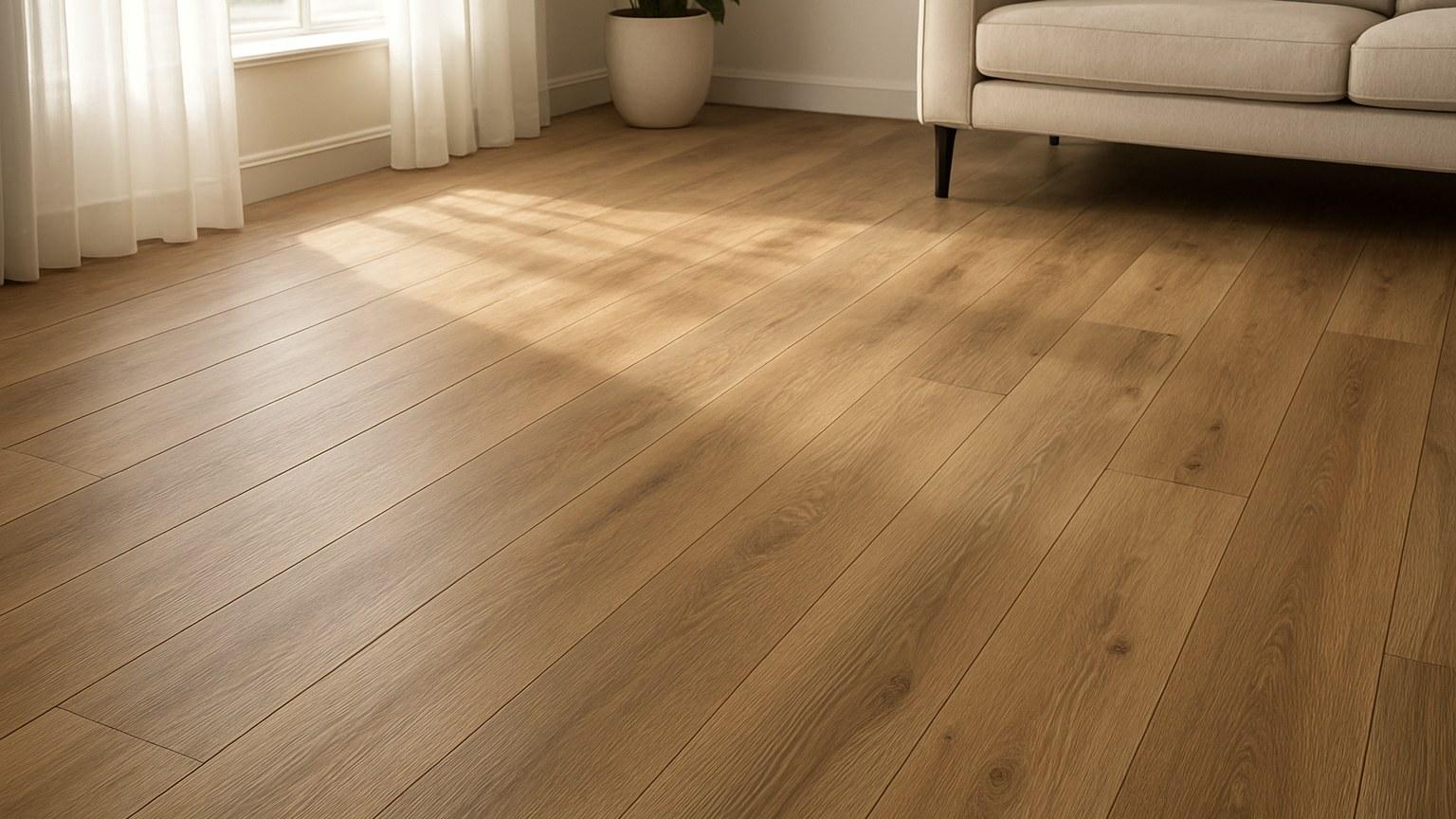
Karndean LVP (luxury vinyl plank) comes in four main lines, and which one fits your room comes down to how it installs: Korlok is the rigid-core, click-lock floating line a careful DIYer can handle, while Knight Tile, Da Vinci, and LooseLay are gluedown or loose-lay jobs. The names and formats blur together on a sample board, so people grab the wrong line for their subfloor and traffic. Picking right up front saves you a tear-out down the road.
Key takeaways
- Korlok is Karndean's rigid-core, click-lock floating line and the DIY-friendly one; Knight Tile and Da Vinci are gluedown and better left to a pro on big or open floors.
- Korlok lines run about $5.49-$9.99 per square foot for material depending on the line (dgfloors.com, 2026), and install labor adds roughly $2-$6 per square foot (homeguide.com).
- The core is waterproof but the installed floor is not; water still reaches the subfloor through seams and the perimeter, especially on gluedown and loose lay.
- Karndean sells through an approved retailer network, not big-box stores, so order samples and check the specific collection's wear layer before you commit.
- Most Karndean complaints trace back to subfloor prep, not the plank itself.
What Karndean LVP Actually Is (and How It's Built)
Karndean Designflooring is a vinyl brand that sells both luxury vinyl planks (the long wood-look boards most people call LVP) and luxury vinyl tiles (the square stone-look pieces, LVT). People use the terms loosely, but it's the same material in two shapes. If you're weighing other manufacturers, Forbo's vinyl flooring lineup is one more worth comparing.
Every Karndean board is built in layers. A clear wear layer on top takes the scuffs and foot traffic. Under that sits a printed design layer, a photo of wood or stone that gives the floor its look. Below that is the core that carries the plank, and some lines add a pad backing right onto the bottom.
The install split is what drives this whole guide: most Karndean lines are flexible gluedown vinyl that you bond flat to the floor, while one line, Korlok, uses a stiff rigid core that clicks together and floats on top of the subfloor instead of sticking to it.
All of it is PVC (polyvinyl chloride) vinyl, not laminate and not real wood. You'll see the Ty Pennington name attached to some Karndean marketing. That's brand recognition, not a quality grade, so don't let it sway the line you choose. MSI's Everlife vinyl flooring line is built from the same PVC layering, just under a different brand name.
Karndean's Collections Compared: Korlok, Knight Tile, Da Vinci, LooseLay
The quick version: Korlok floats and is the DIY-friendly one, Knight Tile and Da Vinci glue down, and LooseLay grips the subfloor without adhesive. The table below lines them up side by side. Mannington's flooring lineup follows a similar split between floating and gluedown options, if you want a second brand to cross-shop.
| Collection | How it installs | Look and format | Best for |
|---|---|---|---|
| Korlok (Select / Reserve / Pro) | Rigid core, floating click-lock, attached pad | Wide wood and stone planks and tiles | DIY rooms, basements, uneven subfloors, high-moisture rooms like kitchens and baths |
| Knight Tile | Gluedown | Budget wood and stone, broad range | Open floors, hallways, value jobs |
| Da Vinci | Gluedown, thin plank | Most realistic, design-led wood and stone | Design-focused living spaces, open plan |
| LooseLay | Loose lay, friction-grip backing | Wood and stone planks | Lift-and-replace, rentals, easy subfloor access |
Karndean collections grouped by install type, look, and the room or job each one suits.
Korlok is the rigid-core line, sold as Select, Reserve, and Pro. It clicks together, floats, and carries its own attached pad. Because the core is stiff, it forgives a less-than-perfect subfloor better than the gluedown lines do. CoreLuxe's rigid vinyl plank line works on a similar click-and-float principle, if you want another rigid-core option to compare.
Knight Tile is the budget gluedown line with a wide wood and stone range, good for stretching a dollar across an open floor. Da Vinci is also gluedown but thinner, and it's the design-led line with the most realistic looks. LooseLay is the oddball: a friction-grip backing lets planks sit flat without glue, so you can lift one out and swap it later. If a French oak look is what you're after, Malibu Wide Plank's french oak vinyl plank line is another realistic option to put next to Da Vinci.
Kitchens, bathrooms, and mudrooms often get left off flooring comparison charts, but each Karndean line still has a different fit for these rooms. Korlok is the one I steer people toward first. Its click-lock joint pulls planks tighter at the seam than a glued edge does, and Karndean markets the line with a waterproof core and a lifetime residential warranty.
That's not the same as a waterproof floor, water can still creep in where a plank meets a cabinet toe-kick or a tub surround, so caulk those transitions and mop up spills fast. Knight Tile and Da Vinci can still go in a kitchen, but since they're gluedown with no locking seam, I'm stricter there about sealing every edge and making sure the subfloor is fully dry before the adhesive goes down.
Gluedown vs Rigid Core vs LooseLay: Picking Your Install
The install type matters more than the color you pick. It decides how hard the job is and who should do it. Gluedown lines (Knight Tile, Da Vinci) bond flat to the subfloor with adhesive and need a very flat, dry base. Korlok's rigid core floats on a click joint. LooseLay sits on its grip backing, no glue at all.
For DIY, click-lock Korlok is realistic for a patient homeowner with a decent subfloor. For gluedown on big open floors with stairs and moisture transitions in spacious room layouts, I'd tell you to pay a pro. Spreading adhesive evenly across a wide floor and timing the tack is where a first-timer gets in trouble.
Subfloor comes first, before a single plank goes down. Check that the floor is flat, and run a moisture test on any concrete slab. A floating floor like Korlok also requires leaving space around the complete perimeter for expansion; the exact measurement comes from the Korlok install sheet, not what you read online.
I put Korlok down in a split-level near Huber Heights where the slab dipped by the basement stairs. The rigid core bridged most of it, but I still ground down one high spot first, because a stiff plank rocks on a bump and the click joint works loose over a season or two.
One more thing on Korlok: it already has an attached pad, so don't stack a second underlayment under it. Adding one can void the warranty. If you're on a gluedown line and wondering whether you need any padding at all, read up on whether vinyl flooring needs underlayment in the first place and check your product sheet on acclimation too, since that varies by line.
Durability, Water Resistance, and Cleaning
Karndean's Korlok line markets a lifetime residential warranty and a waterproof core, but read that carefully: a waterproof core is not a waterproof floor. Water still gets under the planks at the seams and the perimeter and sits on the subfloor, and that's especially true on gluedown and loose-lay lines like Knight Tile, Da Vinci, and LooseLay, where there's no locked joint holding things tight.
For the wear layer, don't trust a single mil number you read somewhere, a mil is just a thousandth of an inch, the unit used to measure how thick that top wear layer is. Each Karndean collection has its own rating, so look up the one you're buying and go heavier for a kitchen or a hallway than you would for a bedroom. The high-traffic rooms eat through a thin wear layer first.
Cleaning is simple if you keep to a few rules. Sweep or vacuum up grit before it grinds scratches into the surface, then damp-mop with a pH-neutral cleaner, one that's neither acidic nor alkaline, so it won't dull the finish, or a Karndean-approved product. Skip steam mops, abrasive pads, and wax, because heat and grit do more harm than the dirt you're chasing. Put felt pads under furniture legs, and wipe spills fast where they can creep into seams and edges.
Minor surface scuffs usually buff out. A plank that's actually gouged gets replaced, and that swap is far easier on a loose-lay or click floor than on gluedown, where the plank is stuck down for good.
What Karndean LVP Costs and Where to Buy
Material runs roughly $2-$4 per square foot according to todayshomeowner.com and $3-$7 per square foot according to carpetreviewed.com across the broader range. The Korlok lines sit higher, around $5.49-$9.99 per square foot by line according to dgfloors.com (2026), while LooseLay lands around $4-$12 per square foot according to phoenixtilespecialist.com.
Labor adds about $2-$6 per square foot for install according to homeguide.com, or $4-$6 per square foot for professional install according to dgfloors.com. Basements and stairs cost more than an open room, because of the cutting, the transitions, and the prep a slab needs. Underlayment, where a floor needs it, runs about $0.50-$2 per square foot according to carpetexchange.com, but remember Korlok already includes its pad, so you're not paying that on top.
The table below breaks down the Korlok lines by material cost, per dgfloors.com for 2026.
| Korlok line | Low ($/sq ft) | High ($/sq ft) |
|---|---|---|
| Korlok Select plank | 5.49 | 6.99 |
| Korlok Select tile | 5.99 | 7.49 |
| Korlok Reserve plank | 6.99 | 8.99 |
| Korlok Pro | 7.49 | 9.49 |
| Korlok Reserve XL plank | 7.99 | 9.99 |
Source: dgfloors.com
Material cost per square foot for each Korlok line, 2026.
Each bar runs from the low to the high material price per square foot for that Korlok line, 2026.
Karndean sells through an approved retailer network, not the big-box aisles, so you won't grab it off a warehouse shelf. Use Karndean's Floorstyle visualizer to test looks in a room, then order physical samples before you commit. A small square in your own light tells you more than a screen ever will. If you're weighing where else to shop for vinyl beyond Karndean's own dealers, it helps to compare where to buy vinyl flooring across the major retail options.
Karndean vs COREtec and Other LVP Brands
Neither brand is universally better; they're built for different installs. COREtec is a rigid-core floating floor made for DIY-friendly click installs, which is its whole pitch. Karndean's real edge is its gluedown design range and its LooseLay options, which COREtec doesn't match on looks and format variety.
| Karndean | COREtec | Shaw Pantheon HD Plus | |
|---|---|---|---|
| Main install | Gluedown, plus Korlok click and LooseLay | Rigid core, click-lock float | Rigid core, click-lock float |
| Strength | Design range, realistic gluedown looks | Easy DIY click, attached pad | Rigid-core value, click install |
| Where sold | Approved retailer network | Flooring dealers and some big-box | Flooring dealers |
If your floor is a flat, DIY click job, a rigid-core line often wins on ease. If you want the thinnest, most realistic gluedown look, Karndean's Da Vinci is hard to beat. To match Karndean's floating option against the rigid-core competition line by line, see which COREtec line actually holds up in your room, and for another rigid-core click floor worth cross-shopping, read up on Shaw Pantheon HD Plus.
Across all of these, the brand matters less than the install and the subfloor under it. The Karndean complaints I've seen trace back to a floor that wasn't flat or dry enough, not the plank. Those same install and subfloor factors are usually what decides how long vinyl flooring lasts, no matter which brand you pick.
Which Karndean Line for Whom
Pick by your subfloor and who's doing the work, in that order.
Choose Korlok if you're a careful DIYer, your subfloor isn't perfectly flat, or you're going into a basement. The rigid core floats, forgives small dips, and carries its own pad.
Choose Knight Tile if you want Karndean looks on a tighter budget and you're hiring a pro to glue down an open floor or hallway. Choose Da Vinci if the look is the priority and you want the most realistic gluedown planks for a living space, again with a pro for a large floor.
Choose LooseLay if you want to lift and swap planks later, you're outfitting a rental, or you need to get at the subfloor without a full tear-out. It's the most flexible to live with over time.
Whatever you land on, test the subfloor first and order real samples. The line is the easy choice; the prep is what decides whether the floor lasts.
Sources
- 2026 Flooring Sustainability Summit program and speakers (TCNA)
- International Product Assurance Laboratories customer quality service award (TCNA)
- Green Label Plus adhesive certification (Carpet and Rug Institute)
- Green Label Plus certified carpet program (Carpet and Rug Institute)
- Maine VOC emissions regulation, Chapter 152 (EPA archive)
- Dgfloors.com