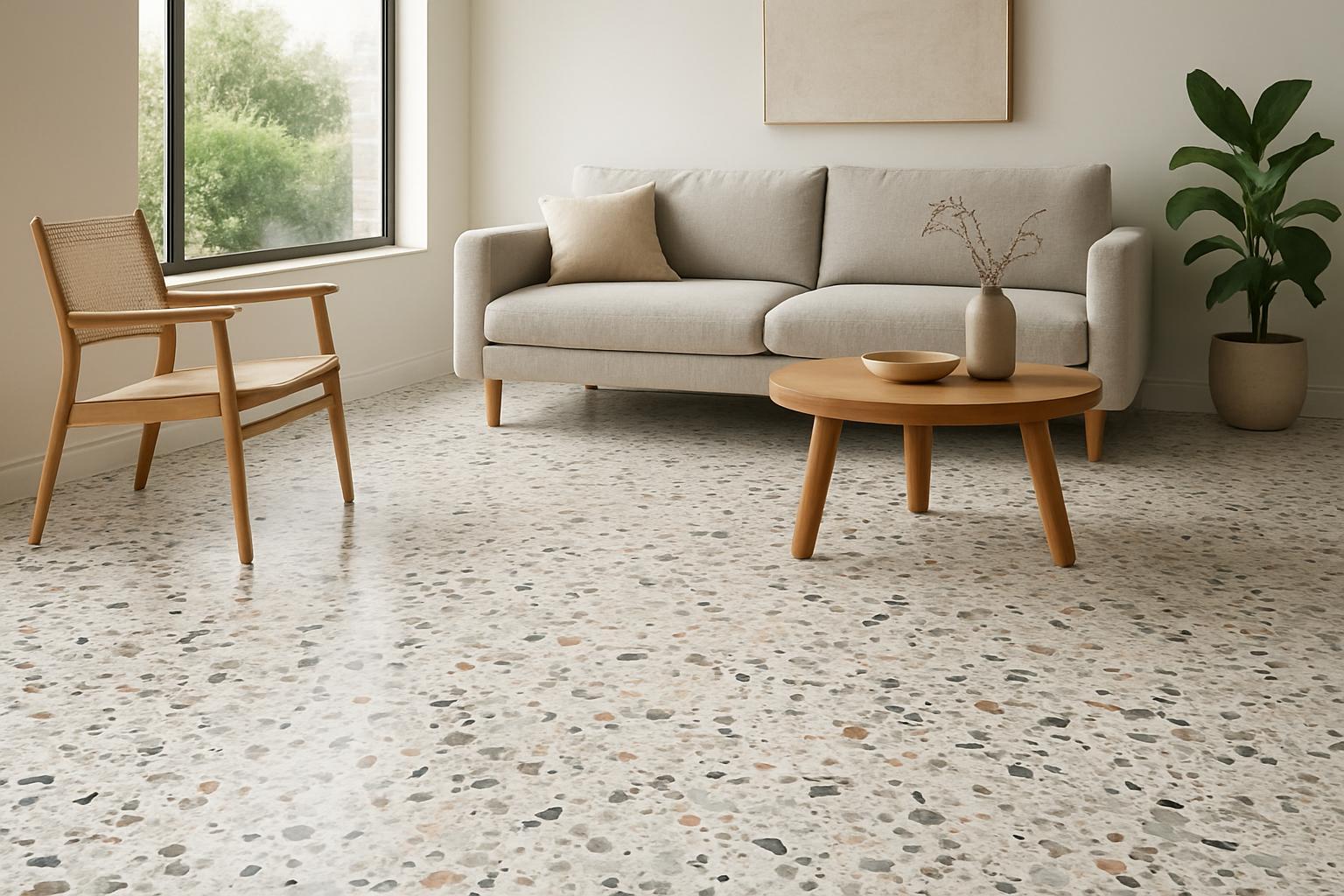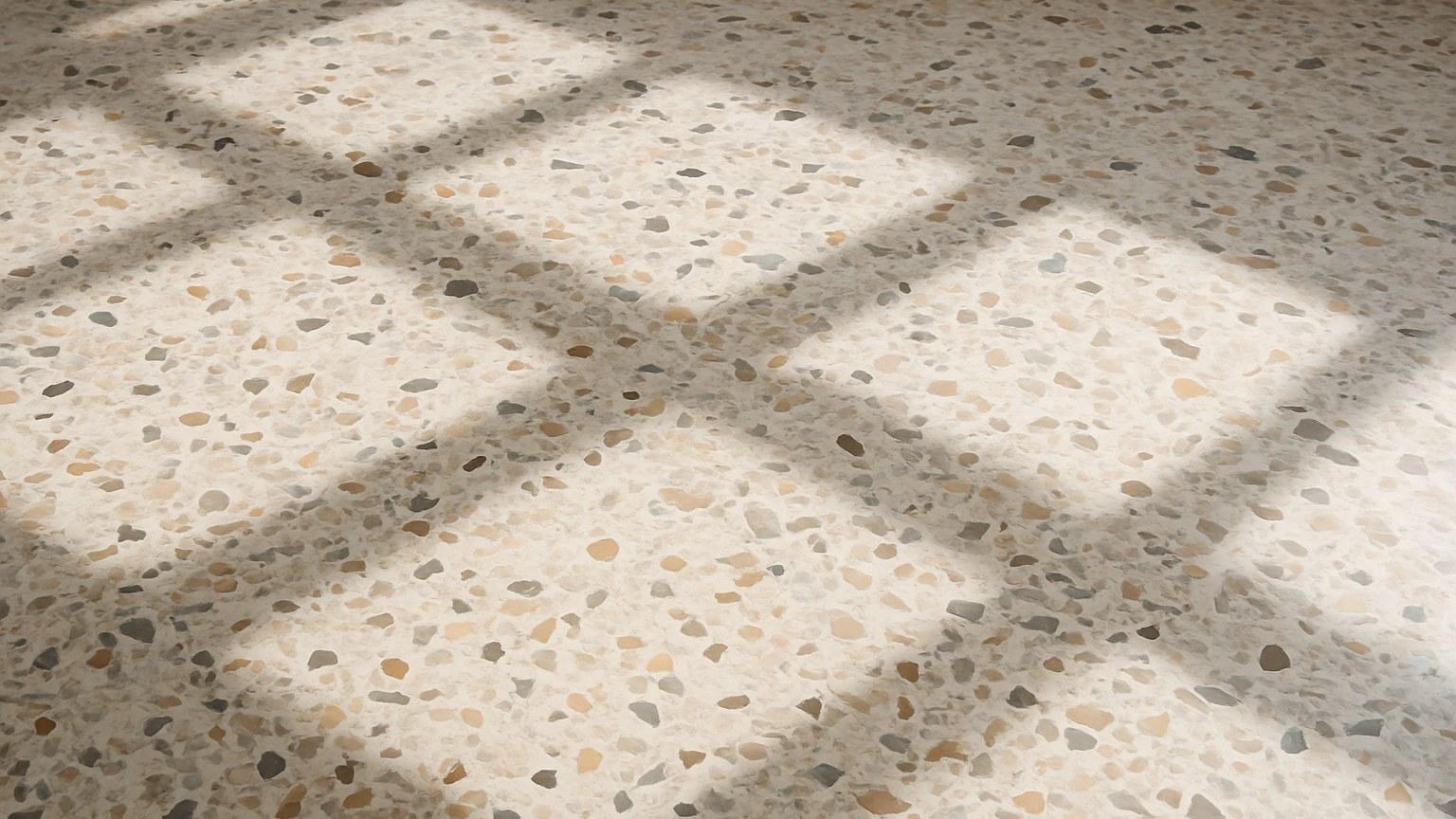
With terrazzo floors, the binder you set the stone chips into decides the price, the thickness, and where the floor can go. Same chips, different binder, a completely different floor. That one choice is why two quotes for one room can land thousands of dollars apart.
Key takeaways
- Terrazzo isn't one material, it's a recipe: stone or glass chips set in a binder, then ground flat and polished. The binder is what changes everything else.
- The three binders are cementitious (traditional), epoxy resin, and polyacrylate. Epoxy is a thin indoor topping; cementitious is thick and handles outdoors and heavy slabs.
- Installed poured terrazzo runs about $20-$70 per square foot and terrazzo tile about $15-$35 per square foot, per homeguide.com; the wide spread tracks binder type and residential vs. commercial scale.
- Restoring an old terrazzo floor usually costs far less than replacing it: roughly $3-$8 per square foot to clean, hone, and polish versus $15 and up per square foot for new terrazzo tile installed.
- In wet rooms and on terraces, the chips-and-binder surface can get slick, so slip resistance (coefficient of friction) and a textured finish matter more than the look.
What a Terrazzo Floor Is Actually Made Of
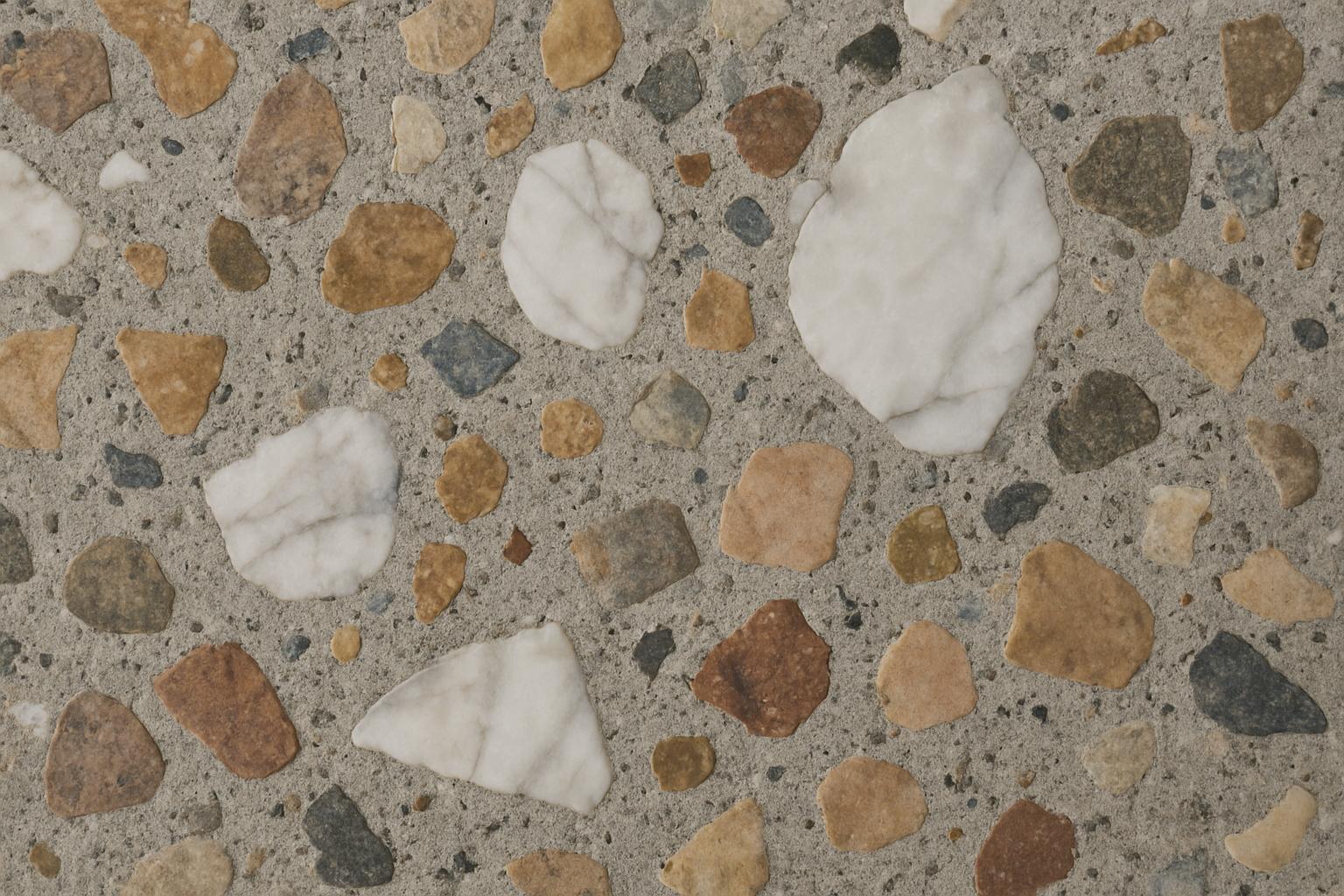
A terrazzo floor is stone or glass chips mixed into a binder, poured or set in place, then ground flat and polished until the chips show through. That's the whole idea.
The chips can be marble, granite, recycled glass, or even mother-of-pearl shell. The color and the pattern run all the way through the floor. So when the surface wears, you don't hit a different layer underneath the way you would with a printed vinyl or a thin wood veneer. What you walk on today is what you walk on in twenty years. If you like that stone look but want a single consistent tile instead of embedded chips, limestone-look porcelain tile delivers a similar visual without the aggregate.
Thin metal or plastic strips called divider strips split the floor into color fields and tell the floor where it's allowed to crack. Then the whole surface gets ground down and polished so the stone faces come up smooth and bright. That same strip-based boundary idea shows up again wherever a terrazzo floor meets another material, and six tile-to-hardwood transition options walk through the strip choices for that junction.
At heart this is the mosaic family: small hard pieces set in place and read as one surface. If you like that stone-chip look but want it in tile form, start with why the grout lines decide whether a mosaic floor works, and if marble is the chip you keep picturing, marble floor tile versus marble-look porcelain covers that stone on its own. Either way, keeping each small piece aligned instead of sliding into crooked lines is the installer's real skill, covered in install mosaic tile without crooked grout lines.
The Binder Is the Whole Story
The one thing that swings cost, install method, thickness, and where terrazzo belongs is the binder, not the chips. Pick the binder and almost every other decision falls out of it.
Think of it like a cake. The same stones are the raisins. Mix them into one batter and you get a thick, heavy slab that handles a parking garage. Mix them into another and you get a thin, bright topping that belongs in a lobby.
Cement binder gives you a thick, heavy floor that can go outdoors. Resin binders give you a thin, color-rich floor that mostly stays inside.
Every question later in this guide, the price gaps, the DIY-or-hire call, the wet-room worry, traces back to which binder sits around those chips.
500 Years of Terrazzo, Boiled Down
Terrazzo goes back about 500 years to Venetian workers who set leftover marble offcuts into a floor instead of throwing the scraps out. That thrifty start still describes it: terrazzo turns stone waste into a finished floor. That same waste-not instinct shows up today in outsider-art landmarks like a mosaic house built entirely from salvaged tile.
The trade group here is the National Terrazzo and Mosaic Association (NTMA). It publishes the system specs that installers build to, which is why a cementitious floor poured in one state matches one poured in another.
That's the useful history. Nobody is shopping because of Venice, so I'll leave it there.
The Three Binders, Side by Side
There are three binders, and they are not interchangeable: cementitious (the traditional one), epoxy resin, and polyacrylate. The table below lines up how they differ before I break each one down.
| Binder | Thickness | How it installs | Best for | Watch for |
|---|---|---|---|---|
| Cementitious (traditional) | Thick topping over a mortar bed | Poured wet, cures over days | Large slabs, outdoors, heavy loads | Cracks without divider strips and control joints |
| Epoxy resin | Thin topping bonded to the slab | Troweled, cures fast | Indoor commercial and homes, bold color | Indoor only; not stable in sunlight |
| Polyacrylate | Thin, similar to epoxy | Cement-and-resin blend, breathable | Slabs with some moisture, indoor or semi-covered | Fewer color effects than epoxy |
How the three terrazzo binders differ on thickness, install, best use, and the main catch.
The pattern is simple. Cement is thick, heavy, and tough enough for outdoors. The two resins are thin, fast, and indoor-leaning, with polyacrylate being the one that tolerates a little slab moisture.
Cementitious Terrazzo: The Original Terrazzo Concrete Floor
If you searched "terrazzo concrete floor," this is what you mean: cementitious terrazzo is the original kind, a thick cement-based topping laid over concrete. It's basically a decorative concrete system.
It comes in three setups. A bonded system sticks the topping right to the slab. A sand-cushion system floats the topping on a membrane over a bed of sand, which lets the slab move a little without cracking the terrazzo. A monolithic system sits the topping directly on the slab with no bed in between.
This is the binder that survives outdoors, under weight, and across big floors. That's why courthouses, schools, and airports ran it for a century and the floors are still there. Many of those same schools now mix terrazzo corridors with other school floor tiles and vinyl flooring, each chosen for a different kind of daily wear.
The trade-off is weight, thickness, and cure time. It takes days to cure and it adds real height and load. That's why it rarely makes sense as a quick weekend floor in a house.
Cementitious terrazzo cracks if it's not controlled. Control joints are planned breaks in the floor that give it a clean place to move, and divider strips do the same job while also splitting colors. Skip them and the floor decides where to crack on its own.
Epoxy Resin Terrazzo: Thin, Bold, and Indoor-Only
Epoxy terrazzo is the modern commercial standard: a thin resin topping with nearly unlimited color and chip choices, including recycled glass that can count toward LEED credits. (LEED is a green-building rating system, so recycled-glass chips help a project score points.)
It bonds straight to a sound slab and cures fast, so it goes down thinner and lighter than cementitious. Less height added, less weight on the structure.
Epoxy has one hard limit: it yellows and breaks down in sunlight. It stays inside. Use it for lobbies, schools, and kitchens, not a patio or a sunroom that bakes all afternoon.
Because epoxy terrazzo is usually a specialty crew laying big floors, its cost tracks the commercial end of the price range rather than the small-home end.
Polyacrylate Terrazzo: The Middle Ground
Polyacrylate blends cement and acrylic resin. You get a thin topping like epoxy, but one that lets slab moisture pass through instead of trapping it.
That breathability is the whole reason a crew reaches for it. Over a slab that reads a little damp, straight epoxy can bubble or let go as the moisture pushes up with nowhere to escape. Polyacrylate shrugs that off.
It's the least-known of the three, so that's the case for it: pick it when the slab isn't bone-dry and you still want a thin floor. The color range is narrower than epoxy but wider than old cement.
What Terrazzo Floors Cost Per Square Foot
Installed terrazzo runs a wide range, and the spread isn't random. According to homeguide.com, poured terrazzo installed runs about $20-$70 per square foot and terrazzo tile about $15-$35 per square foot. Other sources land inside and around that: thecraftsmanblog.com cites a budget-end $12-$35, and terrazzco.com cites $30-$65 for a standard poured floor and up to $100 or more for custom work.
| Type | Cost per sq ft | Source |
|---|---|---|
| Terrazzo tile, installed | $15-$35 | homeguide.com |
| Terrazzo, installed (general) | $20-$50 | homeguide.com |
| Poured terrazzo, installed | $20-$70 | homeguide.com |
| Budget-end estimate | $12-$35 | thecraftsmanblog.com |
| Standard poured | $30-$65 | terrazzco.com |
| Premium / custom poured | $65-$100+ | terrazzco.com |
Installed terrazzo cost per square foot across tile and poured systems, as reported by three cost references.
Why the gap? It tracks binder type and scale. A small home job costs more per foot than a big institutional pour because the crew still has to haul in grinders and spend the same slow hours, just over fewer square feet.
Split it in your head into two buckets. Materials are the chips and the binder. Labor is the grinding and polishing, and that's where most of the money goes. Pouring is quick; grinding a floor flat and polishing it to a shine is slow, skilled work, and it's the bulk of the bill no matter the binder.
Terrazzo tile is the cheapest way in and the one option a handy homeowner can touch. If you're weighing that entry price against other hard floors, LVP (luxury vinyl plank) tile sorted by wear-layer tier and real installed cost lays the vinyl-versus-tile numbers out side by side.
Restore That Old Terrazzo or Rip It Out?
If you have an old terrazzo floor under carpet or tired tile, restoring it almost always beats tearing it out. You're keeping the slab and the chips that are already there.
Restoration means cleaning, filling cracks, honing (grinding the surface down to fresh stone), and polishing it back up. Even a floor that looks hopeless, dull, stained, hairline-cracked, usually comes back once the top skin is ground off and the chips are re-exposed.
The money math is simple. You pay for labor and diamond grinding, not for new material. That lands well under the $15-and-up per square foot that homeguide.com cites for new terrazzo tile installed, and far under a fresh poured floor.
Replacement only wins when the concrete slab under the terrazzo has failed or the terrazzo has lifted clean off it. Cosmetic damage isn't that. Cracks and dullness are a restoration job, not a demolition job.
Terrazzo in Wet Rooms: Slip Is the Real Problem
A polished terrazzo floor is slick when it's wet, and that's the thing to solve before the look. The chips and binder grind to a smooth, glassy face, and water on glass is exactly as grippy as it sounds.
What matters here is slip resistance, measured as coefficient of friction - basically how much grip the surface gives your foot when it's wet. The flooring trade tests this against the ANSI-NFSI B101.5 standard (the American National Standards Institute and National Floor Safety Institute's wet-floor slip test), and the Tile Council of North America (TCNA) publishes slip-resistance guidance for ground stone finishes like terrazzo. A mirror polish reads low against that standard. A honed or lightly textured finish reads higher.
For a bathroom floor or a shower, that's the move: a textured or honed finish, or smaller mosaic-scale pieces so the extra grout lines add grip. The same logic runs through which bathroom tile ideas hold up and which come back as problems, and it applies to terrazzo too. Spec the finish for grip first, then pick the chips.
Can You DIY Terrazzo, or Should You Hire It Out?
Terrazzo tile is the only version most homeowners should attempt themselves, and even that's a careful job. A poured terrazzo floor, in any binder, is a specialty crew call. Terrazzo tile often comes in the same classic hexagon shape covered in hexagon tile decisions that cause callbacks, a pattern that predates the poured slab by decades.
Terrazzo tile sets down like other floor tile, or clicks together in the panel versions, so if you're comfortable with tile you can handle it. If you want the look with far less skill, a stone-chip peel-and-stick floor tile or a click-lock tile floor gets you close without thinset.
A poured floor is a different animal. Mixing binder and chips to spec, pouring it level, and then grinding the whole thing flat and polishing it to a finish takes commercial grinders and a crew that does it for a living. This isn't a rent-a-tool weekend. For a poured terrazzo floor, hire it out, full stop.
Subfloor Flatness and Moisture Come First
Before any poured terrazzo touches it, the slab has to be flat, sound, and dry. Skip that and the binder choice won't save you.
What fails almost always traces to what sits under the surface, not the surface itself. A thin resin topping over a slab that reads damp is exactly the kind of job that comes back ugly, bubbling or letting go months later. That moisture reading, not the chips you picked, determines how the maker's warranty applies.
Flatness matters because a thin topping telegraphs. Every low spot and ridge in the slab shows up in the finished floor. The crew grinds to level, but starting flat means less grinding and a better result.
Moisture is the dividing line between binders. Epoxy wants a dry slab. Polyacrylate can live over a slab that reads a little damp because it breathes. Cementitious is the most forgiving but the heaviest. Match the binder to what the slab actually tests at, not to the color card.
And honor the control joints. A poured floor needs the planned breaks and divider strips where the system calls for them, or it cracks on its own schedule.
Terrazzo by Room
Terrazzo shines in high-traffic hard-wearing rooms and gets fussier in wet or cold ones. Here's the room-by-room read.
Entryways and foyers are the sweet spot. The floor is hard, it doesn't scratch through to a different layer, and grit doesn't wear it out. It takes wet boots and dropped keys for decades.
Kitchens work well too, with the same caution as any hard floor: dropped glass shatters and your legs feel it after a long day of standing.
Bathrooms are fine if you fix the slip first, as covered above. The surface itself handles water with no trouble; the grip is the only question.
Basements come down to moisture and binder. A polyacrylate topping or terrazzo tile over a tested slab beats a straight epoxy pour that could bubble off damp concrete.
Outdoor terraces and patios are cementitious only. The resins break down in sunlight, so the original cement binder is the one that belongs outside.
Terrazzo is hard and cold underfoot everywhere. That's the one honest knock across every room: great for durability, not cozy on bare feet.
Keeping a Terrazzo Floor Looking New
Sealed and swept, terrazzo is one of the lower-maintenance hard floors you can own. The work is light once the floor is set up right.
Seal it on the schedule the installer sets, usually a penetrating sealer that soaks in rather than coating the top. Clean it with a neutral, pH-balanced cleaner and plain water. Keep acids off it: vinegar, citrus cleaners, and harsh bathroom products etch the stone chips and dull the binder over time.
Grit is the real enemy, same as any polished floor. Walk-off mats at the doors and regular sweeping stop sand from sanding the shine down. Every so often, a floor that's lost its luster gets honed and re-polished rather than replaced, which is the same move as a full restoration, just lighter.
Who Terrazzo Actually Makes Sense For
Terrazzo pays off when you want a floor that lasts generations and you're matching the binder to the room instead of chasing a photo.
Pick cementitious for outdoors, big slabs, and heavy loads. Pick epoxy for a bright indoor floor on a dry slab. Pick polyacrylate when the slab reads damp and you still want it thin. Pick terrazzo tile when you want the look on a smaller budget or want to lay it yourself.
Where it doesn't fit: a quick cheap refresh, a cozy bedroom, or a sunny patio done in resin. For those, the money and the material belong elsewhere.
If you're torn between terrazzo tile and a lower-cost hard floor, LVP versus tile and which one comes back as a problem is the useful next read, because it compares the two on exactly the durability-versus-cost math this decision turns on.