
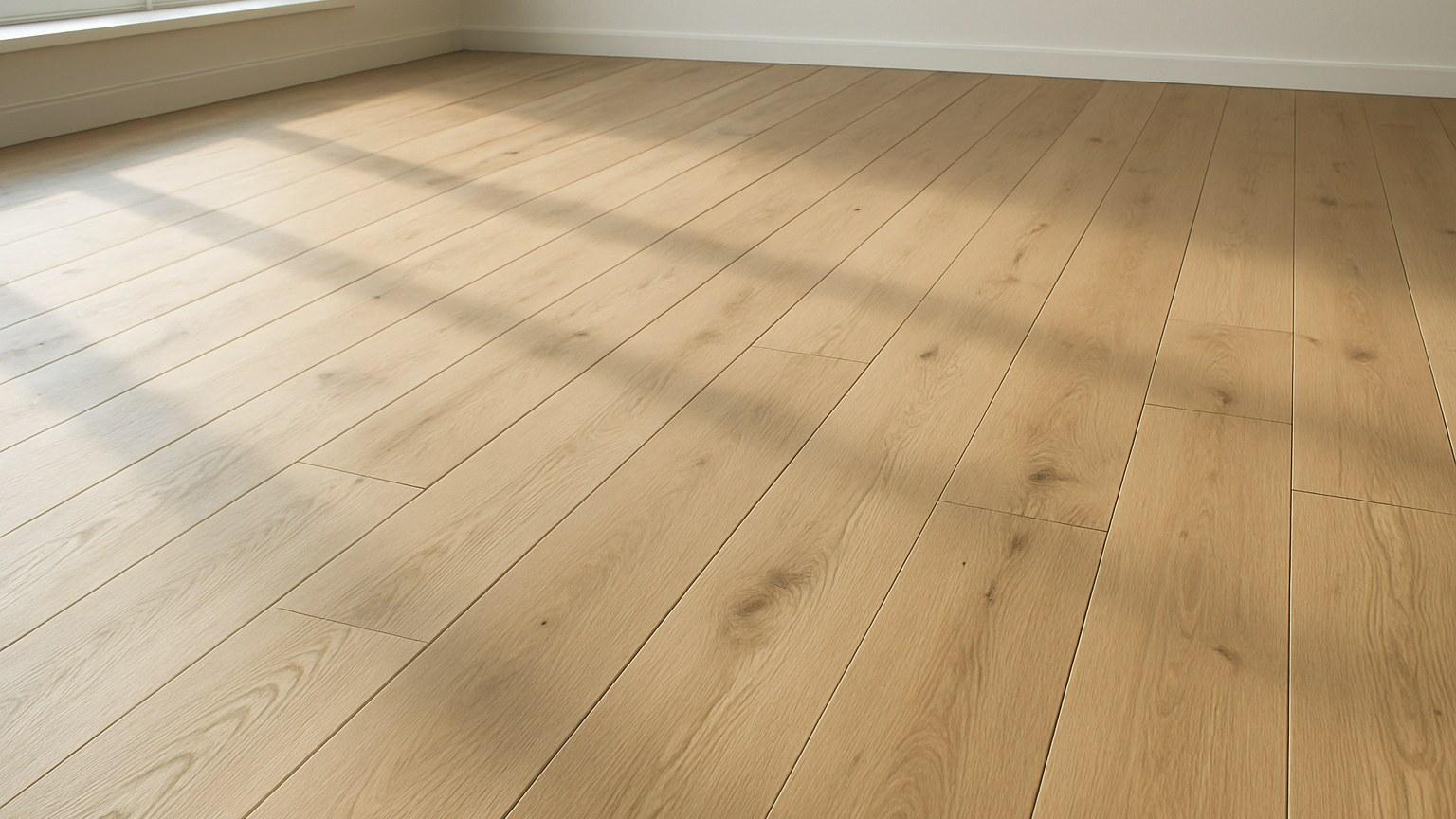
For wide plank light wood flooring that fits almost any room, natural matte white oak is the safest pick: bright, neutral, and better at hiding scuffs than bleached looks. The catch is that "light wood" isn't one thing, so the wrong finish shows every dent. Below are five looks that hold up, by room and budget.
Key takeaways
- White oak in a natural matte finish is the safest light wide plank pick for most rooms: bright, neutral, and it hides scuffs better than bleached or whitewashed looks.
- 'Wide plank' starts at 5 inches, and wider boards move more, so moisture control matters more than the fact that there are fewer boards to lay.
- Per NWFA/NOFMA International Standards, flooring is manufactured at 6%-10% moisture content with a 5% allowance, and width tolerance is .005" under 3" versus .008" over 3".
- Installed cost runs about $6-$25 per square foot (hallmarkfloors.com), with labor alone at $3-$10 and engineered materials at $3-$14.
- Basements (below grade) and bathrooms call for engineered, not solid, because the failure point is the seams, not the board face.
What Wide Plank Light Wood Really Means
"Wide plank" starts at 5 inches wide. "Extra wide" usually means 7 inches and up, which includes the 12-inch boards a lot of people search for. The wider you go, the more a floor reads as one continuous surface instead of a stack of narrow strips.
Light tone is the other half. Here is what the common terms mean before you walk into a showroom:
- Natural: no stain, just a clear or matte finish over the raw wood. The color is whatever the species is.
- Whitewash: a thin white tint that pales the wood while letting grain show through.
- Bleached: the wood is lightened chemically or by a factory process, going further than a whitewash.
- Nordic or Scandinavian: very pale, cool, almost gray-white tones meant to look airy.
Wider boards read lighter and more open because there are fewer seams, more unbroken grain, and more flat surface to bounce light across the room.
The species and the finish together decide how bright a floor looks and how well it hides dents and scratches. Wide plank pine is another light route worth a look, though it dents far easier than oak.
The 5 Best Light Wide Plank Looks
If you want one answer, natural matte white oak is the look most people should pick. It's bright, neutral, and forgiving. The other four below each win at something specific, so match the look to your room and traffic.
White Oak, Natural: The Safe Default
White oak with a clear matte finish sits between warm and cool, so it works with almost any wall color and furniture. The matte sheen scatters light instead of reflecting it, which hides fine scuffs and dust. It's the easiest light floor to live with in a living room or across a whole house. Many homeowners choose prefinished white oak hardwood floors to get this exact look without any on-site sanding or finishing.
Wire-Brushed Bleached Oak: Pale and Tough
Wire-brushing scrubs out the soft grain to leave a textured surface, and the bleach keeps it pale and modern. That texture is the trick: it breaks up the reflection so scratches disappear into it. For busy households and pet owners still wanting a pale floor, I'd recommend this choice. This hand-scraped, wire-brushed texture is part of what gives a floor that rustic hardwood flooring look.
Nordic/Scandinavian Whitewash: The Brightest Look
This is the lightest, airiest look of the five, cool and almost gray-white. It makes a room feel bigger and brighter, which helps dim or north-facing spaces. The downside is honest: a smooth, very pale finish hides dust fine but shows dents, so keep it in bedrooms and lower-traffic modern rooms.
Light Hickory: Bright With Busy Grain
Light hickory is pale overall but loud underneath, with heavy grain swirl and color change board to board. That busy look is a feature here, because it swallows scratches that would jump out on a calm floor. It's a strong choice for entries and busy family rooms.
Natural Maple: Smooth and Pale
Natural maple is the smoothest and most uniform of the bunch, a clean pale floor with almost no grain drama. That even surface is pretty, but it also means dents and scratches have nowhere to hide. Save maple for formal or low-traffic rooms where it won't take a beating.
| Look | How it reads | What it hides | Best for |
|---|---|---|---|
| White oak, natural matte | Bright, neutral, balanced warm-cool | Scuffs and dust well | Living rooms, whole-home |
| Wire-brushed bleached oak | Pale, textured, modern | Scratches, texture breaks the reflection | High-traffic rooms, pets |
| Nordic/Scandinavian whitewash | Very light, airy, cool | Dust OK, but shows dents | Bedrooms, bright modern spaces |
| Light hickory | Light with strong grain variation | Scratches, hidden in busy grain | Busy households, entries |
| Natural maple | Pale, smooth, uniform | Dust, but shows dents and scratches more | Low-traffic, formal rooms |
How five light wide plank looks compare on room feel, wear, and the room each suits.
Do Light Wide Planks Make a Room Look Bigger?
Yes, usually. Fewer seams and a pale, reflective surface make a room read larger and brighter than the same square footage in narrow, dark strips.
Plank direction helps too. Run the boards the long way of the room, and the eye follows the grain the full length, which stretches the space.
There is a limit. In a small, narrow room, very wide boards can feel heavy and chop the floor into just a few lines. Pick width to the room, not the other way around.
Light tones also bounce daylight, so the biggest payoff shows up in dim or north-facing rooms that never get much direct sun.
Light Wide Plank Room by Room
The short version: bedrooms, living rooms, and open-plan spaces are easy wins. Kitchens and bathrooms call for engineered. Basements call for engineered plus a moisture test on the slab.
No real hardwood is waterproof, and that matters here. The plank face can shrug off a quick spill, but the seams between boards are where water sneaks down. Fix the spill fast and the seams stay dry; let it sit and that's where the trouble starts. When that kind of damage does slip through, hardwood floor repair techniques can often save the affected boards without a full refinish.
If you're weighing a wet or below-grade room, it's worth comparing hardwood against vinyl plank before you commit, since vinyl tolerates standing water that wood never will.
Bedroom
A great fit, and the easiest room of all. Moisture is low, foot traffic is light, so both solid and engineered work and any of the five looks is fair game.
Kitchen
Engineered only, and wipe up spills quickly. The seams are the weak point near the sink and dishwasher, so a textured wire-brushed finish that hides the odd water mark earns its keep here.
Bathroom
Engineered only, and even then it's the riskiest wood room. Skip solid entirely. Standing water from a tub or shower attacks the seams, so if the bathroom sees heavy use, wood may not be the smart call at all.
Basement
Engineered only, because below grade solid hardwood is not recommended. Concrete slabs push moisture upward, so test the slab's moisture before you order anything. If the slab reads wet, no floor fixes that from the top.
Solid vs. Engineered: The Stability Standards
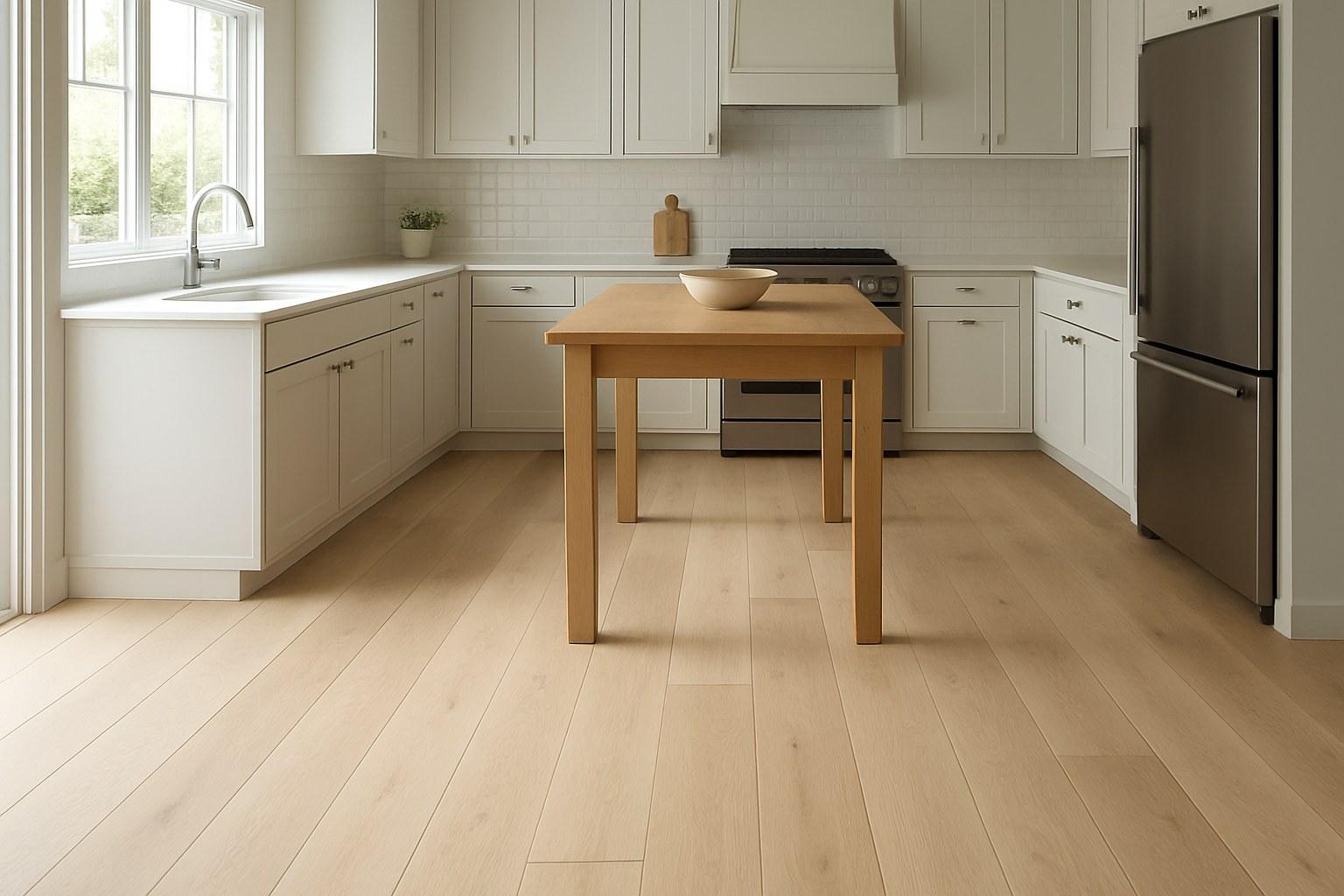
For wide, light boards going over concrete or below grade, engineered is the stable choice. Its plywood-style core resists the swelling and shrinking that cups and gaps a solid board; solid hardwood generally is not recommended in those spots. For a broader look at choosing between the two structures and matching species to a room, see this solid vs. engineered hardwood guide.
The numbers behind this are published. Per the NWFA/NOFMA International Standards (the National Wood Flooring Association and National Oak Flooring Manufacturers Association), flooring is made at 6% to 10% moisture content with a 5% allowance. Too wet and it cups; too dry and it gaps.
Width tolerance tells the same story. Boards under 3 inches are held to .005 inch, while boards over 3 inches get .008 inch. Wide plank is simply allowed a touch more movement, which means prep and moisture control carry more weight the wider you go.
I learned the moisture lesson the slow way. On one solid oak job I never looked under the house first. By spring the floor had cupped along the outside wall, because the crawlspace below had no real ventilation and kept feeding damp air up into the boards. Now I ask what's under the joists before I lay a single plank.
| Standard | Figure | Why it matters |
|---|---|---|
| Moisture content (as manufactured) | 6%-10%, with a 5% allowance | Board arrives dry and stable; too wet cups, too dry gaps |
| Width tolerance, boards under 3" | .005" | Tighter seams on narrow strip flooring |
| Width tolerance, boards over 3" | .008" | Wide plank is allowed a bit more variation, so prep and moisture control carry more weight |
Source: NWFA/NOFMA International Standards
Moisture and width specs that wide plank floors are manufactured to.
What Light Wide Plank Costs
Expect roughly $6 to $25 per square foot installed. That's the all-in range hallmarkfloors.com gives for wide plank wood flooring, covering both the boards and the labor to lay them.
Split it out and labor runs about $3 to $10 per square foot on its own, with engineered material around $3 to $14 depending on species, veneer thickness, and finish. Solid material runs roughly $5 to $28 per square foot, per hallmarkfloors.com, though it swings hard by species and region, so get it quoted locally.
That overall range doesn't split out by the five looks above, since hallmarkfloors.com prices by install type, not by finish name. In practice, extra mill work is what moves the number: a specialty finish like bleaching, wire-brushing, or a Nordic whitewash tint costs more than a plain natural finish on the same species, because the mill runs extra passes to get there. Species plays a part too, hickory and white oak generally run higher as raw material than maple, though exactly how much depends on the product line, so get a supplier quote for the specific species and finish before you weigh it against this range.
| Line item | Cost per sq ft |
|---|---|
| Engineered material | $3-$14 |
| Labor (install) | $3-$10 |
| Installed, all in | $6-$25 |
Where in that range you land depends on the job. Basements and stairs cost more than an open room: stairs are slow, fussy handwork, and a below-grade slab usually needs extra moisture prep before anything goes down.
Installation: Faster or Fussier?
Both, and it depends on your conditions, not the board count. Fewer, wider boards go down faster once you start, but wide planks demand stricter acclimation and moisture control, which can erase that time savings.
Prep comes first, every time. Check that the subfloor is flat and run a moisture test before a single board goes down. Then leave the expansion gap around the room that the maker's own instruction sheet calls for, because that number is set by the product, not by a universal rule.
Acclimation is the same story. Some products want days of sitting in the room, some say it's not needed at all, so trust the manufacturer's documentation, not forum rules.
On DIY versus hiring out, be straight with yourself. Click-lock engineered is realistic for most handy homeowners. Glue-down floors, stairs, and big open rooms with a moisture transition are where I'd hire a pro. If you want the order of operations spelled out, read the full step-by-step hardwood install guide before you rent any tools.
Keeping Light Floors Clean (and Hiding Scratches)
Light floors are easier to live with than dark ones. Dust and fine scratches show far less on pale wood than they do on a dark stain, where every speck stands out.
Finish matters more than color here. A matte or wire-brushed surface hides wear on any tone, while high-gloss shows every scuff no matter how light the wood is.
The routine is simple: dry dust or vacuum often, then damp-mop with a wood-safe cleaner. Never leave standing water, since that's how the seams fail. For the full method, see the hardwood floor cleaning guide.
Refinishing is a spec question. Solid can usually be sanded several times over its life, but an engineered floor's thin veneer caps how many times, if at all, so check the veneer thickness the maker publishes. When the day comes to sand a solid floor, a floor sander rental is the usual route for a DIY refinish.