
When Diane in Asheville called me about a water-damaged patch in her kitchen, she handed me a torn piece of case cardboard instead of a spec sheet. That's Blue Ridge Hardwood Flooring for you: a budget-to-mid hardwood line sold exclusively as a Home Depot house brand, with no factory website or showroom to call for backup. The real specs live on the case label, and once a run sells out, that scrap of cardboard is all you have. Here's how to work out what you've got and what to do next.
Key takeaways
- Blue Ridge Hardwood Flooring is a budget Home Depot-exclusive house brand, sold mostly by the case, not a standalone showroom brand with its own factory outlet.
- It has appeared as both 3/4-inch solid and thinner engineered/click-lock planks in oak, hickory, and maple, so check the case label for the exact build since lines change.
- There's no public evidence Blue Ridge itself holds NWFA/NOFMA mill certification, so lean on Janka hardness and that certification as your own quality yardstick.
- Availability is spotty, so matching or replacing usually means hunting clearance and outlet stock or switching to a comparable brand like Bruce or Malibu Wide Plank.
What Is Blue Ridge Hardwood Flooring?
Blue Ridge Hardwood Flooring is a low-to-mid budget hardwood line sold as a Home Depot house brand. It's not a showroom brand with its own factory, dealer network, or outlet store you can walk into. It shows up on the sales floor, sells by the case, and moves on.
That "house brand" setup matters more than the name on the box. There are no standalone spec sheets floating around online, no showroom to visit, and lines get discontinued without warning. So the floor you loved two years ago may simply not exist as a product anymore.
Here's the practical problem I run into constantly: people already own Blue Ridge, they need to match a room or fix a water-damaged patch, and they can't find a single honest spec. The fix is to treat your own case label as the master document.
Before the last case leaves your garage, get your phone out and photograph the label. You want the species and finish name, the board thickness and plank width, the square feet per case, and the lot or run number that controls color matching. Note too whether it's a solid board or an engineered click-lock plank, because that one detail changes how you repair or extend it. That photo is the spec sheet Blue Ridge never published.
Solid vs. Engineered vs. Click-Lock: Which Build You Actually Have
Blue Ridge has shipped in more than one construction, so the brand name alone tells you almost nothing. Your case label tells you the rest.
Solid 3/4-inch boards get nailed or stapled down. You can refinish them several times over their life, but I don't recommend them below grade or over a concrete basement slab, where moisture works its way up.
Engineered planks use a plywood-style core with a real wood veneer on top. That core stays more stable over concrete and below grade. The catch is the thin veneer: how many times you can sand it, if at all, is set by the wear-layer spec, not by wishful thinking. If the adhesives holding that plywood core together give you pause, our non-toxic hardwood flooring guide explains why a formaldehyde-free label on the box doesn't guarantee what you'd hope.
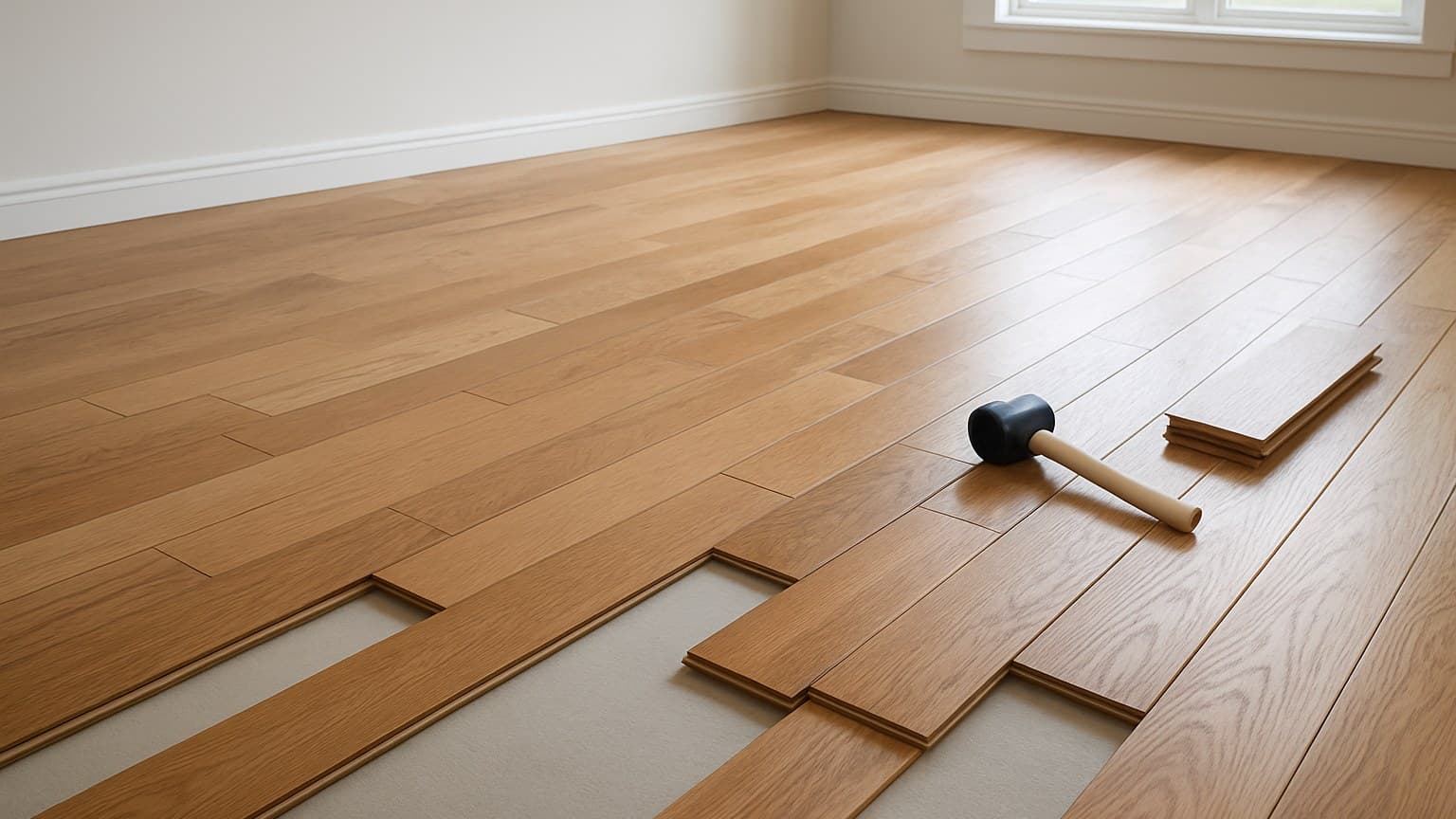
Click-lock engineered floats over the subfloor with no glue or nails, which makes it the most DIY-friendly of the three. It still needs a flat, dry subfloor and an expansion gap around the room per the box instructions. If that's what you have, our guide to click hardwood flooring walks the locking systems in more depth.
Pick your build by where the floor is going, grade level and moisture, as much as by how it looks. If you're weighing that same solid-versus-engineered call on a floor outside the Blue Ridge line, our guide to choosing solid vs. engineered hardwood floors walks through matching construction and species to the room.
| Build | Install | Below grade | Refinish | DIY-friendly |
|---|---|---|---|---|
| Solid 3/4" | Nail / staple down | Not recommended | Several times | Moderate (tools needed) |
| Engineered (glue/nail) | Glue or nail down | OK with moisture control | Limited by veneer | Low (hire out) |
| Click-lock engineered | Floating, no glue | OK with moisture control | Rarely, if at all | High |
How the three Blue Ridge build types compare on install method, below-grade use, refinishing, and DIY difficulty.
Radiant heat is the other placement question I get asked as often as below-grade moisture, and Blue Ridge's paperwork is just as quiet on it. As a rule, solid 3/4-inch board is not a good radiant-heat candidate, the board is thick enough that it moves and cups over a heated subfloor more than manufacturers want to warranty. Engineered construction is generally the more radiant-friendly option, since the cross-layered core resists that movement better than solid wood, but "generally friendly" is not the same as "approved." Whether a specific Blue Ridge engineered or click-lock run is rated for radiant heat is exactly the kind of thing that isn't in any public spec sheet, so treat it the same way you'd treat certification or wear-layer thickness: call Home Depot customer service with your lot number, or check the installation sheet inside the box, before you install over in-floor heat.
Species, Sizes, and Finish Options
Across the different runs, Blue Ridge has appeared in red oak, white oak, hickory, and maple, milled in random-length planks. That fragmented catalog is why no single page ever listed it all.
On sizes, don't trust a rule of thumb over your label. Solid boards run around 3/4-inch thick. Engineered is thinner, the Blue Ridge Engineered Oak click-lock cases I've opened run close to 3/8 inch, but other engineered lines in the catalog differ, and widths change by line too. Coverage per case varies too, so read the number off the box rather than guessing.
Finishes come in a few flavors. Smooth is the standard flat face. Hand-scraped means the surface is textured and roughed up on purpose, and low-gloss keeps the shine down. Scraped and low-gloss finishes both hide dents and scratches better, which is why I steer busy families toward them. If you're shopping hand-scraped boards from a different brand, our guide to spotting real hand scraped hardwood flooring explains how to tell genuine hand-tooled texture from a machine-stamped imitation.
None of that finish talk, smooth, hand-scraped, low-gloss, tells you what's actually protecting the wood from scratches. That's a separate spec: the topcoat chemistry. Most prefinished hardwood, budget lines included, is sealed with either a straight polyurethane finish or a polyurethane blended with aluminum-oxide particles for added scratch resistance; aluminum-oxide-fortified topcoats generally hold up to foot traffic and light scuffs better than polyurethane alone, which is why you'll see it called out as a selling point on higher-tier lines. Blue Ridge's case labels and box inserts don't consistently spell out which topcoat a given run uses, so if scratch resistance is what you're optimizing for, that's a question to ask Home Depot or read off the finish-warranty language on your specific box rather than assume from the sheen alone.
Species drives durability and how it takes color. Oak stains evenly and forgives mistakes. Hickory is the hardest and shrugs off dents. Maple is hard too, but it blotches under stain, so it looks best in light, natural tones.
| Species | Typical build | Look | Best for |
|---|---|---|---|
| Red oak | Solid & engineered | Warm, pronounced grain | Whole-home, stains evenly |
| White oak | Solid & engineered | Cooler, tighter grain | Modern tones, high traffic |
| Hickory | Solid & engineered | High color variation | Kitchens, kids, pets |
| Maple | Solid & engineered | Clean, subtle grain | Light, contemporary rooms |
Source: These are the species and finish patterns I've seen on Blue Ridge cases and comparable Home Depot hardwood on the sales floor
Species reported in the Blue Ridge line with their typical build, look, and best-fit rooms.
How to Judge Quality: Certification, Janka, and Thickness
Since Blue Ridge gives you little to go on, use an outside yardstick. The strongest one is NWFA/NOFMA Mill Certification, run jointly by the National Wood Flooring Association (NWFA) and the National Oak Flooring Manufacturers Association (NOFMA). According to the NWFA, this is an active third-party quality program that continues to induct mills, recent additions include Bluegrass Wood Products, Sheoga Hardwood Flooring, and Premier Hardwood Products, all of which joined the NWFA/NOFMA program in 2024. It's worth applying that same skepticism to eco marketing elsewhere, since our guide to sustainable hardwood flooring shows how little the green label on the box actually certifies.
Be clear on one thing: I've seen no public evidence that Blue Ridge itself holds that certification. Treat it as the benchmark you ask about, not a badge this brand claims. If a seller can't confirm the mill behind the product, that tells you how much documentation actually exists.
Next, use Janka hardness, a standard test that measures how well a wood resists denting. Higher numbers take abuse better. The ranking below tracks with what I see on real floors: oak is the everyday workhorse, and hickory is the one I'd put under a dog and a couple of kids.
| Species | Janka rating |
|---|---|
| Red oak | 1290 |
| White oak | 1350 |
| Hard maple | 1450 |
| Hickory | 1820 |
On engineered boards, the veneer thickness caps how many times you can refinish, so check that wear-layer number before you assume you can sand it later. This isn't theory for me. When Frank in Charlotte wanted his solid oak sanded a fourth or fifth time, it went down to the tongue in one corner before I caught it. A floor can look perfectly fine on top with almost nothing left to take off.
Before you commit, run this quick check:
- Ask whether the mill holds NWFA/NOFMA Mill Certification
- Match Janka hardness to the room's traffic
- Confirm engineered veneer (wear-layer) thickness for future sanding
- Check the finish warranty term against the specific product, not the brand
- Inspect a few boards for milling gaps, cupping, and off-color runs
Source: NWFA/NOFMA runs the Mill Certification program buyers should ask about
A pre-purchase quality check for any Blue Ridge lot before you buy it.
Installation and Acclimation Basics
Prep decides how this floor lives or fails. Before a single plank goes down, check that the subfloor is flat and run a moisture check with a moisture meter, the tool that reads how wet the wood and the subfloor actually are. According to the NWFA's Homeowners Handbook to Real Wood Floors, subfloor and jobsite moisture testing is a core step in a proper wood floor installation, skip that step, and the manufacturer warranty stops covering you outright. That same prep stage is also where you decide on the vapor barrier or cushioning layer beneath the boards, a choice our guide on what to put under hardwood flooring walks through in more detail.
Acclimation is not one-size-fits-all. Some products want days of sitting in the room, some say it's unnecessary, so the sheet inside your box governs whether and how long, not advice passed around online.
Every floating floor also needs an expansion gap around the whole room so the boards can grow and shrink with the seasons. Always leave the gap; the exact size is set by the manufacturer's instructions, so look up the number for your product rather than eyeballing it.
On DIY versus hiring out, I'll be straight. Click-lock over a flat, dry subfloor is realistic for most handy homeowners, materials for click-lock engineered generally fall in the rough range of $4 to $8 per square foot, though pricing varies by retailer and region, and your labor cost is just your own time. Nail-down solid, glue-down engineered, stairs, and big open-plan floors with moisture transitions between rooms are where I'd hire a pro instead; installation labor for those jobs typically runs somewhere around $3 to $8 per square foot on top of materials, with actual quotes varying by market, and basements and stairs tending to push toward the higher end because of the extra prep and cutting involved.
Where to Buy It Now, and What to Do If You Can't
Blue Ridge availability is spotty, so buying it fresh today is a hunt, not a click. Your best shots are Home Depot clearance racks and flooring closeout stock, where discontinued runs land.
Start with clearance channels, and go in knowing that a clearance flooring outlet is often where discontinued house-brand runs end up. If you're matching an existing floor, the lot number off your label is what lets you find boards from the same run and color batch. Our breakdown of whether clearance hardwood is defective or just leftover helps you tell a good closeout deal from a problem pile.
If Blue Ridge is truly gone, don't force it. Switch to a comparable budget-to-mid brand in the same species and build, like Bruce or Malibu Wide Plank, and match the finish and width as closely as you can. And if the room in question sees heavy moisture, a bathroom, a laundry, a basement, be willing to step off hardwood entirely toward LVP flooring, which tolerates water far better than any real wood. If you're open to a different material altogether rather than another hardwood swap, our bamboo flooring vs hardwood guide compares how the two hold up on cost and durability.
So who should still buy it? If you own Blue Ridge and just need a few more cases to finish or repair a room, chase the clearance stock by lot number. If you're starting fresh and want documented specs and a warranty you can actually trace, buy a named brand with a public spec sheet instead.